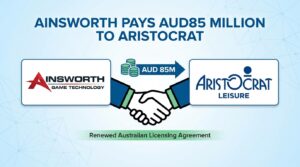
Ainsworth Game Technology has agreed to pay Aristocrat Leisure AUD85 million (approximately $60 million) as part of a renewed licensing arrangement in Australia. The deal restructures the longstanding intellectual property relationship between the two gaming technology companies, both headquartered in Sydney. While the agreement resolves a commercial tension that had simmered for years, it also reshapes how Ainsworth can develop and distribute products under Aristocrat’s patent portfolio going forward.
What the AUD85 Million Deal Signals for Gaming IP
The payment reflects more than a simple licensing renewal. It underscores the growing value of proprietary gaming technology and the leverage that patent holders wield in an industry where hardware innovation and game math are tightly protected. Below are the strategic takeaways from this agreement:
- IP monetisation is accelerating: Aristocrat continues to extract significant value from its patent portfolio, reinforcing its position as one of the most IP-rich companies in global gaming.
- Ainsworth secures operational continuity: By locking in a renewed licence, Ainsworth avoids the disruption of losing access to foundational technologies embedded in its product lines.
- The AUD85 million figure, while substantial, arguably gives Ainsworth a clearer cost structure for planning R&D and market expansion over the licence term.
- Competitive dynamics shift: Smaller gaming manufacturers watching this deal will note the cost of operating within another company’s IP ecosystem, a reality that could push consolidation or in-house development efforts across the sector.
The Aristocrat-Ainsworth Relationship: A Complicated History
These two companies share more than a market. Ainsworth Game Technology was founded by Len Ainsworth, who also founded Aristocrat decades earlier before selling his stake. That origin story has created a persistent overlap in technology, talent, and competitive positioning (a distinction the market has never fully priced in). Aristocrat, now a global giant with annual revenues exceeding AUD5 billion, holds a substantial shareholding in Ainsworth, adding another layer of entanglement.
Previous licensing arrangements between the two firms have occasionally surfaced in investor discussions, particularly around whether Ainsworth’s reliance on Aristocrat IP constrains its ability to differentiate. The renewed deal does not eliminate that question. But it does provide a defined financial framework, which at least on paper reduces uncertainty for both parties.
How the Payment Breaks Down
Details on the exact payment schedule and licence duration have not been fully disclosed. What is known suggests the AUD85 million covers access to a broad set of Aristocrat patents relevant to Ainsworth’s gaming machine development and distribution in the Australian market. The agreement may also touch on digital and online segments, though neither company has confirmed that scope publicly.
| Detail | Information |
|---|---|
| Licensee | Ainsworth Game Technology |
| Licensor | Aristocrat Leisure Limited |
| Payment Amount | AUD85 million (~USD60 million) |
| Market Covered | Australia (primary) |
| Nature of Agreement | Renewed IP licensing arrangement |
| Digital/Online Scope | Not publicly confirmed; broader terms remain undisclosed |
Why Patent Licensing Shapes the Gaming Sector’s Future
Gaming technology patents cover everything from random number generation algorithms to cabinet ergonomics and bonus feature mechanics. For manufacturers like Ainsworth, building products without infringing on a competitor’s IP portfolio is extraordinarily difficult. The sheer density of patents held by Aristocrat’s global technology division means that licensing is often the pragmatic path, even when it comes at a steep price.
This dynamic mirrors what has played out in other technology-heavy industries. Smartphone manufacturers, for instance, routinely pay cross-licensing fees that run into billions. Gaming has not reached that scale, but the trajectory is clear. And while some mid-tier manufacturers have invested heavily in building proprietary IP to reduce dependence, the cost of doing so often rivals the licensing fees they are trying to avoid.
Still, the strategic calculus differs for every company.
Reframing Value: What Licensing Deals Reveal About Market Positioning
Deals like this one carry a psychological dimension that extends beyond balance sheets. For Ainsworth’s leadership, committing AUD85 million signals confidence in the company’s ability to generate returns that justify the outlay. It frames the payment not as a cost but as an investment in competitive relevance. That reframing matters when communicating with investors, regulators, and distribution partners who evaluate whether a manufacturer has the technological foundation to remain viable in regulated markets.
From Aristocrat’s perspective, the licensing revenue reinforces a narrative of IP dominance without requiring additional capital expenditure. Every dollar earned from licensing carries margins that product sales rarely match. It also sends a message to the broader market: Aristocrat’s technology is foundational enough that competitors will pay significant sums simply to operate alongside it. Whether that positioning holds as new entrants bring fresh approaches to game design and platform architecture remains an open question, one that the next licensing cycle will likely answer more definitively.
For industry observers, the deal also highlights a tension between collaboration and competition that defines modern gaming. Two companies sharing IP, shareholders, and historical DNA are simultaneously cooperating on licensing terms and competing for floor space in the same casinos. That paradox is not unique to gaming, but few sectors make it quite so visible.
Frequently Asked Questions
What does the AUD85 million payment cover?
The payment secures Ainsworth’s renewed access to Aristocrat’s patent portfolio for gaming machine development and distribution, primarily in the Australian market. The full scope of technologies covered has not been publicly itemised.
Why does Ainsworth need to license technology from Aristocrat?
Aristocrat holds an extensive portfolio of gaming technology patents. Many of these patents cover fundamental aspects of electronic gaming machine design, making licensing a practical necessity for manufacturers operating in overlapping technology spaces. Building entirely around such patents is costly and, in many cases, technically impractical.
Does this deal affect Ainsworth’s operations outside Australia?
The announced terms focus on the Australian market. Whether separate arrangements govern Ainsworth’s international operations, particularly in North America and Latin America, has not been detailed in this disclosure.
How does this compare to previous licensing agreements between the two companies?
Earlier arrangements between Ainsworth and Aristocrat have not always been disclosed with the same level of financial specificity. The AUD85 million figure provides a rare benchmark for understanding the commercial weight of gaming IP licensing in Australia.