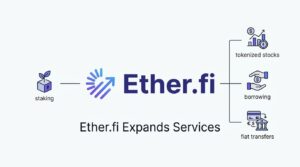
Ether.fi, the liquid staking protocol that has carved out a significant position in Ethereum’s restaking ecosystem, is pushing aggressively into retail banking territory. The company announced Thursday a sweeping set of new features under its Summer release: tokenized stock trading, portfolio-wide borrowing, and global fiat transfers. It’s a deliberate pivot, one that signals how DeFi-native platforms are no longer content to stay in their lane. And the timing raises questions about where the boundary between crypto protocols and neobanks actually sits.
What the Summer Release Signals for DeFi’s Retail Ambitions
Before unpacking the individual features, it’s worth stepping back to consider what this bundle of announcements means strategically. Ether.fi isn’t bolting on a single product. It’s layering an entire financial services stack on top of its existing staking infrastructure, targeting a user base that until now had to juggle multiple platforms for lending, investing, and moving money across borders.
- Tokenized stock trading brings traditional equity exposure directly into a DeFi app, potentially reducing the friction that keeps crypto-native users from diversifying into conventional markets
- Portfolio-wide borrowing allows users to leverage their full asset base (not just staked ETH) as collateral, a meaningful expansion of capital efficiency
- Global fiat transfers position Ether.fi as a payments layer, competing not just with other protocols but with fintech companies and remittance services
- The combined offering suggests Ether.fi is building toward a single-app financial experience, a model that mirrors what neobanks like Revolut have pursued from the traditional finance side
- For competitors focused narrowly on staking or restaking, this broadening of scope could force a strategic rethink
Tokenized Stocks: Bridging Two Worlds
The addition of tokenized stock trading is arguably the most attention-grabbing element. By enabling users to buy and sell representations of traditional equities within its app, Ether.fi’s expanding platform collapses a gap that has long separated DeFi participants from conventional markets. Users who hold staked ETH or other crypto assets can now access equity exposure without leaving the ecosystem.
That said, tokenized stocks remain a regulatory grey zone in many jurisdictions. The mechanism typically involves a third-party issuer creating on-chain tokens backed by real shares held in custody. Whether regulators in the US, EU, or Asia treat these instruments as securities, derivatives, or something else entirely varies widely (a distinction regulators have been slow to harmonize). How Ether.fi navigates this patchwork will matter as much as the feature itself.
Borrowing Against the Full Portfolio
Portfolio-wide borrowing is a quieter but potentially more consequential addition. Most DeFi lending protocols allow users to borrow against specific collateral pools. Ether.fi’s approach lets users treat their entire portfolio as a single collateral base. The practical effect: better capital efficiency and lower liquidation risk for diversified holders.
This mirrors how prime brokerage works in traditional finance, where institutional clients pledge a basket of assets rather than individual positions. Bringing that model to retail DeFi users is not trivial. It requires robust cross-asset risk engines and real-time valuation infrastructure. Whether Ether.fi has built this in-house or partnered with existing protocols for the backend remains less clear.
Why This Matters for Capital Efficiency
Consider a user holding staked ETH, stablecoins, and now tokenized equities. Under a siloed model, each asset would have its own borrowing limit and liquidation threshold. Under portfolio-wide borrowing, the combined value supports a single credit line. The risk is more distributed. The utility is higher. But the complexity of managing correlated drawdowns across asset classes is real, and it’s the kind of problem that surfaces during market stress, not calm.
Fiat Transfers and the Neobank Comparison
Global fiat transfers push Ether.fi into territory occupied by companies like Wise, Remitly, and traditional banks. For a protocol rooted in Ethereum staking, this is a significant identity expansion. Still, the logic tracks: if users already hold assets on the platform, enabling them to move fiat in and out without switching apps reduces churn and deepens engagement.
The competitive question is whether Ether.fi can match the compliance infrastructure, banking partnerships, and currency coverage that established fiat transfer services have spent years assembling.
Reframing DeFi Protocols as Financial Ecosystems
What Ether.fi is attempting reflects a broader pattern in crypto: the collapse of single-purpose protocols into multi-service platforms. This trajectory has precedent in traditional tech, where companies like Amazon and Apple expanded from core products into sprawling ecosystems. In DeFi, the equivalent move involves stacking lending, trading, payments, and yield products into a unified interface.
From a neuro-linguistic programming perspective, the framing matters enormously. Ether.fi is no longer asking users to think of it as “a staking protocol.” The Summer release reanchors the brand identity around a different mental model: a financial hub. That shift in perception, if it takes hold, changes how users evaluate the platform. They stop comparing it to Lido or Rocket Pool and start comparing it to Revolut or even Robinhood. The language used in the announcement (“Summer release,” the emphasis on lifestyle-oriented financial tools) is designed to trigger associations with consumer tech product cycles, not infrastructure upgrades. This is deliberate positioning. By aligning the user’s internal representation of the product with something familiar and aspirational, Ether.fi increases the likelihood of adoption among users who might otherwise dismiss DeFi as too technical or too narrow. The psychological reframe, from protocol to platform, from staking to financial life, is as strategic as any feature on the roadmap.
Frequently Asked Questions
What is Ether.fi’s Summer release?
It’s a bundled product update that adds tokenized stock trading, portfolio-wide borrowing, and global fiat transfers to the Ether.fi app, expanding the protocol well beyond its original liquid staking focus.
How does portfolio-wide borrowing differ from standard DeFi lending?
Rather than borrowing against a single asset, users can pledge their entire portfolio as collateral. This improves capital efficiency and mirrors how prime brokerage functions in traditional finance, though it introduces more complex risk management requirements.
Are tokenized stocks on Ether.fi regulated?
Regulatory treatment varies by jurisdiction. Tokenized stocks typically involve on-chain representations of real equities held in custody by a third party. Users should verify the legal status of these instruments in their own region before trading.
Does this make Ether.fi a bank?
Not in a regulatory sense. But functionally, the combination of lending, investing, and fiat transfers puts it in direct competition with neobanks and fintech platforms. Whether regulators eventually require banking-equivalent licensing for platforms offering this range of services is an open and increasingly pressing question.



