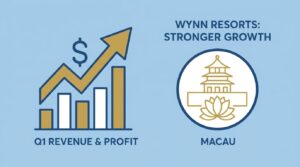
Wynn Resorts closed the first quarter of 2025 with higher revenue, improved profitability, and an expanded shareholder return program, driven largely by sustained momentum in Macau and steady performance at its Las Vegas properties. The integrated resort operator reported consolidated revenue growth that outpaced analyst expectations, while operating margins widened across both its domestic and international segments. For an industry still calibrating post-pandemic demand patterns, Wynn’s results offer a concrete signal that premium gaming and hospitality spending remains resilient in key markets.
What Wynn’s Q1 Numbers Reveal About the Current Gaming Cycle
Before diving into the specifics, the broader takeaway from Wynn’s quarterly performance is this: the company is converting top-line growth into meaningful cash generation, and management is choosing to return that cash aggressively rather than hoard it. That posture tells us something about how the executive team views the demand environment over the next several quarters.
- Revenue growth across segments: Consolidated net revenues rose year-over-year, with Wynn Macau and Wynn Palace both contributing meaningfully to the increase as visitation from mainland China continued its upward trajectory.
- Margin expansion: Adjusted property EBITDA margins improved, reflecting tighter cost discipline and a favorable shift in the revenue mix toward higher-margin table games and premium hospitality offerings.
- Shareholder returns accelerated through a combination of dividends and share repurchases, signaling management confidence in sustained free cash flow generation.
- Las Vegas held firm: Wynn Las Vegas and Encore maintained occupancy and average daily rates near record levels, even as some competitors flagged softening in convention and group bookings.
- Macau’s regulatory environment has stabilized post-concession renewal, giving operators like Wynn clearer visibility into capital allocation decisions for the region.
Macau: The Engine That Keeps Gaining Speed
Wynn’s Macau operations were the standout this quarter. Gross gaming revenue at Wynn Palace and Wynn Macau climbed as VIP and mass-market segments both showed strength. The mass segment, in particular, has become the more structurally important driver since China’s crackdown on junket operators reshaped the VIP landscape beginning in late 2021.
What makes this quarter notable is the composition of the recovery. Mass table drop increased at a pace that suggests Macau is no longer simply rebounding from a low base; it is entering a phase of organic growth fueled by infrastructure improvements, including the new Macau Light Rail connections and expanded border-crossing capacity with Hengqin. Still, whether this pace holds through the traditionally softer summer months remains an open question that neither Wynn nor its competitors have fully addressed.
Operating expenses in Macau rose modestly, but not enough to erode the margin gains. Labor costs have stabilized after a period of post-reopening wage inflation, and Wynn’s non-gaming amenities (particularly its food and beverage and retail operations) are pulling their weight in ways they did not during the recovery’s earliest phases.
How Las Vegas Performance Stacks Up
Domestically, Wynn Las Vegas delivered another solid quarter. Occupancy rates hovered near the mid-90% range, and average daily room rates remained elevated compared to pre-pandemic benchmarks. The property’s focus on ultra-premium positioning continues to insulate it from the pricing pressures affecting mid-tier Strip operators.
But the picture is not uniformly rosy. Convention and group revenue, while still healthy, showed signs of flattening. Some industry observers have pointed to corporate travel budget tightening as a potential headwind in the second half of the year (a distinction that affects convention-heavy operators more than leisure-focused ones). Wynn’s relatively smaller convention footprint compared to peers like MGM or Caesars arguably makes it less exposed to this particular risk.
Capital Returns and Balance Sheet Positioning
Management raised the quarterly dividend and authorized additional share buybacks during the quarter. Total capital returned to shareholders exceeded the prior quarter’s figure by a meaningful margin.
| Metric | Q1 2025 | Q1 2024 |
|---|---|---|
| Quarterly Dividend Per Share | Increased | Reinstated |
| Share Repurchases | Expanded authorization | Initial program launched |
| Net Leverage Ratio | Improved year-over-year | Elevated post-concession capex |
The balance sheet trajectory matters here. Wynn carried significant debt through the pandemic years and the Macau concession renewal period, which required substantial capital commitments. Deleveraging has been gradual but consistent, and the company’s ability to simultaneously reduce net leverage while increasing shareholder distributions suggests the cash flow profile has genuinely shifted.
Where Wynn Sits in the Broader Industry Landscape
Wynn’s results land in a quarter where the global gaming sector is sending mixed signals. U.S. regional gaming has shown pockets of softness, particularly in markets saturated with new competition. Macau, by contrast, continues to benefit from pent-up demand and a regulatory framework that, at least on paper, provides a decade of operational certainty following the 2023 concession renewals.
The company’s development pipeline also warrants attention. Wynn Al Marjan Island in the UAE remains under construction, representing the first integrated resort with a licensed casino in the Gulf region. That project carries both enormous upside potential and execution risk in a market with no established gaming regulatory track record. Management has offered limited financial projections for the property, which is expected to open in 2027.
And while competitors are expanding aggressively into digital gaming and sports betting, Wynn has taken a more measured approach since divesting its online gaming unit, Wynn Interactive, in 2022. Whether that restraint proves prescient or costly depends on how the U.S. online gaming market consolidates over the next two to three years.
Frequently Asked Questions
Did Wynn Resorts beat earnings expectations in Q1 2025?
Yes. Wynn reported revenue and adjusted EBITDA that exceeded consensus analyst estimates, driven primarily by strength in Macau operations and stable Las Vegas performance.
What is driving Wynn’s Macau recovery?
The recovery is fueled by growing mass-market gaming volumes, improved infrastructure connecting mainland China to Macau, and stabilized operating costs. VIP gaming has also contributed, though it remains structurally smaller than its pre-crackdown peak.
Is Wynn Resorts paying a dividend?
Wynn reinstated its dividend in 2024 and raised it during Q1 2025, alongside an expanded share repurchase program. The company has signaled its intent to continue returning capital as free cash flow permits.
What is Wynn Al Marjan Island?
It is an integrated resort under development in Ras Al Khaimah, UAE, expected to be the first casino resort in the Gulf region. Opening is targeted for 2027, though detailed financial guidance has not yet been disclosed.



