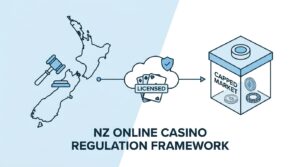
New Zealand has locked in the final rules governing licensed online casinos, establishing a deliberately capped market that will limit the number of operators permitted to serve Kiwi players. The regulatory framework, shaped over years of consultation and legislative revision, positions New Zealand among a growing cohort of jurisdictions choosing controlled market entry over open licensing. For operators eyeing the Asia-Pacific region, the implications stretch well beyond Wellington.
What New Zealand’s Capped Online Casino Market Means for Operators and Players
The decision to cap the number of licensed operators reflects a regulatory philosophy that prioritises harm minimisation and market integrity over volume-driven competition. Rather than opening the floodgates, New Zealand’s approach creates scarcity by design. Here’s what matters most:
- The number of online casino licences will be strictly limited, creating a high-barrier, high-value market for successful applicants
- Operators must meet rigorous responsible gambling, anti-money laundering, and consumer protection standards before and after licensing
- Unlicensed operators targeting New Zealand players will face enforcement measures, including IP blocking and payment disruption
- Revenue from licensed operations will be channelled partly toward problem gambling services and community funding
- The framework draws on models already tested in markets like the Netherlands and Ontario, though with distinct local adaptations
How the Licensing Cap Reshapes Competitive Dynamics
A capped licensing model does something unusual in gambling regulation: it turns the licence itself into a strategic asset. Operators who secure one of the limited slots gain not just market access but a degree of insulation from the kind of margin-crushing competition seen in more open jurisdictions. That shift matters because it changes the calculus for major international operators weighing whether to invest in compliance infrastructure for a relatively small market.
New Zealand’s population sits just above five million. On paper, that’s modest. But the country’s high internet penetration rate and established gambling culture (particularly around sports betting and pokies) make it a market where per-capita spend could prove attractive under the right conditions. The cap ensures that those conditions favour depth of engagement over breadth of competition.
Still, not everyone sees it that way. Some industry voices have argued that restricting operator numbers risks pushing players toward unlicensed offshore platforms, particularly if the licensed options fail to match the product range and user experience available elsewhere. Whether New Zealand’s enforcement toolkit proves sharp enough to counter that risk remains an open question.
Enforcement and the Offshore Challenge
New Zealand’s regulators have signalled that enforcement against unlicensed operators will be a cornerstone of the new regime. The toolkit reportedly includes DNS blocking, payment processing restrictions, and potential penalties for advertising by unauthorised platforms. These measures echo strategies deployed in jurisdictions like Sweden and Australia, with varying degrees of success.
The practical challenge is familiar. Determined players can circumvent IP blocks with relative ease, and offshore operators have historically adapted quickly to payment restrictions. What gives New Zealand’s approach a slightly different edge is the combination of a small, well-connected population and a regulatory apparatus that has had years to study what has and hasn’t worked elsewhere (a distinction regulators have been slow to enforce in some comparable markets).
Arguably, the real test won’t be whether unlicensed sites can be blocked entirely. It will be whether the licensed market offers enough variety and value to make circumvention feel unnecessary for most players.
Responsible Gambling Provisions Take Centre Stage
Embedded throughout the framework are responsible gambling requirements that go beyond checkbox compliance. Licensed operators will need to implement real-time monitoring tools, self-exclusion systems linked to a national register, and deposit limits that players can tighten but not loosen without a cooling-off period. Staff training requirements and mandatory reporting of suspicious behavioural patterns add further layers.
The New Zealand Department of Internal Affairs, which oversees gambling regulation, has emphasised that these provisions are non-negotiable conditions of licence retention. Operators who fall short face suspension or revocation, not just fines.
A Regulatory Blueprint Worth Watching
New Zealand’s model sits at an interesting intersection. It borrows from European regulated markets but adapts for a smaller, geographically isolated economy where channelisation rates will be scrutinised closely. If the capped model delivers high channelisation without the enforcement headaches that have plagued larger markets, other mid-sized jurisdictions in the Asia-Pacific corridor may look to replicate elements of the approach.
And while the framework is now finalised, the operational rollout will take time. Licence application windows, technical certification processes, and the buildout of the national self-exclusion register all sit on timelines that have yet to be publicly detailed in full. The gap between regulatory intent and operational reality has tripped up more than one jurisdiction before.
Frequently Asked Questions
How many online casino licences will New Zealand issue?
The exact number has not been publicly confirmed, but the framework establishes a strict cap designed to limit the market to a small number of vetted operators. This is intentional, aimed at maintaining regulatory oversight and reducing harm.
When will licensed online casinos go live in New Zealand?
No firm launch date has been announced. The regulatory framework is finalised, but application windows and technical certification timelines are still being developed.
What happens to offshore operators currently serving New Zealand players?
Unlicensed operators will face enforcement actions including IP blocking and payment disruption. Players are expected to migrate toward licensed platforms, though the effectiveness of enforcement will depend on execution.
Will sports betting be included under the same framework?
The current framework focuses on online casino operations. Sports betting in New Zealand operates under a separate regulatory structure, though future alignment has not been ruled out by regulators.



