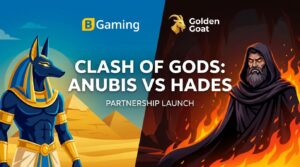
BGaming, the prolific iGaming content studio, has unveiled its latest slot title, Clash of Gods: Anubis vs Hades, a mythology-themed 5×5 grid game developed in collaboration with publishing partner Golden Goat. The release pits two of the ancient world’s most iconic underworld deities against each other in a mechanic-rich slot designed to appeal to players who gravitate toward high-volatility, narrative-driven gameplay. It marks another step in BGaming’s strategy of leveraging third-party partnerships to accelerate its content pipeline while maintaining creative control over game mechanics and math models.
What This Release Signals for BGaming’s Portfolio Strategy
Before diving into the specifics, it’s worth framing what this launch represents in the broader context of BGaming’s 2024–2025 roadmap. The studio has been steadily expanding its catalogue through a dual approach: in-house development and co-creation with external partners like Golden Goat. That model allows faster time-to-market without diluting the studio’s signature math-first design philosophy. Here’s what stands out from a strategic lens:
- Partnership-driven scaling: By working with Golden Goat as a publishing collaborator, BGaming extends its reach into new operator networks and player segments without bearing the full production burden alone.
- Mythology as a proven vertical: Greek and Egyptian mythology remain among the highest-performing thematic categories in online slots, and combining both in a single title is a deliberate play for cross-demographic appeal.
- The 5×5 grid format signals a move away from traditional payline structures toward cluster-pay or grid-based mechanics, which tend to generate longer session times.
- Brand differentiation: In a market saturated with mythology slots, the “clash” framing introduces a competitive narrative layer that most competitors in this thematic space lack.
How the Game Mechanics Shape the Player Experience
Clash of Gods: Anubis vs Hades runs on a 5×5 reel layout, a format that has gained considerable traction among studios targeting mid-to-high volatility player profiles. The grid structure opens up design possibilities that standard 5×3 configurations simply cannot match, particularly around cascading wins and expanding multiplier chains.
While BGaming has not disclosed the full mathematical model publicly, the studio’s track record suggests an RTP in the 96%+ range, consistent with its broader catalogue. The thematic duality between Anubis (Egyptian god of the dead) and Hades (Greek ruler of the underworld) isn’t just cosmetic. It likely drives a dual-feature system where players encounter different bonus rounds or modifier sets depending on which deity’s domain activates during gameplay.
That kind of branching mechanic keeps sessions unpredictable.
Golden Goat’s Role in the Publishing Equation
Golden Goat operates as a game publishing and distribution partner within the iGaming ecosystem, helping studios like BGaming’s slot development operation place content across a wider network of licensed operators. The arrangement is increasingly common in the industry: studios retain IP ownership and creative direction, while publishing partners handle integration, compliance packaging, and market-specific distribution.
Still, the model carries risks. When a studio’s brand identity is strong (as BGaming’s arguably is), handing off any part of the player-facing pipeline requires careful quality alignment. Whether Golden Goat’s distribution footprint meaningfully expands this title’s reach beyond BGaming’s existing operator base remains the open question.
Why Mythology Slots Continue to Dominate
The online slot market produces thousands of new titles annually, yet mythology-themed games consistently rank among the top performers by gross gaming revenue. A few structural reasons explain the persistence:
| Factor | Impact on Performance |
|---|---|
| Universal narrative recognition | Players require no onboarding to understand characters like Hades or Anubis, reducing friction to engagement |
| Visual design ceiling | Mythological themes allow high-production art direction that justifies premium positioning |
| Cross-cultural appeal | Greek and Egyptian mythology resonate across European, Latin American, and Asian player bases with roughly equal familiarity |
| Sequel and expansion potential | Pantheon-based IP lends itself naturally to franchise extensions without requiring new brand investment |
BGaming’s decision to merge two mythological traditions into a single confrontation format is, at least on paper, a smart way to capture both audience pools simultaneously.
The Psychology Behind Dual-Deity Game Design
Beyond pure mechanics, there’s a behavioural dimension worth examining. Games that present players with a choice between two competing forces tap into well-documented cognitive patterns. The framing of Anubis versus Hades creates an implicit sense of agency, even in a game governed entirely by random number generation. Players feel they are participating in a contest rather than simply spinning reels.
This perception of control (a distinction behavioural economists have studied extensively in gambling contexts) correlates with higher engagement metrics. When a player identifies with one “side” of a conflict, session duration tends to increase, and so does the emotional weight attached to wins and near-misses. BGaming’s design team appears to understand this dynamic well. The studio has previously incorporated choice-driven bonus rounds in other titles, and the Anubis vs Hades framework extends that principle to the game’s entire thematic architecture.
Contrast this with a standard single-theme mythology slot, where the player is a passive observer of one god’s story. The adversarial structure reframes the experience as something closer to a narrative event. And while the mathematical outcomes remain identical regardless of which deity “wins,” the psychological framing shifts how players interpret those outcomes. A loss during an Anubis round feels different from a loss during a Hades round, even when the numbers are the same.
That kind of perceptual layering is difficult to engineer convincingly, but when it works, it creates the sort of title that operators actively promote rather than simply list.
Frequently Asked Questions
What is Clash of Gods: Anubis vs Hades?
It’s a 5×5 grid online slot developed by BGaming in collaboration with Golden Goat, featuring a mythological battle between the Egyptian god Anubis and the Greek god Hades.
Who developed this slot?
BGaming created the game, with Golden Goat serving as the publishing partner responsible for broader distribution and operator integration. The creative and mathematical design sits with BGaming.
Is the game available at all online casinos?
Availability depends on operator agreements and regional licensing. Players should check whether their preferred platform carries BGaming or Golden Goat titles.
What makes this slot different from other mythology-themed games?
The dual-deity clash mechanic introduces a competitive narrative layer that most mythology slots lack. Rather than following one god’s story, players experience a confrontation between two underworld rulers, which shapes both the bonus features and the overall session feel.



