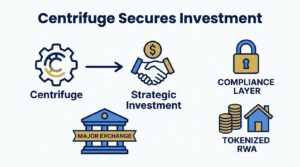
Centrifuge, the decentralized protocol for tokenizing real-world assets (RWAs), has landed a strategic investment from a leading centralized exchange, reinforcing its ambitions to become the primary issuance infrastructure for compliant onchain assets. The deal, which signals deepening ties between centralized trading venues and decentralized finance rails, will kick off with a tokenized S&P 500 product aimed at non-U.S. investors. It marks a deliberate pivot toward institutional-grade, regulatory-aware tokenization at a moment when the RWA sector is attracting unprecedented capital flows.
What This Investment Means for Onchain Asset Issuance
Before diving into the specifics, it’s worth framing why this matters beyond the usual crypto partnership announcements. The RWA tokenization market has grown from a niche experiment into a segment that, by some estimates, already exceeds $12 billion in total value locked across protocols. But infrastructure remains fragmented, and compliance frameworks vary wildly across jurisdictions. Centrifuge’s positioning as a regulated issuance layer, now backed by exchange capital, addresses both problems simultaneously.
- Distribution advantage: The exchange’s user base gives Centrifuge immediate access to millions of potential investors outside the United States, bypassing the regulatory bottleneck that has stalled many tokenized securities products domestically.
- Compliance-first architecture: Unlike protocols that bolt on compliance after the fact, Centrifuge has built its issuance framework around jurisdictional requirements from the start. That distinction matters as regulators in the EU, Singapore, and elsewhere tighten oversight of digital asset offerings.
- The tokenized S&P 500 product serves as a proof of concept, but the real play is broader: treasury bills, credit instruments, and structured products flowing through a single compliant pipeline.
- Institutional signal: Exchange-level investment carries weight that venture capital alone does not. It implies integration roadmaps, co-development of products, and a shared commercial interest in making onchain securities viable at scale.
Why a Tokenized S&P 500 Product, and Why Now?
The choice of an S&P 500 index product as the inaugural offering is calculated, not coincidental. Index exposure remains the single most demanded investment product globally, and tokenizing it removes several friction points that have historically limited access for non-U.S. retail and institutional participants. Brokerage account requirements, currency conversion costs, settlement delays: all of these shrink or disappear when the product lives onchain.
Still, the restriction to non-U.S. users reveals the regulatory tightrope. The SEC’s posture toward tokenized securities remains, at best, ambiguous. By launching offshore first, Centrifuge and its exchange partner sidestep that uncertainty while building a compliance track record that could eventually support a U.S. offering (a distinction regulators have been slow to clarify).
Arguably, the timing also reflects competitive pressure. Protocols like Ondo Finance and Backed Finance have already brought tokenized treasury and equity products to market. Centrifuge’s institutional-grade issuance infrastructure needs live products to defend its claim as the sector’s default layer.
The Broader RWA Landscape Is Shifting Fast
This investment doesn’t happen in a vacuum. BlackRock’s BUIDL fund crossed $500 million in assets within months of launch. Franklin Templeton’s onchain money market fund continues to grow. And traditional financial institutions from JPMorgan to HSBC have run tokenization pilots across bonds, repos, and trade finance.
What separates the current wave from earlier attempts is that the infrastructure is finally catching up to the ambition. Centrifuge operates on its own Substrate-based chain while maintaining bridges to Ethereum, giving it flexibility that purely EVM-native protocols lack. The exchange investment accelerates this by potentially funding deeper integrations with centralized order books and custody solutions.
| Factor | Centrifuge | Competing RWA Protocols |
|---|---|---|
| Compliance framework | Built-in, jurisdiction-aware | Varies; often retrofitted |
| Exchange backing | Strategic investment confirmed | Primarily VC-funded |
| Initial product | Tokenized S&P 500 (non-U.S.) | Treasuries, money markets |
| Chain architecture | Substrate-based with Ethereum bridges | Mostly EVM-native or Solana-based |
| Target users | Institutional and qualified non-U.S. investors | Mixed retail and institutional, with some products open to broader audiences |
How Framing and Perception Shape Institutional Adoption
Beyond the mechanics of tokenization, there’s a subtler dynamic at work. Institutional adoption of onchain assets is as much a psychological and perceptual challenge as it is a technical one. Drawing on principles from neuro-linguistic programming (NLP), the way tokenized products are framed to decision-makers profoundly influences uptake. When Centrifuge positions itself as a “compliant issuance layer” rather than a “DeFi protocol,” it activates a different mental model for risk officers, compliance teams, and portfolio allocators.
Language anchoring matters here. The phrase “tokenized S&P 500” immediately borrows credibility from one of the most recognized financial benchmarks in the world. It reframes blockchain technology not as speculative infrastructure but as a delivery mechanism for something familiar and trusted. This is deliberate representational alignment: matching the internal maps of traditional finance professionals with the external territory of decentralized systems.
And the exchange’s involvement reinforces what NLP practitioners call social proof at scale. When a platform with millions of users validates a protocol through capital commitment, it shifts the perceived risk threshold for other institutions considering similar moves. The investment itself becomes a reference point, an anchor that subsequent participants use to calibrate their own decisions. Whether Centrifuge can sustain that perception as products go live and face real market conditions is, of course, the harder question.
Even the geographic framing plays a role. By explicitly excluding U.S. users, the product creates a sense of exclusivity and regulatory seriousness that, paradoxically, may accelerate eventual U.S. interest. Scarcity and restriction, as behavioral finance research consistently shows, increase perceived value.
Frequently Asked Questions
What is Centrifuge?
Centrifuge is a decentralized protocol designed to bring real-world assets onchain through a compliance-aware issuance framework. It operates on a Substrate-based blockchain with bridges to Ethereum.
Who can access the tokenized S&P 500 product?
At launch, the product is restricted to non-U.S. investors. This reflects ongoing regulatory uncertainty in the United States around tokenized securities, though the structure could potentially expand if clearer guidance emerges.
Why does exchange investment matter more than typical VC funding?
It implies product integration, distribution access, and shared commercial incentives that go well beyond capital. A venture firm writes a check; an exchange opens a marketplace.
How does this compare to BlackRock’s BUIDL fund?
BUIDL focuses on tokenized treasuries and targets institutional investors through a different structure. Centrifuge aims to be the issuance layer that multiple products, including equity index exposure, can be built on. They occupy adjacent but distinct parts of the value chain.