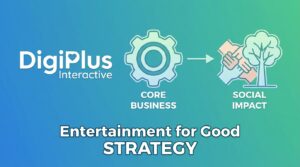
DigiPlus Interactive Corp, the Philippines-based digital entertainment company, has formally launched what it calls an “Entertainment for Good” strategy, weaving social responsibility commitments directly into its online gaming operations. The initiative positions the publicly listed firm as one of the few in Southeast Asia’s regulated gaming sector to tie measurable community outcomes to its commercial growth model. By anchoring corporate social responsibility not as a peripheral programme but as a strategic pillar, DigiPlus is making a bet that purpose-driven branding can sharpen its competitive edge in an increasingly crowded market.
What DigiPlus’s Strategic Pivot Signals for the Industry
The announcement arrives at a moment when regulators across the Asia-Pacific region are tightening scrutiny on online gaming operators, particularly around responsible gaming practices and community impact. Before unpacking the details, here are the core strategic takeaways from DigiPlus’s move:
- Revenue-linked social investment: DigiPlus is tying portions of its gaming revenue to community development projects, creating a direct financial bridge between platform performance and social outcomes.
- Brand differentiation in a saturated market: With dozens of licensed operators competing for Filipino consumers, embedding social good into the product narrative gives DigiPlus a positioning advantage that pure-play competitors lack.
- The strategy could serve as a regulatory shield, demonstrating proactive alignment with government priorities around digital inclusion and responsible entertainment.
- Scalability signal: By institutionalising the framework now, DigiPlus appears to be building infrastructure that can travel with the company into new markets or product verticals.
- Stakeholder messaging: As a publicly traded company on the Philippine Stock Exchange, this positions DigiPlus favourably for ESG-conscious institutional investors scanning emerging market opportunities.
How the Framework Actually Works
At its core, the Entertainment for Good strategy channels resources from DigiPlus Interactive’s gaming platforms into four broad areas: education, livelihood support, disaster resilience, and digital literacy. The company has not disclosed a fixed percentage of revenue earmarked for these initiatives, though it has indicated that funding scales proportionally with platform growth.
That proportional model matters.
Unlike flat-rate CSR budgets that shrink in relative terms as a company grows, a revenue-linked approach means social investment expands alongside the business. In practice, this creates an incentive structure where commercial success and community impact move in the same direction. Whether the execution matches the ambition remains to be seen, but the architecture is more sophisticated than the typical corporate philanthropy playbook.
Regulatory Context and the Philippine Gaming Landscape
The Philippines has emerged as one of Asia’s most active regulated online gaming jurisdictions, with PAGCOR (the Philippine Amusement and Gaming Corporation) overseeing a complex ecosystem of domestic and offshore operators. Recent years have seen significant regulatory tightening, particularly around offshore operations, with the government shutting down numerous POGO (Philippine Offshore Gaming Operator) entities linked to fraud and labour violations.
Against that backdrop, a domestic operator publicly committing to community-facing outcomes sends a deliberate signal. DigiPlus is, in effect, drawing a line between itself and the segment of the industry that has attracted negative attention. And while the company operates in a fundamentally different regulatory category than offshore operators, the reputational halo effect of proactive social investment shouldn’t be underestimated (a distinction regulators have been slow to enforce consistently across the sector).
Still, the question of measurement looms. How will DigiPlus quantify the impact of its education and livelihood programmes? Will third-party audits be involved? The company has signalled transparency commitments but has yet to publish a detailed impact measurement framework.
The Psychology of Purpose-Driven Gaming
There is a growing body of evidence suggesting that consumers, particularly younger demographics, respond more favourably to brands that articulate a clear social purpose. This is not merely a marketing observation. Neurolinguistic research into decision-making patterns shows that when individuals perceive alignment between their entertainment choices and their personal values, engagement deepens at a cognitive level. The brain processes value-congruent activities differently, activating reward pathways that reinforce loyalty and reduce churn.
For DigiPlus, this has tangible business implications. Filipino gamers who believe their participation contributes to community development are, arguably, more likely to remain active on the platform. The framing shifts the internal narrative from “I am spending money on gaming” to “my entertainment supports something meaningful.” That reframe, subtle as it sounds, can alter retention curves and lifetime customer value in measurable ways.
Behavioural economists have documented similar effects in adjacent industries. Subscription services that donate a portion of proceeds to charitable causes consistently report higher retention rates than comparable services without such programmes. The mechanism is not altruism alone; it is identity reinforcement. People stay because leaving would conflict with the version of themselves they have constructed around the choice.
DigiPlus appears to understand this dynamic. Its messaging around Entertainment for Good leans heavily into community identity and shared outcomes, language designed to activate precisely these psychological anchors. Whether the company has formally engaged behavioural scientists in crafting the strategy is unclear, but the architecture reflects those principles.
Market Positioning and What Comes Next
DigiPlus reported strong financial performance in recent quarters, with its digital platforms driving user growth across multiple product lines. The Entertainment for Good strategy layers onto that momentum rather than diverting from it.
| Strategic Dimension | Traditional CSR Approach | DigiPlus “Entertainment for Good” Model |
|---|---|---|
| Funding mechanism | Fixed annual budget | Revenue-proportional allocation |
| Relationship to core business | Peripheral, often disconnected | Integrated into platform narrative and user experience |
| Scalability | Limited by budget cycles | Grows with commercial performance |
| Regulatory signalling | Reactive compliance | Proactive alignment with government development priorities |
| Consumer psychology impact | Minimal brand differentiation | Identity-reinforcing engagement loop that supports retention |
Competitors in the Philippine digital entertainment space will be watching closely. If DigiPlus can demonstrate that purpose-driven positioning translates into measurable user growth and retention advantages, the model could become a template for other operators across Southeast Asia.
Frequently Asked Questions
What is DigiPlus Interactive’s Entertainment for Good strategy?
It is a corporate framework that ties the company’s online gaming revenue to social impact programmes in education, livelihood support, disaster resilience, and digital literacy across the Philippines. The approach integrates social investment into the business model rather than treating it as a separate philanthropic activity.
Is DigiPlus a regulated gaming operator?
Yes. DigiPlus Interactive Corp operates under Philippine regulatory oversight and is publicly listed on the Philippine Stock Exchange, distinguishing it from unlicensed or offshore operators that have faced government crackdowns in recent years.
How does this strategy affect DigiPlus’s financial outlook?
The revenue-proportional funding model means social investment scales with business growth. While specific financial allocations have not been publicly disclosed, the structure is designed to avoid the trade-off between profitability and social spending that characterises traditional CSR budgets. For investors, the ESG alignment may also broaden the company’s appeal to institutional capital.
Why does purpose-driven branding matter in gaming?
Research in behavioural economics and consumer psychology consistently shows that value-aligned brands achieve stronger customer loyalty. In gaming specifically, where user churn is a persistent challenge, giving players a reason to stay beyond the product itself can materially improve retention metrics.