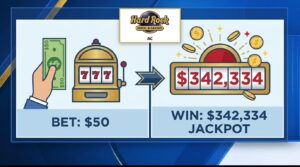
A visitor from Brooklyn walked into Hard Rock Hotel & Casino with a modest $50 wager on a slot machine and walked out with $342,334.25. The win, which unfolded on the casino floor without much fanfare beforehand, stands as a striking reminder of the outsized variance embedded in modern slot gaming. Details surrounding the exact machine and timing remain sparse, but the payout figure has been confirmed by the property.
What a $50-to-$342K Slot Hit Signals for Casino Operators
Large jackpot events like this one carry implications well beyond the individual winner. They shape marketing narratives, influence foot traffic patterns, and feed the aspirational psychology that keeps slot floors profitable. Here’s what matters from a business and industry standpoint:
- Marketing leverage: A verified six-figure payout from a $50 bet generates organic media coverage and social proof that no advertising budget can replicate at the same cost
- Slot volatility remains the core product differentiator for casino floors competing against online alternatives
- Player acquisition signal: Jackpot stories disproportionately attract low-to-mid-stakes recreational players, the demographic most casinos are fighting to retain
- Property positioning: For Hard Rock’s expanding portfolio of hotel and casino destinations, individual jackpot wins reinforce brand association with high-reward experiences
The Mechanics Behind Outsized Slot Payouts
Not every $50 spin carries the same probability of producing a six-figure return. The outcome depends heavily on the specific game’s paytable structure, its volatility classification, and whether the machine participates in a progressive jackpot network. High-volatility slots are engineered to pay out less frequently but in larger amounts, which is precisely the profile that produces headlines like this one.
What’s less discussed is the regulatory scaffolding underneath. Gaming commissions in jurisdictions like New Jersey mandate minimum return-to-player (RTP) percentages and require independent testing of random number generators. That infrastructure exists to ensure outcomes like a $342,334 payout are genuinely random (a distinction that matters more than most players realize). The win isn’t a glitch or a promotion. It’s the tail end of a probability distribution doing exactly what it was designed to do.
Why Jackpot Stories Still Move the Needle
In an era where digital gaming platforms can offer thousands of slot titles from a phone screen, physical casinos lean heavily on experiential differentiation. A jackpot moment on a casino floor carries sensory weight that no app notification can match: the sound, the crowd reaction, the immediate human verification of something improbable.
And yet, the strategic value of these moments is shifting. Casino operators increasingly use jackpot events as content anchors across social media, email campaigns, and loyalty program communications. A single verified win can generate weeks of downstream engagement. The Brooklyn guest’s story, for instance, fits neatly into a narrative arc that Hard Rock’s marketing team can deploy across multiple channels without embellishment.
Still, there’s a tension here. Publicizing large wins without contextualizing the odds risks reinforcing unrealistic expectations among recreational gamblers. Responsible gaming frameworks require operators to balance promotional enthusiasm with transparency about probability.
How Cognitive Framing Shapes Player Behavior
From a neuro-linguistic programming perspective, jackpot stories activate specific cognitive patterns that influence decision-making far beyond the individual event. The anchoring effect is immediate: once a player hears “$50 turned into $342,334,” that ratio becomes a mental reference point, subtly recalibrating their perception of what’s possible on any given spin. This isn’t manipulation in the traditional sense. It’s how human brains process extreme outcomes.
Availability bias compounds the effect. Because jackpot wins receive disproportionate media attention relative to their frequency, they become cognitively “available” examples that players retrieve when evaluating their own chances. The thousands of $50 bets that returned nothing don’t generate stories, so they don’t occupy mental real estate.
Operators who understand these dynamics can design more ethical engagement strategies. Framing jackpot communications within broader responsible gaming messaging, for example, allows the aspirational narrative to coexist with honest probability disclosure. The goal isn’t to suppress excitement but to ensure the framing doesn’t distort rational assessment. Language choices matter enormously here: describing a win as “rare” versus “possible” activates different evaluative circuits in the reader’s mind. Skilled communicators in the gaming industry already calibrate these distinctions, though not all do it consistently.
Frequently Asked Questions
How rare is a $342,334 slot jackpot from a $50 bet?
Extremely rare. The exact odds depend on the specific machine’s paytable and RNG configuration, but payouts of this magnitude from a single low-denomination wager typically represent statistical outliers in the far tail of the distribution.
Does Hard Rock Hotel & Casino pay jackpots in a lump sum?
Payment structures vary by jurisdiction and jackpot type. Some progressive jackpots offer annuity options, while standalone machine wins are generally paid as lump sums, subject to applicable tax withholding.
Are slot machine outcomes truly random?
Yes. Licensed casinos operate machines with certified random number generators that are independently tested and regulated by state gaming commissions. Each spin’s outcome is statistically independent of previous results.