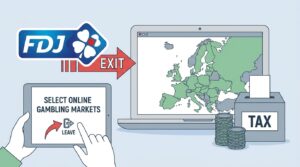
French lottery and gaming giant FDJ United is actively considering withdrawing from certain online gambling markets or divesting non-core assets, a strategic pivot driven by rising tax burdens across European jurisdictions. The move signals a broader recalibration within the company’s international portfolio, one that could reshape its competitive footprint in regulated iGaming. For an operator of FDJ’s scale, the calculus is straightforward: when tax regimes erode margins beyond a sustainable threshold, even established market positions become expendable.
What’s Driving FDJ United’s Strategic Reassessment
The pressure isn’t abstract. Several European governments have either enacted or proposed increases to gross gaming revenue (GGR) taxes on online operators, squeezing profitability in markets where customer acquisition costs were already climbing. FDJ United, which expanded its digital and international presence significantly through its 2024 acquisition of Kindred Group, now faces the uncomfortable arithmetic of maintaining operations in jurisdictions where regulatory costs outpace revenue growth.
That acquisition gave FDJ access to Kindred’s portfolio of brands and licences across multiple regulated markets. But inheriting a broad geographic spread also means inheriting exposure to fiscal environments the company didn’t design its strategy around. And while consolidation was the thesis behind the Kindred deal, the post-merger reality involves hard choices about which markets justify continued investment.
This isn’t unique to FDJ. Operators across the sector have been trimming their geographic exposure in response to tax hikes, with several pulling out of markets like the Netherlands and parts of Latin America where the regulatory burden has intensified. What makes FDJ’s situation worth watching is the scale of the decision and the signal it sends about the sustainability of certain European tax frameworks for online gambling.
Key Strategic Implications for the Gambling Industry
FDJ United’s potential market exits carry consequences well beyond its own balance sheet. Here’s what industry stakeholders should be tracking:
- Margin defence over market share: FDJ is prioritising profitability in its core markets rather than maintaining a presence everywhere, a shift that mirrors moves by Entain and Flutter in recent years
- Non-core asset sales could reshape local competition: If FDJ divests brands or licences in specific jurisdictions, smaller operators or private equity buyers may acquire them at discounted valuations
- Tax policy is now the single largest variable in market-entry and market-exit decisions for European online gambling operators
- The Kindred integration faces a narrower scope: Rather than operating Kindred’s full portfolio, FDJ may concentrate resources on a smaller number of high-margin markets, particularly France and the Nordics
- Regulators in affected markets may face a paradox: higher taxes intended to increase state revenue could instead reduce the number of licensed operators, potentially pushing activity toward unlicensed platforms
Which Markets Are Most Vulnerable?
FDJ United has not publicly identified the specific markets under review, but the contours are discernible from recent fiscal developments across Europe. The table below outlines jurisdictions where online gambling tax increases have been enacted or proposed in the past 18 months:
| Jurisdiction | Tax Change | Effective / Proposed | Operator Impact |
|---|---|---|---|
| Netherlands | GGR tax raised from 29.5% to 37.8% | 2025 | Multiple operators have exited or scaled back |
| Germany | Turnover-based tax maintained at 5.3% on stakes | Ongoing | Widely criticised as unsustainable for online verticals, particularly casino and poker |
| Italy | Proposed increases under fiscal reform discussions | Under review | Could affect mid-tier operators disproportionately |
| France | Stable (core market for FDJ) | N/A | FDJ retains monopoly on lottery; online sports betting competitive but manageable |
Germany’s turnover-based model remains arguably the most punitive structure in Europe for online operators. The Netherlands, meanwhile, has seen its tax rate climb sharply enough that several licensed operators have already ceased Dutch operations. Whether FDJ holds positions in both markets through Kindred’s legacy licences is a detail the company has not fully disclosed (a distinction that matters more than most analysts acknowledge).
How Tax Policy Reshapes Operator Psychology
There’s a behavioural dimension to these decisions that pure financial analysis tends to overlook. When operators face repeated, unpredictable tax increases, the effect compounds beyond the immediate fiscal hit. It erodes confidence in the regulatory compact itself. Executives begin pricing in not just current tax rates but anticipated future increases, which distorts investment planning and accelerates withdrawal timelines.
This dynamic creates a feedback loop. Operators who remain in high-tax markets must absorb the costs that departing competitors leave behind, including higher customer acquisition spending as brand competition thins and regulatory compliance costs that don’t scale down with fewer players. The rational response, at least on paper, is to concentrate capital in jurisdictions where the fiscal framework is stable and predictable.
FDJ United’s home market of France offers exactly that kind of stability. The company’s lottery monopoly and regulated online betting operations provide a revenue base that most international competitors cannot replicate. Retreating to strength isn’t retreat at all; it’s reallocation.
Still, the psychological cost of contraction shouldn’t be underestimated. For a company that positioned the Kindred acquisition as a transformative international expansion, narrowing the portfolio within a year sends a complicated message to investors. The strategic logic may be sound, but the narrative requires careful management.
What Comes Next for FDJ and the Sector
FDJ United’s next earnings disclosure will likely provide more specificity on which markets or assets are under review. In the meantime, potential acquirers of divested assets are already positioning. Private equity firms with existing gambling portfolios have been active buyers of distressed or non-core iGaming assets throughout 2024 and into 2025, and FDJ’s potential disposals would fit that pattern neatly.
For regulators, the broader question remains unresolved. Tax increases on licensed online gambling generate short-term revenue, but they also thin the field of compliant operators. Whether that trade-off is acceptable depends on how seriously governments weigh channelisation rates against fiscal targets.
FDJ United’s deliberations are, in that sense, a stress test for European gambling regulation itself. The answer won’t come from one company’s portfolio review. But the direction of travel is becoming harder to ignore.
Frequently Asked Questions
Why is FDJ United considering leaving certain online gambling markets?
Rising tax rates on gross gaming revenue in several European jurisdictions have compressed margins to the point where continued operations may not be financially viable. FDJ is evaluating whether to exit these markets or sell non-core assets acquired through its Kindred Group takeover.
Which markets could FDJ United exit?
The company hasn’t named specific jurisdictions, but markets with recent or proposed tax increases, such as the Netherlands and Germany, are widely considered the most likely candidates based on current fiscal conditions.
How does this affect the Kindred Group acquisition?
The Kindred deal gave FDJ a broad international portfolio. Exiting select markets would narrow that portfolio but could improve overall profitability by concentrating resources on higher-margin jurisdictions. It reframes the acquisition as selective integration rather than wholesale expansion.
Could other operators follow FDJ’s lead?
Several already have. Operators including Entain and smaller regional players have withdrawn from markets where tax burdens became unsustainable. FDJ’s moves would reinforce an industry-wide trend toward geographic selectivity.



