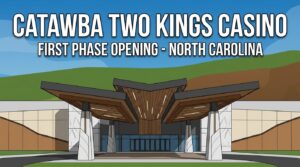
The Catawba Indian Nation has officially opened the first phase of its Two Kings Casino Resort in Kings Mountain, North Carolina, marking a significant milestone in what the tribe describes as a transformative economic development effort. The initial opening features a temporary gaming floor with electronic gaming machines and table games, while the broader vision encompasses a full-scale resort destination. Located roughly 35 miles west of Charlotte, the project positions itself at the intersection of tribal sovereignty, regional tourism, and a rapidly shifting gaming landscape in the southeastern United States.
What the Two Kings Casino Opening Signals for the Southeast Gaming Market
This isn’t simply another casino launch. The Catawba Nation’s push into North Carolina carries strategic weight that extends well beyond the gaming floor, touching on tribal economic self-determination, competitive dynamics with existing operators, and the broader regulatory framework governing tribal gaming rights.
- The first phase delivers immediate gaming capacity while construction continues on the permanent resort complex, a phased approach designed to generate revenue early
- Proximity to Charlotte gives Two Kings Casino access to one of the fastest-growing metropolitan populations in the U.S., a catchment area few tribal casinos can match
- Employment and infrastructure investment tied to the project are expected to ripple through Cleveland County and surrounding communities
- The opening intensifies competition with the Eastern Band of Cherokee Indians, which operates two established casino properties in western North Carolina
- Tribal sovereignty protections underpin the legal basis for the project, though not all stakeholders have embraced that framework without challenge
A Phased Build With Long-Term Ambitions
The Catawba Nation has opted for a development strategy that prioritizes speed to market. By launching a temporary gaming facility first, the tribe can begin generating operating revenue while the permanent structure takes shape around it. That permanent facility is expected to include a hotel, expanded gaming space, dining venues, entertainment options, and convention areas.
Still, the scale of the full buildout deserves scrutiny. Projects of this magnitude in the tribal gaming sector often face construction delays, financing pressures, and regulatory hurdles that can stretch timelines considerably. Whether the Catawba Nation can maintain momentum through subsequent phases will depend on early revenue performance and continued access to capital markets (a dependency that has tripped up other tribal developments in the past).
The temporary facility itself, while modest compared to the final vision, is far from bare-bones. Electronic gaming terminals and live table games anchor the floor, and early visitor traffic will serve as a real-time stress test for operations, staffing, and guest experience systems.
Regional Competition and the Charlotte Factor
Geography matters here more than usual. Charlotte’s population surpassed 900,000 in recent estimates, and the broader metro area tops 2.7 million. That urban mass has historically lacked a nearby casino option, with the closest Cherokee properties sitting roughly three hours away in the Smoky Mountains. Two Kings Casino cuts that drive to under 40 minutes for most Charlotte residents.
The Eastern Band of Cherokee Indians, which operates Harrah’s Cherokee Casino Resort and its sister property in Murphy, has publicly opposed the Catawba project. The dispute centers on whether the Catawba Nation holds legitimate rights to operate gaming on land in North Carolina, given the tribe’s historical base in South Carolina. Federal recognition and a 2020 land-in-trust decision by the Department of the Interior provided the legal foundation, but litigation and political friction have shadowed the project from the start.
And while legal challenges have not halted construction, they have shaped public perception. Some North Carolina lawmakers have questioned the precedent of one tribe operating gaming facilities on another tribe’s traditional territory.
How Tribal Gaming Economics Work in Practice
Tribal casinos operate under the Indian Gaming Regulatory Act of 1988, which established three classes of gaming and the framework for tribal-state compacts. Class III gaming, which includes slot machines and table games, typically requires a compact with the state. The Catawba project, however, has proceeded under federal authorization rather than a traditional state compact, a distinction that has fueled much of the legal debate.
Revenue from tribal gaming operations flows differently than commercial casino income. Tribes are not subject to state gaming taxes in the conventional sense, though they often negotiate revenue-sharing agreements. For the Catawba Nation, gaming revenue is expected to fund tribal government services, healthcare, education, and infrastructure. This reinvestment model is central to the economic argument tribal leaders have made in favor of the project.
| Feature | Temporary Facility (Phase 1) | Planned Permanent Resort |
|---|---|---|
| Gaming Floor | Electronic gaming machines, table games | Expanded gaming with significantly more capacity |
| Hotel | Not included | Full-service hotel planned |
| Dining & Entertainment | Limited food and beverage options | Multiple restaurants, bars, and live entertainment venues |
| Distance from Charlotte | Approximately 35 miles west | |
| Legal Basis | Federal land-in-trust decision; Indian Gaming Regulatory Act | |
Economic Ripple Effects Beyond the Casino Floor
Kings Mountain, a city of roughly 11,000 residents, stands to absorb a disproportionate share of the project’s economic impact. Construction jobs during the buildout phase, permanent positions once the resort is fully operational, and ancillary spending at nearby businesses all factor into the calculus. Local officials have expressed cautious optimism, though infrastructure strain on roads and public services remains a concern that hasn’t been fully addressed.
Arguably, the most consequential effect may be less visible: the normalization of gaming as an economic engine in a state that has historically been conservative on gambling policy. North Carolina legalized sports betting in 2024, and the Two Kings Casino opening adds another layer to a market that is evolving faster than many anticipated.
Frequently Asked Questions
Where is the Catawba Two Kings Casino located?
The casino is situated in Kings Mountain, North Carolina, approximately 35 miles west of Charlotte. Its proximity to the Charlotte metro area gives it a significant geographic advantage over other gaming destinations in the state.
Is the casino fully built?
No. The current opening covers only the first phase, a temporary gaming facility. The permanent resort, including a hotel and expanded amenities, is still under construction.
Why has the project faced legal opposition?
The Eastern Band of Cherokee Indians and some state officials have challenged the Catawba Nation’s right to operate a casino in North Carolina, arguing the land-in-trust process and jurisdictional questions were not properly resolved. Federal authorization has allowed the project to proceed despite these objections, though the legal landscape could still shift.
How does tribal casino revenue get used?
Under federal law, net revenues from tribal gaming must be directed toward tribal government operations, economic development, charitable purposes, or the general welfare of the tribe and its members. The Catawba Nation has indicated that proceeds will fund healthcare, education, and community infrastructure.