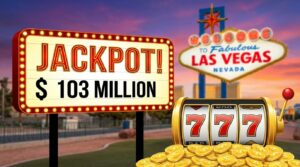
A visitor from Atlanta hit a staggering $103 million jackpot on a single $5 spin at a Las Vegas casino, choosing to walk away with a lump sum payout rather than annuitized payments over time. The win ranks among the largest slot machine payouts in Nevada history, drawing renewed attention to the economics of progressive jackpot systems and the gaming industry’s ability to generate headline-grabbing moments. While details about the winner remain limited, the sheer scale of the prize has sparked conversation across the casino sector about player engagement, jackpot mechanics, and the outsized marketing value these rare events deliver.
What a $103 Million Jackpot Signals for the Casino Industry
Massive progressive jackpot wins are statistically rare, but their ripple effects extend well beyond the individual winner. For operators, a payout of this magnitude functions as organic advertising that no marketing budget could replicate. Here’s what matters from a business and strategic perspective:
- Player acquisition boost: Jackpot headlines drive measurable spikes in foot traffic and new player sign-ups at the winning property and across the broader market.
- Progressive jackpot pool economics: Wins of this size reset the jackpot seed, but the network contribution model means the pool rebuilds quickly from a fraction of every qualifying bet placed across linked machines.
- Lump sum payouts, while smaller than the annuitized total, still represent enormous single-event liabilities that operators and their insurance partners must plan for.
- Regulatory scrutiny: Payouts above certain thresholds trigger mandatory IRS reporting and, in some cases, state-level audits of the machine’s random number generator integrity.
- Brand differentiation: The property where the win occurred gains a lasting narrative advantage, one that competitors cannot easily counter.
The Lump Sum Decision: Why Most Big Winners Take Cash Now
The Atlanta visitor’s choice to accept a lump sum rather than structured payments over decades follows a well-established pattern among large jackpot winners. Financial advisors almost universally recommend evaluating the net present value of the annuity against the immediate lump sum, factoring in federal and state tax obligations, investment return assumptions, and personal financial circumstances.
For a $103 million advertised jackpot, the lump sum is typically a significant discount from the headline number. That gap reflects the time value of money baked into the annuity’s structure. Still, for most winners, taking the cash upfront provides flexibility that a 20- or 30-year payment schedule simply cannot match (a distinction that financial literacy advocates have long argued should be better communicated to players before they sit down at the machine).
Nevada imposes no state income tax, which gives winners in Las Vegas a notable advantage over those hitting jackpots in jurisdictions like New York or California. Federal taxes, however, apply regardless.
How Progressive Jackpots Actually Work
Progressive slot systems pool a small percentage of every wager placed on linked machines, sometimes across a single casino floor, sometimes across an entire state or multi-state network. The jackpot grows continuously until someone triggers the winning combination. After a payout, the system resets to a predetermined seed amount and begins climbing again.
The machines themselves rely on certified random number generators, and the odds of hitting a top-tier progressive jackpot are astronomically low. Depending on the game, the probability can sit somewhere around 1 in 50 million spins or worse. That rarity is precisely what allows the prize pools to accumulate into nine-figure territory.
Companies like International Game Technology, which manufactures many of the progressive slot systems found on casino floors worldwide, engineer these networks to balance player excitement with actuarial sustainability. The math has to work for the operator over millions of spins, even when a single spin produces a $103 million liability.
The Marketing Aftershock Casinos Count On
Every record-breaking jackpot generates media coverage that reaches audiences far beyond the typical casino customer base. And while operators cannot predict when or where the next big hit will land, they design their floor layouts, machine placement strategies, and loyalty programs around the aspirational pull these moments create.
What’s harder to quantify is how long the effect lasts. A property that paid out $103 million will reference that win in promotional materials for years. But whether it translates into sustained revenue growth or merely a short-term traffic spike depends on execution, the broader competitive landscape, and whether the property can convert curiosity into repeat visits.
Frequently Asked Questions
How much does the winner actually receive from a $103 million jackpot?
The lump sum payout is substantially less than the advertised figure, often around 50–60% of the total. After federal taxes of 24–37%, the net amount shrinks further, though the absence of Nevada state income tax helps preserve more of the payout compared to other states.
Are slot machine jackpots truly random?
Yes. Licensed casinos in Nevada operate under strict regulatory oversight from the Nevada Gaming Control Board, which requires all slot machines to use certified random number generators. The outcomes cannot be influenced by the casino or the player.
How rare is a jackpot of this size?
Extremely. Progressive jackpots exceeding $100 million have occurred only a handful of times in the history of commercial gaming. The odds on any individual spin are typically tens of millions to one against hitting the top prize.
Broader Implications for Gaming Revenue and Player Behavior
Large jackpot events tend to reinforce a cognitive pattern that behavioral economists call the availability heuristic. When people see or hear about someone winning a life-changing sum, they overestimate their own probability of experiencing a similar outcome. This psychological mechanism arguably drives more incremental gaming revenue than any loyalty program or promotional offer ever could.
Casinos understand this dynamic well. Floor designs, sound effects, and even the physical placement of progressive machines near high-traffic areas are all calibrated to maximize visibility when a win occurs. The celebration itself becomes part of the product.
Yet there’s a tension here that the industry rarely addresses publicly. The same psychological triggers that make jackpots compelling also raise questions about responsible gaming practices. Regulators in Nevada and other jurisdictions have gradually expanded disclosure requirements and self-exclusion programs, but the gap between regulatory frameworks and the persuasive architecture of a modern casino floor remains wide.
Whether this particular $103 million win prompts any policy discussion is uncertain. What it will certainly prompt is another wave of visitors to Las Vegas, each hoping that lightning might strike twice on a $5 spin.



