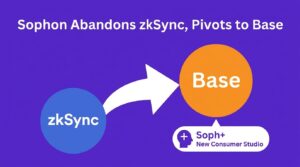
Sophon, the blockchain project that raised $60 million through node sales, is shutting down its zkSync-based Layer 2 chain and repositioning itself as a consumer product studio called “Soph+.” The new entity will build exclusively on Base, Coinbase’s Ethereum Layer 2 network. Thursday’s announcement marked the end of a chain that, despite significant fundraising, struggled to attract meaningful user activity — reportedly drawing fewer than 200 daily active users. The pivot raises pointed questions about the sustainability of infrastructure-first strategies in a market increasingly rewarding applications over chains.
What Sophon’s Shutdown Signals for Layer 2 Economics
Before unpacking the strategic details, it’s worth framing what this move represents at a broader level. Sophon’s trajectory — from a well-funded Layer 2 launch to a quiet decommissioning — illustrates a pattern that has become difficult to ignore across the modular blockchain landscape. Capital alone does not guarantee network effects, and the gap between raising funds and retaining users has widened for many infrastructure-focused projects.
- Sophon raised $60 million via node sales but failed to convert that capital into sustained on-chain activity, with daily active users reportedly below 200
- The decision to migrate to Base suggests growing confidence among builders that established Layer 2 ecosystems offer better distribution than launching a standalone chain
- Rebranding as “Soph+” signals a deliberate shift from infrastructure provider to application-layer studio, a move that mirrors wider industry sentiment favoring consumer-facing products
- Base, backed by Coinbase’s distribution and liquidity advantages, continues to absorb projects seeking immediate access to users rather than building audiences from scratch
- The $60 million raised through node sales now sits in an awkward position — investors bought into a chain that no longer exists in its original form
From Chain to Studio: The Mechanics of the Pivot
Sophon’s original thesis centered on operating a zkSync-powered Layer 2 tailored to entertainment and consumer applications. That thesis, at least on paper, wasn’t unreasonable. But execution told a different story. Fewer than 200 daily active users is not a struggling chain — it’s functionally dormant.
The rebrand to Soph+ repositions the team as builders rather than chain operators. Instead of maintaining validators, sequencers, and the full overhead of a standalone network, the project will now develop consumer applications directly on Coinbase’s Base Layer 2 network. That’s a fundamentally different cost structure and a fundamentally different bet.
Still, the transition isn’t seamless. Node sale participants invested in infrastructure that is being retired. How Sophon handles obligations to those participants — whether through token conversions, refunds, or migration incentives — will determine whether the pivot is perceived as strategic agility or a breach of implicit commitments.
Why Base Keeps Winning the Migration Game
Base has become something of a gravitational center for projects abandoning standalone chain strategies. Its appeal isn’t mysterious: Coinbase brings regulatory credibility (a distinction that matters more with each passing enforcement cycle), a built-in user base numbering in the tens of millions, and fiat on-ramp infrastructure that most Layer 2s simply cannot replicate.
For Soph+, the calculus is straightforward. Building on Base eliminates the cold-start problem that killed the original Sophon chain. Rather than spending resources attracting users to an unfamiliar network, the team can focus on product development within an ecosystem where users already exist.
Whether Base’s dominance in attracting these migrations translates into long-term ecosystem diversity or creates a new form of platform dependency is a question the industry hasn’t fully reckoned with.
The Broader Pattern: Infrastructure Fatigue Meets Application Hunger
Sophon is not an isolated case. Across the Ethereum ecosystem and beyond, the proliferation of Layer 2 and Layer 3 chains has created a fragmented landscape where most networks compete for the same thin pool of active DeFi and gaming users. The result: a market caught between two frameworks. One rewards infrastructure launches with venture capital and token premiums. The other rewards actual usage, retention, and revenue.
These two frameworks are increasingly in tension. Projects that raised capital on the promise of sovereign chain economics are discovering that users don’t care about chain architecture. They care about applications that work. And they tend to congregate where liquidity already lives.
The pivot from chain to application studio reflects a maturing (arguably overdue) recognition that distribution matters more than decentralization theater. Soph+ is betting that a small team building focused consumer products on a high-traffic chain will outperform a well-funded but empty network.
What Should Node Sale Investors Expect?
This remains the most uncomfortable dimension of the announcement. Node sales, by design, sell participation in a specific network. When that network ceases to exist, the value proposition changes entirely. Sophon has not publicly detailed a comprehensive compensation or migration plan for node sale participants, and the absence of clarity here is conspicuous.
Frequently Asked Questions
What was Sophon’s original purpose?
Sophon operated a zkSync-based Layer 2 chain designed for entertainment and consumer applications. It raised $60 million through node sales to fund the network’s development and launch.
Why is Sophon shutting down its chain?
The chain failed to gain traction, attracting fewer than 200 daily active users despite significant funding. The team concluded that building applications on an established Layer 2 offered a more viable path than maintaining a standalone network.
What is Soph+?
Soph+ is the rebranded entity that will function as a consumer product studio building exclusively on Base. It represents a shift from infrastructure operation to application development.
How does this affect node sale participants?
That’s not yet fully clear. Participants purchased nodes for a chain that is being decommissioned, and Sophon has not released detailed plans for how those investments will be addressed under the new structure.
Why did Sophon choose Base over other Layer 2 networks?
Base offers access to Coinbase’s large existing user base, fiat on-ramp infrastructure, and growing ecosystem of applications — advantages that directly address the distribution challenges Sophon faced as a standalone chain.
| Attribute | Sophon (Original) | Soph+ (New Direction) |
|---|---|---|
| Model | Standalone Layer 2 chain | Consumer product studio |
| Technology Base | zkSync | Base (Coinbase L2) |
| Capital Raised | $60 million via node sales | Leveraging existing treasury |
| Daily Active Users | Fewer than 200 | Targeting Base’s existing user pool |
| Core Focus | Chain infrastructure and entertainment dApps | Consumer applications built on established infrastructure |
The blockchain industry’s appetite for new chains has not disappeared, but the tolerance for chains without users is eroding fast. Sophon’s pivot to Soph+ may prove prescient or premature — but it reflects a market reality that more projects will likely confront in the months ahead.