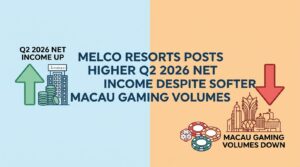
Melco Resorts & Entertainment delivered improved net income in the second quarter of fiscal 2026, even as broader Macau gaming revenue showed signs of cooling. The result underscores a widening gap between operator-level profitability and market-wide volume trends across the world’s largest casino hub. For investors and industry watchers tracking the post-pandemic trajectory of Macau’s six concessionaires, Melco’s quarter offers a case study in margin discipline amid shifting demand patterns.
What Melco’s Q2 Numbers Signal for Macau’s Recovery Arc
Before diving into the specifics, it helps to frame what this earnings cycle reveals about the state of play in Macau and the strategic positioning of its operators. The takeaways below distill the business implications worth watching.
- Profitability over volume: Melco’s ability to grow net income while Macau’s aggregate gaming revenue softened suggests the company is extracting more value per visitor through non-gaming revenue streams and cost management.
- Mass-market pivot continues to pay off. The premium mass and mass-market segments remain the engine of sustainable margins, a structural shift that predates the pandemic but has accelerated since 2023.
- Operational efficiency gains appear to be sticking, not just a one-quarter anomaly but part of a multi-quarter trend in how Melco manages its Cotai properties.
- VIP weakness persists: High-roller volumes remain below pre-pandemic peaks, reflecting both regulatory pressure on junket operators and a broader reorientation of Macau’s gaming economy.
- The quarter raises a question few analysts have fully answered: how much further can margin expansion go before top-line growth becomes essential again?
Revenue Mix and the Margin Story
Melco’s Q2 results reflect a deliberate recalibration. While total gaming revenue dipped modestly compared to the prior-year quarter, the company’s non-gaming segments (a distinction regulators have been slow to formally incentivize across all concessionaires) contributed meaningfully to the bottom line. Hotel occupancy across its flagship properties, including City of Dreams Macau and Studio City, remained robust. Food and beverage, entertainment, and retail all posted incremental gains.
That mix matters.
When gaming volumes soften, operators historically face margin compression. Melco’s ability to hold or expand margins in a softer revenue environment points to structural improvements in how the company allocates capital and manages headcount. Labor costs in Macau have risen steadily since the territory’s reopening, making cost discipline harder to sustain. Yet Melco appears to be absorbing those increases without sacrificing profitability, at least on paper.
How Macau’s Broader Market Compares
Macau’s gross gaming revenue for the quarter came in below some analyst forecasts, with the territory’s six operators collectively generating figures that, while still elevated relative to 2022 and 2023, suggest the sharpest phase of the post-COVID rebound has passed. The table below contextualizes Melco’s position within the broader market.
| Metric | Melco Resorts (Q2 2026) | Macau Market (Q2 2026 Est.) |
|---|---|---|
| Net Income Trend | Higher year-over-year | Mixed across operators |
| Mass-Market Revenue | Stable to slightly up | Broadly stable |
| VIP Segment | Continued softness | Below pre-pandemic levels across the board |
| Non-Gaming Contribution | Growing share of total revenue | Varies significantly by operator; some lag behind |
| Operating Margin | Improved | Flat to modestly improved sector-wide |
Not every concessionaire has managed the same balancing act. Some operators remain more exposed to VIP volatility, while others have been slower to build out non-gaming amenities that Macau’s government has explicitly encouraged under the new concession terms granted in 2023.
Strategic Positioning: What Melco Is Betting On
Under CEO Lawrence Ho, Melco Resorts has invested heavily in integrated resort experiences that extend well beyond the gaming floor. Studio City’s Phase 2 expansion, which added hotel capacity, indoor waterpark facilities, and entertainment venues, represents the most visible expression of this strategy. The bet is straightforward: as Macau’s regulatory framework increasingly rewards diversification, operators who build compelling non-gaming ecosystems will capture a disproportionate share of visitor spending.
Still, execution risk remains. Capital expenditure on non-gaming assets takes years to generate returns, and Melco carries a debt load that, while manageable at current revenue levels, leaves limited room for error if Macau’s recovery stalls. The company’s leverage ratio warrants monitoring through the back half of the fiscal year.
The Behavioral Economics Behind Macau’s Shifting Visitor Profile
Understanding Melco’s results requires looking beyond balance sheets and into the psychology of Macau’s evolving visitor base. The territory’s tourists are not the same cohort that drove pre-pandemic VIP volumes. Today’s visitors from mainland China skew younger, travel in smaller groups, and allocate spending differently. They prioritize experiences, dining, and social-media-worthy moments alongside (and sometimes instead of) table games.
This behavioral shift aligns with principles familiar to anyone studying decision-making frameworks. Visitors are anchoring their expectations around experience quality rather than pure gambling access. Operators who frame their properties as lifestyle destinations rather than casinos with hotels attached are, in effect, reanchoring the value proposition. Melco’s investment in entertainment programming, celebrity chef restaurants, and immersive attractions at Studio City and City of Dreams reflects an intuitive grasp of this reframing. The language used in marketing materials has shifted too: less emphasis on gaming tables, more on “world-class experiences” and “unforgettable stays.” And while such phrasing risks sounding generic, the capital allocation behind it is concrete. Properties that successfully trigger aspirational identity cues in their target demographic tend to capture higher per-visitor spend, even when overall visitation numbers plateau. For Melco, the challenge is sustaining that perception as competitors invest in similar upgrades across the Cotai Strip.
Frequently Asked Questions
Did Melco’s revenue increase in Q2 2026?
Melco’s net income rose year-over-year, though total gaming revenue was modestly softer. The improvement came primarily from cost discipline and growing non-gaming contributions rather than top-line gaming growth.
Why is Macau’s VIP segment still underperforming?
Regulatory crackdowns on junket operators, tighter capital controls from mainland China, and a broader industry pivot toward mass-market gaming have all contributed. The VIP segment may never return to its pre-2020 scale.
What properties does Melco operate in Macau?
Melco’s Macau portfolio includes City of Dreams, Studio City, and Altira Macau. City of Dreams and Studio City, both on the Cotai Strip, are the primary revenue generators.
How does Melco compare to other Macau operators?
Melco has been among the more aggressive investors in non-gaming diversification. Its margin performance in Q2 2026 appears to have outpaced several peers, though full comparative data across all six concessionaires is still emerging.