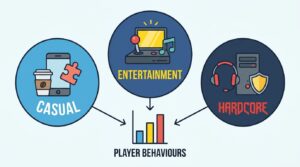
BGaming has released granular performance data underpinning its Three Game Worlds framework, offering the industry a rare quantified look at how segmenting slot portfolios by player psychology translates into measurable engagement differences. The Malta-based provider, which has steadily expanded its global footprint across regulated markets, structured its catalogue around three distinct player archetypes: Casual, Entertainment, and Hardcore. The data, shared publicly in early 2025, reveals sharp divergences in session length, bet sizing, and feature interaction across these segments, giving operators concrete benchmarks for portfolio optimisation.
What BGaming’s Segmentation Data Actually Reveals
Before diving into the numbers, it’s worth framing why this matters commercially. Most slot providers talk about player segmentation in broad strokes. Few attach real metrics to those categories. BGaming’s disclosure gives operators and affiliates something actionable: a data-backed rationale for how game placement, lobby curation, and bonus strategy should differ depending on which world a title belongs to.
- Casual World titles show the highest session frequency but shortest average session duration, suggesting players dip in and out rather than committing to extended play
- Entertainment World games generate the strongest feature engagement rates, with players triggering bonus rounds at notably higher frequency
- Hardcore World products attract the smallest player pool but deliver the highest average bet sizes and longest individual sessions
- Cross-segment migration remains limited; players who prefer Casual titles rarely shift to Hardcore, reinforcing the case for distinct lobby positioning
- The framework has informed BGaming’s development pipeline, with upcoming releases designed to deepen engagement within each world rather than chase broad-market appeal
Three Worlds, Three Behavioural Profiles
BGaming’s Casual segment targets players who treat slots as light entertainment. Think low volatility, familiar themes, and mechanics that don’t demand deep understanding. Session data confirms the hypothesis: these players engage frequently but briefly, often during idle moments rather than dedicated gambling sessions. Retention here depends on variety and accessibility, not complexity.
The Entertainment segment sits in the middle and, arguably, represents the most commercially versatile category. Games in this world blend narrative elements with moderate volatility, and the data shows players actively seeking out bonus features rather than simply spinning through base game. That behavioural pattern has implications for how operators structure promotional offers around these titles (a point not every affiliate programme has caught up with yet).
Then there’s Hardcore. Smaller audience, higher stakes, longer commitment. Players in this segment behave more like enthusiasts than casual consumers. They study paytables, chase high-volatility mechanics, and demonstrate significantly higher lifetime value on a per-player basis. But the segment’s narrower reach means operators need to be deliberate about where and how they surface these games.
Why the Boundaries Between Segments Hold
One of the more striking findings is how little crossover exists between the three worlds. Players self-select into a segment and largely stay there. This challenges a common industry assumption that a well-designed game can appeal to everyone. It can’t, at least not according to BGaming’s data. And that rigidity in player preference has real consequences for game development strategy: building a title that tries to straddle two worlds risks resonating with neither.
How This Shapes Operator Strategy
For operators, the practical takeaway is straightforward but often ignored. Lobby design should reflect behavioural segmentation, not just provider branding or release date. A Casual player scrolling past a wall of Hardcore titles isn’t just unlikely to convert; they may disengage from the platform entirely.
BGaming’s approach also carries implications for bonus mechanics. Offering free spins on a high-volatility Hardcore title to a player whose history skews Casual is, in effect, wasted spend. The data supports a more surgical approach to CRM, one where promotional assets align with the player’s demonstrated world preference.
| Segment | Session Length | Bet Size | Feature Engagement | Player Pool Size |
|---|---|---|---|---|
| Casual | Short, frequent | Low | Moderate | Largest |
| Entertainment | Medium | Medium | Highest | Mid-range |
| Hardcore | Long, sustained | Highest | Moderate-High | Smallest but highest value per player |
The Neuroscience of Player Segmentation
What makes BGaming’s framework particularly interesting is how closely it mirrors principles from behavioural psychology and neuro-linguistic programming. Players don’t just choose games randomly; they gravitate toward experiences that match their internal state and cognitive preferences. Casual players seek what NLP practitioners would call a “comfort anchor” — familiar patterns that require minimal cognitive load and deliver predictable micro-rewards. The brain’s dopamine response in these sessions is frequent but low-intensity, reinforcing habitual return behaviour without deep emotional investment.
Entertainment-segment players, by contrast, respond to what behavioural scientists describe as variable ratio reinforcement schedules. The unpredictability of bonus triggers keeps attention elevated. These players are, in NLP terms, operating in a “toward” motivation pattern: they’re actively pursuing a positive outcome rather than simply avoiding boredom. Their engagement with narrative and feature mechanics reflects a desire for agency within the game experience.
Hardcore players exhibit a different cognitive profile entirely. Their willingness to sustain long sessions at higher stakes suggests a stronger tolerance for delayed gratification and a preference for mastery-oriented experiences. In NLP frameworks, these individuals tend to favour “internal reference” decision-making — they trust their own analysis of game mechanics over external recommendations. This explains why traditional marketing approaches often underperform with this segment; they respond better to transparent data, detailed game information, and community-driven validation than to promotional messaging. Understanding these psychological underpinnings doesn’t just validate BGaming’s slot portfolio segmentation approach; it gives operators a deeper lens for personalising the entire player journey.
Frequently Asked Questions
What is BGaming’s Three Game Worlds strategy?
It’s a framework that segments BGaming’s slot portfolio into three categories — Casual, Entertainment, and Hardcore — each designed around distinct player behavioural profiles and engagement patterns.
Do players move between the three segments?
According to BGaming’s data, cross-segment migration is minimal. Players tend to self-select into one world and remain there, which reinforces the need for targeted lobby placement and promotional strategies rather than one-size-fits-all approaches.
How should operators use this data?
Operators can align lobby curation, CRM campaigns, and bonus offers with each segment’s behavioural tendencies. Matching the right game type to the right player profile reduces wasted promotional spend and strengthens retention. The specifics will vary by market, but the principle holds broadly.
Which segment generates the most revenue?
That depends on the metric. Casual commands the largest player base. Hardcore delivers the highest per-player value. Entertainment sits between, but its strong feature engagement rates make it a reliable driver of sustained play — and, by extension, of gross gaming revenue across a diversified portfolio.