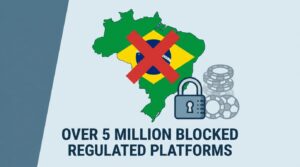
Brazil’s federal government has barred more than 5 million individuals from accessing regulated sports betting platforms, marking one of the largest single enforcement actions in Latin America’s rapidly expanding gambling sector. The crackdown, driven by President Lula’s administration, targets users who fail to meet newly enacted eligibility criteria under the country’s evolving regulatory framework. It signals a decisive shift from market liberalisation toward tighter consumer protection, and it raises hard questions about how other emerging markets will balance revenue ambitions with social safeguards.
What Brazil’s Mass Exclusion Means for the Regulated Betting Industry
The scale of this intervention is difficult to overstate. Blocking 5 million users from legal platforms doesn’t just reshape Brazil’s domestic market; it sends a signal across Latin America, where several countries are watching Brazil’s regulatory experiment closely before designing their own frameworks. Here’s what matters most from a strategic standpoint:
- Consumer protection as enforcement priority: The Lula administration is treating eligibility screening not as a formality but as an active gatekeeping mechanism, removing millions who don’t meet financial or identity verification thresholds.
- Revenue impact on licensed operators: Losing access to millions of registered users will compress the addressable market for platforms that invested heavily in Brazilian licensing.
- Unlicensed operators may absorb displaced demand, potentially undermining the very protections the policy intends to create.
- Regulatory precedent for the region: Colombia, Peru, and Argentina are each at different stages of iGaming regulation. Brazil’s willingness to sacrifice short-term tax revenue for enforcement credibility could influence their approaches.
- Data infrastructure under stress: Cross-referencing 5 million accounts against government databases (a distinction that sounds straightforward on paper but rarely is) tests the technical backbone of Brazil’s regulatory apparatus.
Who Gets Blocked, and Why Now?
The blocked users reportedly include individuals receiving federal welfare benefits, minors who had circumvented age verification systems, and those flagged through cross-checks with Brazil’s social registry databases. The timing is not incidental. Public pressure had been mounting after media investigations revealed that welfare recipients were spending government transfers on betting apps, a politically toxic revelation for an administration that built its platform on poverty reduction.
Lula’s government moved quickly. The Brazilian Ministry of Finance’s regulatory division implemented the exclusions as part of broader rules that took effect in early 2025, requiring operators to verify users against federal databases before allowing deposits or wagers.
Still, the enforcement raises a tension that hasn’t been fully resolved. Blocking users from regulated platforms does not block them from gambling. It blocks them from gambling legally. And in a country where unlicensed offshore operators already hold significant market share, the risk of pushing vulnerable users toward less transparent alternatives is real.
The Operator Perspective: Compliance Costs and Shrinking TAM
For licensed betting companies operating in Brazil, the immediate effect is a contraction of their total addressable market. Operators who spent months (and considerable capital) acquiring users now face the prospect of deactivating accounts at government direction. Compliance costs are climbing. Verification systems need to interface with federal databases in near real-time, and the penalties for non-compliance remain steep.
Some operators have publicly supported the measures, framing them as necessary for long-term market legitimacy. Others are quieter. The commercial reality is that Brazil’s appeal to international betting firms rested partly on its enormous population and relatively low regulatory barriers during the initial licensing phase. That calculus is shifting.
| Factor | Before Enforcement | After Enforcement |
|---|---|---|
| Estimated registered users on legal platforms | ~50 million+ | Reduced by 5 million+ |
| Welfare recipient access | Largely unrestricted | Blocked via database cross-referencing |
| Operator compliance burden | Moderate (KYC-focused) | High (real-time government database integration) |
| Unlicensed market risk | Significant | Arguably elevated by displacement |
Reframing Responsible Gambling: Lessons in Regulatory Psychology
Beyond the numbers, Brazil’s approach reflects a broader psychological shift in how governments frame gambling regulation. Traditional models treat responsible gambling as an individual obligation: self-exclusion tools, deposit limits, awareness campaigns. Brazil is inverting that model. The state is deciding who can participate, not waiting for individuals to opt out.
This paternalistic framework carries both strengths and risks. On one hand, it protects populations that behavioural research consistently identifies as most vulnerable to gambling harm, particularly those experiencing financial precarity. Welfare recipients, by definition, are in that category. On the other hand, removing agency from adults creates friction with the broader liberalisation narrative that justified legalisation in the first place.
What’s particularly notable is how the policy leverages existing data infrastructure. Brazil’s Cadastro Único, the unified social registry covering over 40 million low-income families, became the enforcement backbone. Few countries possess a comparable tool. That means replicating this approach elsewhere would require either building similar systems or finding alternative verification pathways, neither of which is trivial.
The psychological framing also matters for public perception. By positioning the crackdown as protecting the poor rather than restricting freedoms, the Lula administration has managed to generate broad political support for what is, in practice, a significant curtailment of market access. Whether that framing holds as displaced users migrate to unregulated channels remains an open question.
Frequently Asked Questions
Why did Brazil block 5 million users from betting platforms?
The government identified individuals who did not meet eligibility criteria under new regulations, including welfare recipients and minors who had bypassed age checks. The exclusions are part of a broader effort to prevent vulnerable populations from gambling with public assistance funds.
Does this affect all betting platforms in Brazil?
The enforcement applies to licensed, regulated platforms. Unlicensed offshore operators, which still serve a substantial portion of Brazilian bettors, fall outside this mechanism, though the government has signalled separate actions targeting those sites.
Could other Latin American countries adopt similar measures?
In theory, yes. But Brazil’s approach depends heavily on its Cadastro Único social registry, a database infrastructure that most neighbouring countries lack. Replication would require significant investment in data systems and political will to prioritise enforcement over revenue.
What happens to operators who fail to comply?
Penalties include fines and potential licence revocation. The Ministry of Finance has indicated that compliance audits will intensify throughout 2025, with particular scrutiny on platforms that were slow to implement user verification protocols.



