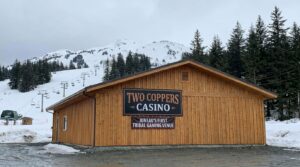
Two Coppers Casino has begun accepting players near the Eaglecrest Ski Area, giving Juneau its first tribal gaming operation. The venue, operated under the authority of a federally recognized tribe, represents a significant step for Alaska’s capital city in a state where commercial casino gambling remains prohibited. While details about the facility’s scale and game offerings are still emerging, the opening signals a broader shift in how tribal sovereignty intersects with gaming regulation in remote Alaskan communities.
What Juneau’s First Tribal Casino Means for Alaska’s Gaming Landscape
The arrival of a tribal casino in Juneau is not a routine business opening. Alaska has long occupied an unusual position in U.S. gaming law, with no state-authorized commercial casinos and limited forms of legal gambling restricted primarily to pull-tabs, bingo, and charitable gaming. Tribal gaming, however, operates under a separate federal framework governed by the Indian Gaming Regulatory Act (IGRA) of 1988, which grants federally recognized tribes the right to conduct gaming on tribal lands under certain conditions.
- First mover advantage: Two Coppers Casino is positioned as the first tribal gaming venue in Juneau, potentially establishing a template for other tribal nations in Alaska considering similar operations.
- Regulatory precedent: The opening tests the boundaries of tribal gaming authority in a state that has historically resisted casino-style gambling, raising questions about how state and tribal regulatory frameworks will coexist.
- The proximity to Eaglecrest Ski Area could create a tourism synergy that neither the casino nor the ski resort would generate independently.
- Economic implications for Juneau: Even a modest gaming floor introduces new revenue streams, employment opportunities, and visitor spending in a city whose economy leans heavily on seasonal cruise ship tourism and state government employment.
Tribal Sovereignty and the IGRA Framework
Under IGRA, tribes can operate Class II gaming (bingo-style games and certain card games) on tribal lands without a state compact, while Class III gaming (slot machines, table games, sports betting) typically requires a negotiated agreement between the tribe and the state. Alaska’s position on tribal gaming compacts has been, at best, ambiguous. The state has not entered into Class III compacts with any tribe, which means Two Coppers Casino likely operates within the Class II category, at least on paper.
That distinction matters enormously. Class II operations generate meaningful but limited revenue compared to full-scale casinos. Still, they provide tribes with a sovereign revenue mechanism that bypasses the state legislature entirely (a distinction regulators have been slow to enforce consistently across jurisdictions). Whether Alaska’s political establishment views this opening as a contained experiment or an opening salvo in a broader gaming expansion debate remains to be seen.
Location Strategy: Why Eaglecrest?
Siting the casino near Juneau’s Eaglecrest Ski Area is a deliberate choice. The ski area draws both locals and visitors during winter months, and the surrounding area sees recreational traffic year-round. By anchoring the casino near an established destination, the operators tap into existing foot traffic without needing to build awareness from scratch.
Juneau’s geography also plays a role. Accessible only by air or sea, the city functions as a self-contained market. A casino here doesn’t compete with neighboring jurisdictions the way a tribal venue in the Lower 48 might. That isolation could be an advantage, concentrating demand rather than splitting it.
How This Fits Into Alaska’s Broader Economic Picture
Alaska’s economy has been under sustained pressure from prior oil revenue declines and the seasonal volatility of tourism. Tribal gaming introduces a diversification lever that doesn’t depend on state appropriations or federal grants. Consider the following comparison of Juneau’s primary economic drivers:
| Economic Driver | Seasonality | Revenue Stability | Employment Type |
|---|---|---|---|
| Cruise Ship Tourism | May–September | Highly variable | Seasonal, service-sector |
| State Government | Year-round | Dependent on oil revenue and budget cycles | Full-time, public sector |
| Eaglecrest Ski Area | November–April | Weather-dependent | Seasonal, mixed |
| Two Coppers Casino | Year-round (projected) | To be determined | Full-time and part-time, hospitality and gaming operations |
The casino’s year-round operating potential fills a gap that Juneau’s other economic pillars cannot. And while the venue’s initial scale may be modest, the precedent it sets could attract further tribal investment in the region.
Unanswered Questions and What Comes Next
Several dimensions of this story remain unresolved. The tribe has not publicly disclosed projected annual revenues, the number of gaming positions on the floor, or whether it intends to pursue a Class III compact with the state in the future. Arguably, the state’s response will be more consequential than the casino’s opening-day performance. If Alaska’s government signals tolerance or even quiet cooperation, other tribes across the state may accelerate their own gaming plans.
But resistance is equally plausible. Anti-gambling sentiment in Alaska has deep roots, and legislators may face constituent pressure to challenge the legal basis for tribal gaming operations. The result: a political and legal landscape that could shift rapidly in either direction.
Frequently Asked Questions
Is casino gambling legal in Alaska?
Commercial casino gambling is not authorized under Alaska state law. However, federally recognized tribes may operate gaming facilities on tribal lands under the Indian Gaming Regulatory Act, which is a federal statute that supersedes state-level prohibitions in specific circumstances.
What types of games does Two Coppers Casino offer?
Specific game offerings have not been widely detailed. Given Alaska’s lack of a Class III tribal-state compact, the casino most likely operates Class II games such as bingo-style electronic gaming and certain card games.
Could more tribal casinos open in Alaska?
It depends on how this initial operation is received by regulators, the public, and the state legislature. Alaska has over 200 federally recognized tribes, and the Two Coppers opening could serve as a proof of concept for others weighing similar ventures. No other tribe has publicly announced plans at this stage.