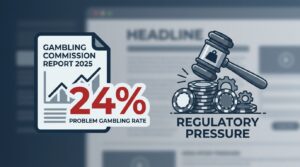
The Gambling Commission has reported a 24% problem gambling rate for 2025, a figure that hands the UK regulator three distinct pressure points as it navigates an already fraught policy landscape. The statistic, drawn from the Commission’s latest assessment cycle, marks a sharp escalation from previous years and places renewed urgency on both operator accountability and legislative reform. For an industry already contending with tighter advertising rules and affordability checks, this number lands like a verdict.
What the 24% Figure Signals for the UK Gambling Sector
Before parsing the strategic implications, it helps to frame what this data point actually represents. A problem gambling rate of 24% does not mean nearly a quarter of the UK population gambles problematically. Rather, it reflects the proportion of active gamblers who exhibit behaviours classified as harmful or at-risk under the Commission’s screening methodology. Still, even within that narrower frame, the trajectory is alarming enough to reshape regulatory priorities for the remainder of 2025 and beyond.
- Operator compliance costs are set to climb. With problem gambling rates at this level, the Commission has stronger grounds to mandate enhanced affordability checks, source-of-funds verification, and real-time intervention tools across licensed platforms.
- Political appetite for stricter legislation grows. The figure gives parliamentary advocates of tighter gambling controls fresh ammunition, particularly around stake limits for online slots and mandatory loss caps.
- The data complicates the industry’s self-regulation narrative, which operators have leaned on heavily since the 2023 White Paper on gambling reform.
- Investor sentiment may shift. Publicly listed operators face the dual risk of regulatory tightening and reputational erosion, both of which feed into share price volatility.
- Charities and treatment providers will likely push for increased funding, arguing that current NHS and third-sector capacity cannot absorb the implied demand.
How the Commission Arrived at This Number
The 24% rate stems from the Gambling Commission’s annual prevalence survey, which uses a combination of the Problem Gambling Severity Index (PGSI) and the DSM-IV screening criteria. Respondents who score 1 or above on the PGSI are categorised as at-risk or problem gamblers (a distinction regulators have been slow to communicate clearly to the public). The methodology has drawn criticism from some industry stakeholders who argue it captures low-risk recreational gamblers alongside genuinely harmful cases, inflating the headline figure.
But methodology debates aside, the direction of travel is unambiguous. Year-on-year increases in this metric narrow the space for operators to argue that existing safeguards are sufficient. The Gambling Commission’s regulatory framework already includes licence conditions requiring operators to identify and interact with at-risk customers. Whether those conditions have teeth is another question entirely.
The Operator Response: Between Compliance and Resistance
Major UK-licensed operators have, at least on paper, invested heavily in safer gambling tools. Deposit limits, reality checks, self-exclusion schemes like GamStop, and AI-driven behavioural monitoring are now standard features across most platforms. Yet the persistent rise in problem gambling rates suggests a gap between tool availability and tool effectiveness.
One explanation is structural. Operators design products to maximise engagement. Safer gambling tools, meanwhile, are often opt-in rather than default. The tension between commercial incentive and harm prevention sits at the core of every regulatory debate in this sector. And while some operators have moved toward proactive intervention models, the industry as a whole has not converged on a single standard for what “meaningful” customer interaction looks like when risk indicators appear.
That gap matters now more than it did a year ago.
Reframing the Conversation: Why Language and Perception Shape Policy Outcomes
Numbers like 24% do not exist in a vacuum. How stakeholders interpret, contextualise, and communicate this figure will determine its policy impact as much as the data itself. This is where principles drawn from neuro-linguistic programming offer a useful lens for understanding the dynamics at play.
Consider the framing effect. When the Commission presents a 24% problem gambling rate, the immediate cognitive response among policymakers and the public anchors to alarm. The number feels large, urgent, and morally charged. Operators, by contrast, attempt to reframe the same data by emphasising that 76% of gamblers show no signs of harm, a classic example of what NLP practitioners call “reframing” to shift the representational system through which information is processed. Neither frame is dishonest, but each activates a different decision-making pathway in the audience.
Anchoring bias plays a role too. Once a figure like 24% enters public discourse, subsequent policy proposals are evaluated relative to it. A regulator proposing moderate reforms risks appearing inadequate against such a stark backdrop, while aggressive intervention seems proportionate. The anchoring effect, well-documented in behavioural economics and central to NLP’s model of how internal representations drive behaviour, means this single data point could shape the ambition level of reforms for years.
There is also the question of rapport and trust between regulator and industry. NLP emphasises that effective communication depends on establishing shared frames of reference. When operators dismiss the Commission’s methodology and the Commission questions operator sincerity, the resulting mismatch in communication patterns (what NLP terms a “break in rapport”) makes collaborative solutions harder to reach. The most productive outcomes in regulatory environments tend to emerge when both sides operate from a shared evidential base, even if they disagree on interpretation. Whether that shared base exists here remains genuinely uncertain.
What Comes Next for Regulation?
The Commission now faces a sequencing challenge. Three regulatory levers are in play simultaneously:
| Regulatory Lever | Current Status | Likely Next Step |
|---|---|---|
| Affordability checks | Consultation phase, thresholds under review | Formal implementation expected by late 2025, though operator pushback could delay timelines |
| Online stake limits | Proposed but not yet enacted | Parliamentary pressure likely to accelerate |
| Advertising restrictions | Voluntary codes tightened in 2024 | Mandatory watershed rules under consideration |
Each lever carries trade-offs. Affordability checks risk driving customers toward unlicensed offshore operators. Stake limits could reduce operator revenue without proportionally reducing harm. Advertising restrictions face legal challenges around commercial speech. The Commission must calibrate its response carefully, knowing that the 24% headline has already set public expectations high.
Frequently Asked Questions
Does the 24% rate mean a quarter of all UK adults have a gambling problem?
No. The figure refers to the proportion of active gamblers who score as at-risk or problem gamblers on standardised screening tools, not the general adult population.
How does this compare to previous years?
The rate has risen from lower baselines in prior Commission surveys, though direct year-on-year comparisons depend on whether methodology remained consistent across cycles.
What can operators do in response?
Operators can strengthen proactive intervention systems, shift safer gambling tools from opt-in to default, and invest in staff training for customer interaction when risk markers surface. Whether they will do so voluntarily, or wait for the regulator to compel it, is the question that defines the next chapter of UK gambling policy.



