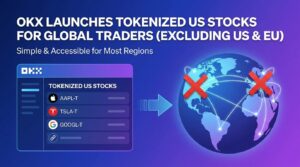
Crypto exchange OKX has rolled out its Unified Tokenized Stocks product, giving eligible traders access to more than 40 tokenized versions of US-listed equities and ETFs. The offering pairs tokens like XNVDA, XAAPL, and XTSLA against the USDT stablecoin, bridging traditional equity exposure with crypto-native infrastructure. But there’s a notable carve-out: users in the United States and the European Union are excluded from participation. The move positions OKX at the intersection of two fast-converging markets while sidestepping the jurisdictions most likely to challenge it.
What OKX’s Tokenized Stocks Launch Signals for Crypto-Equity Convergence
Tokenized equities have been discussed for years, yet adoption has remained stubbornly niche. OKX’s decision to go live with over 40 instruments suggests the exchange sees a viable demand corridor, particularly among traders in Asia, the Middle East, and Latin America who want dollar-denominated equity exposure without the friction of traditional brokerage accounts. Before unpacking the mechanics, here are the strategic takeaways worth watching.
- Geographic exclusion is the strategy, not the limitation. By barring US and EU users, OKX avoids the SEC’s jurisdiction and MiCA’s evolving tokenized securities framework. This isn’t a workaround; it’s a deliberate product-market fit decision targeting underserved regions.
- USDT as the settlement layer anchors the product in crypto liquidity rather than fiat rails, reducing banking dependency and enabling 24/7 trading cycles that traditional markets cannot match.
- The inclusion of ETFs alongside individual stocks (a distinction regulators have been slow to clarify in the tokenized context) broadens the appeal beyond speculative traders to those seeking diversified exposure.
- With 40+ instruments at launch, OKX is signaling scale ambitions. Most competitors in the tokenized stock space have launched with far fewer assets.
- Competitive pressure on rivals like Binance and Bybit intensifies, particularly in markets where regulatory clarity around tokenized securities remains thin.
How the Product Actually Works
Each tokenized stock on OKX represents a synthetic or backed claim on the underlying US equity, tradable in USDT pairs. The design allows crypto-native users to gain price exposure to companies like Nvidia, Apple, and Tesla without opening a securities account or navigating cross-border capital controls.
That’s the pitch, at least on paper.
What remains less clear is the precise custodial and backing structure. Whether these tokens are fully collateralized by the underlying shares, backed by derivatives, or structured as contracts for difference will matter enormously for institutional credibility. OKX has not published granular details on the reserve mechanism, and until it does, sophisticated traders will likely approach the product with calibrated caution. The OKX tokenized stocks trading platform lists the available instruments but leaves some structural questions unanswered.
Why the US and EU Are Excluded
Regulatory geography dictates this product’s boundaries. In the United States, tokenized securities fall under the SEC’s purview, and the agency has shown no appetite for approving offshore platforms offering equity-linked crypto products to American retail investors. The EU’s Markets in Crypto-Assets Regulation (MiCA), which entered full application in late 2024, introduces its own classification challenges for tokenized financial instruments.
By excluding both jurisdictions, OKX reduces its legal exposure considerably. Still, this creates an awkward dynamic: the stocks being tokenized are American, the stablecoin used for settlement is dollar-pegged, yet the product cannot be accessed by American or European users. Whether regulators in permitted jurisdictions will eventually raise their own objections is an open thread.
Regional Regulatory Landscape for Tokenized Securities
| Region | Regulatory Status | Access to OKX Tokenized Stocks |
|---|---|---|
| United States | SEC oversight; tokenized securities treated as securities | Excluded |
| European Union | MiCA framework; classification under review | Excluded |
| Southeast Asia | Varies by jurisdiction; generally permissive for offshore platforms | Eligible (subject to local rules) |
| Middle East (UAE, Bahrain) | Emerging frameworks with sandbox provisions | Eligible |
| Latin America | Limited enforcement; growing crypto adoption among retail users | Eligible |
The Broader Shift Toward On-Chain Equity Access
OKX isn’t operating in a vacuum. Tokenized real-world assets (RWAs), including equities, bonds, and commodities, have attracted increasing attention from both crypto-native firms and traditional financial institutions. BlackRock’s tokenized Treasury fund on Ethereum crossed $1 billion in assets under management earlier this year. Franklin Templeton and Securitize have made similar moves.
Yet there’s a meaningful difference between tokenizing a Treasury bill and tokenizing a volatile tech stock. The risk profile shifts, the regulatory scrutiny deepens, and the question of investor protection becomes harder to dismiss. OKX’s launch sits at the more aggressive end of this spectrum, offering leveraged exposure to equities through a crypto interface without the guardrails that traditional brokerages impose.
And while institutional players are tokenizing assets within regulated wrappers, OKX’s approach leans retail-first, targeting users who may not have alternative access to US equity markets.
What Traders Should Evaluate Before Engaging
For traders considering the product, several factors deserve scrutiny beyond the headline asset list.
- Counterparty risk: who holds the underlying assets, and under what legal framework?
- Liquidity depth in USDT pairs during off-hours or periods of equity market volatility
- Tax treatment in the trader’s home jurisdiction, which may classify tokenized stock gains differently from crypto trading profits
- Whether OKX provides transparent proof-of-reserves or third-party audits for the backing of each tokenized instrument
These aren’t theoretical concerns. The collapse of FTX’s synthetic stock offering in 2022 demonstrated what happens when tokenized equity products lack robust backing and transparent governance.
Frequently Asked Questions
What are tokenized stocks on OKX?
They are digital tokens representing price exposure to US-listed equities and ETFs, traded in USDT pairs on the OKX platform. They allow crypto traders to gain equity market exposure without a traditional brokerage account.
Why can’t US and EU users access this product?
Regulatory constraints in both jurisdictions make it impractical for OKX to offer tokenized securities to those users. The SEC treats such instruments as securities, and MiCA introduces classification requirements that the product may not yet satisfy.
Is this the same as buying actual shares?
No. Tokenized stocks provide price exposure but do not necessarily confer ownership rights, voting rights, or dividend entitlements associated with holding the underlying equity. The exact structure depends on OKX’s product design, which has not been fully disclosed.
How many assets are available at launch?
More than 40 tokenized US stocks and ETFs, including tokens tracking Nvidia, Apple, and Tesla.



