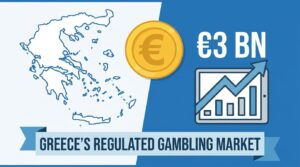
Greece’s gambling sector has crossed a significant revenue threshold. The Hellenic Gaming Commission (EEEP) published its annual report for 2025, confirming that total Gross Gaming Revenue reached €3.07 billion across the country’s regulated market. That figure marks a 6.7% year-on-year climb from 2024, driven largely by digital expansion and surprisingly durable retail performance. But the milestone arrives alongside mounting regulatory pressure that could reshape how operators do business in one of Southern Europe’s fastest-growing gaming jurisdictions.
What the €3 Billion Milestone Signals for Greek Gaming
Crossing the €3 billion GGR line is more than a round number. It positions Greece firmly among Europe’s mid-tier regulated markets and validates the licensing framework the EEEP has built since overhauling its regulatory structure. Before unpacking the broader implications, here are the core takeaways from the commission’s latest data:
- Total GGR hit €3.07 billion, a 6.7% increase over the prior year, suggesting sustained organic growth rather than a one-off spike
- Digital channels continued to gain share, reinforcing the shift in player behaviour that accelerated during and after the pandemic years
- Retail gambling operations held their ground, a pattern that defies the decline seen in several other European markets
- The regulator is tightening compliance and transparency requirements, creating a more demanding operating environment even as revenues climb
- Operators now face what amounts to a strategic paradox: record performance paired with rising costs of regulatory adherence
Digital Expansion as the Primary Growth Engine
Online gambling has been the dominant force behind Greece’s revenue trajectory for several consecutive years now. The Hellenic Gaming Commission’s regulatory framework for online operators has matured considerably since the first wave of licences were issued, and the market has responded. Player registrations on licensed platforms have grown, average spend per user has trended upward, and the product mix has diversified beyond sports betting into casino verticals and live dealer formats.
Still, the digital channel’s dominance raises questions that the EEEP’s report doesn’t fully resolve. How much of this growth reflects genuine market expansion versus migration from unlicensed offshore platforms? And at what point does digital saturation begin to flatten the curve? Greece hasn’t reached that inflection point yet (a distinction that separates it from more mature Nordic markets), but the trajectory suggests it could arrive sooner than some operators expect.
Retail Resilience: An Outlier in the European Context
What stands out in the Greek data is the strength of land-based operations. Across much of Western Europe, retail gambling revenue has been in structural decline. Greece tells a different story. Betting shops, VLT lounges, and casino floors continue to generate meaningful revenue, supported by consumer habits and a tourism economy that funnels foot traffic into physical venues.
This resilience matters for fiscal planning. Retail operations tend to generate higher per-location tax yields and employment figures than their digital equivalents. For policymakers weighing the balance between online liberalisation and land-based protection, Greece offers an unusual case study where both channels are growing simultaneously.
The Regulatory Tightening That Comes With Scale
Record revenue inevitably attracts record scrutiny. The EEEP has signalled clearly that its priorities are shifting from market-building toward market-policing. Responsible gambling frameworks, anti-money laundering protocols, advertising restrictions: all of these are being reinforced or expanded.
For operators, this creates a layered cost structure that didn’t exist five years ago. Compliance teams are growing. Technology investments in player protection tools are no longer optional. And the fiscal burden, already substantial through GGR-based taxation, shows no sign of easing.
One sentence captures the tension well: operators are generating more revenue than ever, yet margins are under pressure from obligations that scale alongside that revenue.
| Metric | 2024 | 2025 | Change |
|---|---|---|---|
| Total GGR | ~€2.88 billion | €3.07 billion | +6.7% |
| Digital sector trend | Strong growth | Continued acceleration | Gaining market share |
| Retail sector trend | Stable | Resilient | Holding ground against digital shift |
| Regulatory environment | Evolving | Tightening significantly | Higher compliance burden across all verticals |
How Operators Can Navigate a Dual-Pressure Market
Markets that grow and tighten at the same time demand a particular kind of strategic thinking. The temptation is to chase top-line revenue while treating compliance as a cost centre. But the operators most likely to sustain performance in Greece over the next three to five years will be those who reframe regulatory adherence as a competitive advantage rather than an overhead line.
Building trust with the regulator creates optionality. Operators with clean compliance records tend to receive faster licence renewals, face fewer operational disruptions, and gain preferential positioning when new product categories open up. In a market where the EEEP is actively consolidating its authority, that trust carries tangible commercial value.
Arguably, the smartest investment an operator can make right now isn’t in customer acquisition. It’s in the infrastructure that keeps regulators satisfied while the market continues to expand beneath them. Technology stacks that automate responsible gambling interventions, real-time transaction monitoring, and granular reporting capabilities are no longer differentiators. They are table stakes.
And there’s a psychological dimension worth considering. Players in regulated markets increasingly associate licensing and visible compliance markers with platform quality. The perception of safety drives retention. Operators who communicate their regulatory standing effectively, without veering into marketing language, can convert compliance investment into brand equity. That feedback loop between trust, retention, and revenue is where long-term margin protection lives.
Frequently Asked Questions
How large is Greece’s regulated gambling market in 2025?
Greece’s total Gross Gaming Revenue reached €3.07 billion in 2025, according to the Hellenic Gaming Commission’s annual report, reflecting a 6.7% increase from the previous year.
What is driving growth in Greek gambling revenue?
The digital sector has been the primary growth engine, with online betting and casino platforms expanding their player base and product offerings. Retail operations have also remained resilient, contributing meaningfully to overall GGR in a way that distinguishes Greece from several other European markets.
Are Greek gambling regulations becoming stricter?
Yes. The EEEP is intensifying its focus on responsible gambling, anti-money laundering compliance, and advertising standards. Operators face a growing cost of compliance alongside their revenue growth.
How does Greece compare to other European gambling markets?
At €3.07 billion in GGR, Greece sits in the mid-tier of European regulated markets. Its dual-channel growth pattern, where both online and retail are expanding, is relatively uncommon across the continent.



