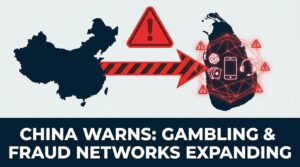
China’s Ministry of Public Security has flagged Sri Lanka as an emerging destination for online gambling syndicates and telecom fraud operations, warning that criminal groups previously concentrated in Southeast Asia are now shifting their base to the island nation. The alert comes amid intensifying Chinese efforts to dismantle cross-border fraud networks that have cost victims billions of dollars annually. Sri Lankan authorities face mounting pressure to respond, with the warning carrying diplomatic weight given Beijing’s significant economic leverage over Colombo.
What China’s Warning Signals for Sri Lanka’s Regulatory Landscape
The expansion of these networks into Sri Lanka is not random. Criminal enterprises follow gaps in enforcement, and the convergence of several factors arguably makes the country attractive: a developing digital infrastructure, limited cross-border policing capacity, and economic vulnerabilities that organised groups exploit for recruitment and cover operations. Before unpacking the broader implications, here are the core strategic takeaways.
- Geographic diversification of fraud networks: Groups that operated primarily in Myanmar, Cambodia, and the Philippines are actively seeking new jurisdictions with weaker regulatory oversight, and Sri Lanka has appeared on that list.
- Diplomatic and economic pressure: China’s public warning carries implicit expectations of cooperation. For Sri Lanka, already navigating complex debt obligations to Beijing, the political calculus around enforcement is layered.
- Telecom fraud and unlicensed online gambling operations tend to arrive together, sharing infrastructure, money-laundering channels, and recruitment pipelines.
- Reputational risk for Sri Lanka’s fintech ambitions: Any association with transnational fraud could undermine the country’s efforts to attract legitimate technology investment and develop its digital economy.
- Regional enforcement gaps: The warning highlights persistent weaknesses in South Asian cross-border policing frameworks that criminal organisations are designed to exploit.
How Southeast Asia’s Crackdown Pushed Networks South
For the past three years, China has led aggressive campaigns to disrupt online gambling and telecom scam compounds across Southeast Asia. Joint operations with Myanmar, Laos, and the Philippines dismantled dozens of compounds in 2023 and 2024, resulting in thousands of arrests and repatriations. But dismantling a compound is not the same as dismantling a network. The operators adapt. They relocate.
Sri Lanka presents a logical next step for groups under pressure. The country’s post-crisis economic fragility (a distinction that matters here, because financial desperation at the individual level feeds recruitment into these operations) creates conditions that mirror what these syndicates exploited in Cambodia and Myanmar. Workers lured by promises of legitimate employment find themselves trapped in fraud operations, a pattern documented extensively by the UN Office on Drugs and Crime.
Still, Sri Lanka is not Cambodia. The country has functioning democratic institutions and a judiciary that, at least on paper, can respond to these threats. Whether it will respond with sufficient speed is the harder question.
The Mechanics of Cross-Border Telecom Fraud
These operations typically involve large-scale call centres where workers, often trafficked or coerced, impersonate bank officials, law enforcement, or government agents to extract money from victims. The schemes target Chinese nationals primarily, though operations have expanded to defraud victims across multiple countries. Revenue flows through cryptocurrency channels, underground banking systems, and shell companies designed to obscure the money trail.
Online gambling operations run in parallel. Unlicensed platforms hosted on servers outside regulated jurisdictions process bets worth millions daily. The Chinese Ministry of Public Security has identified these gambling platforms as a primary vehicle for money laundering, with proceeds cycled back into funding further criminal activity.
Infrastructure Requirements These Groups Seek
| Requirement | Why It Matters | Sri Lanka’s Vulnerability Level |
|---|---|---|
| Affordable commercial real estate | Compounds need physical space for dozens or hundreds of workers | Moderate — post-crisis property market offers low-cost options |
| Reliable internet connectivity | VoIP-based fraud and online gambling platforms require stable bandwidth | Moderate to high — improving telecom infrastructure |
| Weak labour trafficking enforcement | Recruitment and coercion of workers depends on enforcement gaps | Variable — laws exist but enforcement capacity is stretched thin |
| Accessible banking or crypto channels | Revenue must be laundered quickly across borders | Growing — crypto adoption increasing without comprehensive regulation |
Sri Lanka’s Response: What Exists and What’s Missing
Sri Lankan law enforcement agencies have acknowledged the threat in broad terms, though concrete operational responses remain limited in public view. The country’s Computer Emergency Readiness Team (CERT) and the Criminal Investigation Department have the mandate to act, but resource constraints are real. A country still stabilising after its 2022 economic crisis cannot easily redirect scarce policing resources toward transnational cybercrime without external support.
And that support is precisely what China appears to be offering, or expecting. Joint policing agreements between Beijing and Colombo could accelerate, following the template China has established with INTERPOL-coordinated operations across Southeast Asia. Yet such agreements carry their own complexities around sovereignty, data sharing, and the treatment of suspects.
Why This Matters Beyond Law Enforcement
The arrival of organised fraud networks does not only create a policing problem. It reshapes how international investors, regulators, and multilateral institutions perceive a country. Sri Lanka’s efforts to rebuild credibility with the IMF, attract foreign direct investment, and develop a regulated digital economy all become harder if the country is associated with harbouring transnational criminal operations, even passively.
There is also a human dimension that policy discussions often flatten into statistics. Workers trafficked into these compounds face conditions that international organisations have described as modern slavery. The reputational damage is one thing. The human cost is another entirely.
Frequently Asked Questions
Why are online gambling and telecom fraud groups moving to Sri Lanka?
Intensified crackdowns across Southeast Asia have forced these networks to seek jurisdictions with less developed cross-border enforcement capacity. Sri Lanka’s economic vulnerabilities and improving digital infrastructure make it a target.
What types of fraud are involved?
Primarily large-scale telecom scams where operatives impersonate officials to defraud victims, alongside unlicensed online gambling platforms used for both direct revenue and money laundering. The two operations share infrastructure and funding channels.
Does Sri Lanka have laws to address this?
Yes, though enforcement remains the bottleneck. Existing legislation covers cybercrime and gambling offences, but the transnational nature of these operations demands coordination and resources that are currently limited.
What role is China playing?
China has been the most aggressive actor in pursuing these networks globally, driven by the fact that Chinese nationals are both primary victims and, in many cases, coerced participants. Beijing’s warning to Sri Lanka carries both cooperative and coercive undertones, depending on how one reads the diplomatic relationship.