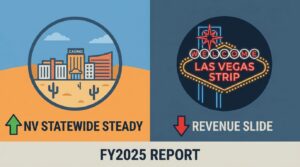
Nevada’s casino industry remained in the black through fiscal year 2025, though the performance was uneven. The Las Vegas Strip, long the engine of the state’s gaming economy, posted declining revenue that weighed on aggregate numbers. Statewide profitability held, but the gap between Strip performance and the rest of the market widened in ways that merit closer attention from operators and investors alike.
What Nevada’s FY2025 Numbers Signal for the Gaming Sector
The headline is reassuring: Nevada casinos, taken as a whole, stayed profitable. But beneath that surface, the data tells a more textured story about where growth is coming from and where it isn’t. Here are the strategic takeaways worth tracking:
- Strip revenue decline is structural, not seasonal. The downturn on the Las Vegas Strip wasn’t confined to a single quarter or driven by a one-off event. It persisted across the fiscal year, suggesting deeper shifts in visitor spending patterns or competitive pressure from other entertainment verticals.
- Non-Strip and regional markets picked up slack. Properties outside the Strip corridor, including downtown Las Vegas and regional Nevada markets, contributed enough to keep statewide figures positive.
- Margins held despite revenue softness, pointing to cost discipline among major operators.
- The diversification thesis is being tested. Operators who invested heavily in non-gaming amenities (hospitality, entertainment, F&B) are now navigating a period where those revenue streams need to compensate for softer table and slot performance.
- Regulatory and tax implications could follow if Strip revenue continues to underperform relative to state projections.
The Strip’s Drag on Statewide Performance
For decades, the Las Vegas Strip has functioned as Nevada’s fiscal backbone. When it thrives, the state thrives. When it stumbles, even modestly, the ripple effects reach budgets, employment figures, and investor sentiment across the sector.
In FY2025, that dynamic played out clearly. Strip gaming revenue declined year-over-year, and while the precise magnitude varies by property and segment, the trend was consistent enough to pull statewide growth into flatter territory. Major operators along the corridor, including those managing flagship resorts, reported softer win totals from both table games and electronic gaming devices.
Still, it would be premature to call this a crisis. The Strip remains enormously profitable in absolute terms. What changed is the trajectory. And in a market where investor expectations are calibrated to growth, flat or declining revenue reads differently than it might in a less scrutinized industry.
Regional Markets and Downtown: A Quiet Counterweight
Away from the neon intensity of the Strip, Nevada’s regional gaming markets turned in a steadier performance. Downtown Las Vegas, Reno, and several smaller markets posted results that, in aggregate, helped offset the Strip’s softness.
This isn’t entirely surprising. Regional casinos tend to serve a more local, repeat-visit customer base (a distinction that insulates them somewhat from the tourism volatility the Strip faces). Their cost structures are leaner, their capital expenditure cycles less aggressive, and their revenue mix often skews more heavily toward gaming rather than hospitality. That model proved resilient in FY2025. Whether it can sustain the weight of statewide expectations is another question entirely.
How Operators Are Responding to Shifting Demand
The major casino companies operating in Nevada have not been passive. Several have accelerated investments in non-gaming experiences, loyalty program enhancements, and digital engagement tools designed to capture a broader share of visitor wallets. Nevada’s regulatory framework for gaming operations continues to evolve alongside these strategies, though the pace of regulatory adaptation arguably lags behind market shifts.
Convention and events business has been one bright spot. Large-scale events, from trade shows to residencies and sporting fixtures, continue to drive visitation. But converting foot traffic into gaming revenue has grown harder. Younger demographics, in particular, allocate entertainment budgets differently than previous generations did. The slot floor competes with the nightclub, the restaurant, the retail experience.
Some operators are leaning into sports betting and iGaming adjacencies as a hedge. Others are doubling down on premium hospitality. Neither strategy has produced a clear winner yet.
Reading the Fiscal Signals: What Comes Next
Nevada’s gaming tax revenue, which funds a significant share of state services, depends heavily on Strip performance. A sustained decline, even a modest one, could force conversations about rate adjustments or broadened tax bases. At least on paper, the state has buffers. In practice, political appetite for gaming tax reform tends to emerge only after the numbers become impossible to ignore.
Investor sentiment will likely hinge on Q1 FY2026 data. If Strip revenue stabilizes or rebounds, the FY2025 dip may be remembered as a correction. If it deepens, expect analyst downgrades and a harder look at capital allocation strategies among the publicly traded operators.
The Psychology of Market Perception in Gaming
Beyond the raw numbers, there’s a psychological dimension to how these results land. In neuro-linguistic programming terms, the framing of “profitable but declining” triggers a fundamentally different response than “declining but still profitable.” The sequence matters. Operators and analysts who anchor their narratives on profitability first create a different cognitive frame than those who lead with the Strip’s revenue slide.
This matters for stakeholder communication. When a CEO frames quarterly results around resilience and margin discipline, the market processes the information through a lens of competence and control. When the same data is framed around revenue headwinds, the dominant association shifts toward risk and uncertainty. Both framings are accurate. Neither is complete.
For executives navigating earnings calls and investor presentations, the lesson is practical: specificity builds trust faster than optimism. Saying “our non-gaming revenue per available room increased 4%” anchors the audience in a concrete, verifiable outcome. Saying “we remain confident in our long-term strategy” does not. The former creates a sensory-rich mental model. The latter floats, unattached to anything the listener can evaluate. In a market where confidence is currency, the distinction between vague reassurance and grounded detail can move share prices.
Operators who understand this dynamic, who calibrate not just what they report but how they sequence and contextualize it, tend to maintain stronger relationships with institutional investors. Those who default to boilerplate language risk being tuned out precisely when attention matters most.
Frequently Asked Questions
Did Nevada casinos lose money in FY2025?
No. Nevada casinos remained profitable statewide. The concern centers on the Las Vegas Strip’s revenue decline, which dragged on overall growth rates without pushing the industry into losses.
Why did the Las Vegas Strip underperform?
Multiple factors appear to be at play, including shifting visitor spending habits, increased competition from non-gaming entertainment options, and evolving demographic preferences. No single cause has been officially identified.
Are regional Nevada casinos doing better than Strip properties?
In relative terms, yes. Regional markets and downtown Las Vegas posted steadier results, partly because their business models rely more on local, repeat customers and carry lower overhead.
Could this affect Nevada’s gaming tax revenue?
Potentially. If Strip revenue continues to soften over multiple fiscal years, state policymakers may need to revisit revenue projections and, possibly, tax structures. That conversation hasn’t started publicly yet.



