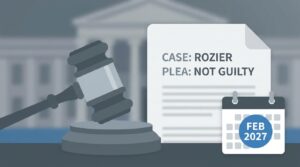
Former Miami Heat guard Terry Rozier entered a not guilty plea to federal charges, with a trial date now scheduled for February 8, 2027. The case marks one of the more prominent legal proceedings involving an active or recently active NBA player in recent memory. Rozier, who was traded to the Phoenix Suns during the 2023–24 season, faces allegations tied to a federal investigation that has drawn significant attention across professional basketball circles and sports law communities alike.
What the Not Guilty Plea Signals for Rozier’s Legal Strategy
The decision to plead not guilty and proceed toward a full trial suggests Rozier’s legal team intends to mount a substantive defense rather than seek a plea agreement, at least at this stage. That posture carries weight. Federal cases rarely go to trial — roughly 90% of federal defendants accept plea deals, according to data from the U.S. Sentencing Commission — which makes Rozier’s path a deliberate and notable choice.
Several factors likely shaped this approach:
- The strength (or perceived weakness) of the government’s evidence as disclosed during early proceedings
- Rozier’s willingness to accept the financial and reputational costs of a prolonged legal fight
- Strategic positioning ahead of potential pre-trial motions that could narrow the scope of charges
- His legal team’s assessment that a jury trial offers a more favorable outcome than negotiated terms
Still, a 2027 trial date means nearly two years of legal limbo. For a professional athlete whose career window is finite, that timeline alone carries consequences beyond the courtroom.
Career and Financial Implications
Rozier, now 30 years old, has earned more than $100 million across his NBA career. He spent three seasons with the Miami Heat’s roster before being dealt to Phoenix in a mid-season trade. Whether the ongoing federal case affects his standing with the Suns or his broader NBA future remains an open question — one the league has not publicly addressed.
The NBA’s collective bargaining agreement gives the league latitude to suspend players involved in criminal proceedings, though such actions typically follow convictions rather than indictments. On paper, Rozier retains his ability to play. In practice, the cloud of a federal trial creates complications that extend well beyond game-day availability: sponsorship relationships, team chemistry considerations, and front-office risk calculations all factor in.
| Factor | Current Status | Potential Impact |
|---|---|---|
| NBA eligibility | Active / no suspension | Could change post-conviction |
| Contract status | Under contract with Phoenix Suns | Trade value diminished during proceedings |
| Endorsement deals | Not publicly disclosed | Brands typically distance during federal cases |
| Trial timeline | February 8, 2027 | Extended uncertainty affecting career planning and public perception |
Why Federal Sports Cases Draw Outsized Scrutiny
Federal investigations involving professional athletes tend to attract a level of public and media attention disproportionate to the charges themselves (a dynamic that cuts both ways for the defendant). The scrutiny intensifies when the case touches on gambling, financial fraud, or conduct that intersects with league integrity policies. And while the specific nature of the allegations against Rozier has not been fully detailed in public filings, the federal venue alone signals prosecutorial seriousness.
This case arrives during a period when U.S. professional sports leagues are navigating an increasingly complex relationship with legalized gambling, financial compliance, and player conduct oversight. The NBA expanded its gambling partnerships significantly over the past five years, which arguably raises the stakes for any integrity-related investigation involving a player.
The Psychological Dimension: Performing Under Legal Pressure
Beyond courtrooms and contracts, there’s a dimension to cases like this that rarely gets adequate attention. Professional athletes operate in environments where mental clarity and emotional regulation directly affect performance. A federal indictment introduces a sustained cognitive burden that no amount of talent can fully compartmentalize.
Research in sports psychology consistently shows that off-court stressors — legal proceedings, family disruptions, financial anxiety — correlate with measurable declines in on-court decision-making and reaction time. The effect isn’t always dramatic. Sometimes it surfaces as hesitation on a play that once felt instinctive, or a fractional delay in processing defensive schemes. Rozier built his career on quick-twitch guard play and high-pressure shot-making, skills that depend on a clear mental bandwidth.
Athletes facing prolonged uncertainty often benefit from structured psychological support frameworks: cognitive behavioral techniques to manage intrusive thoughts during competition, visualization protocols that separate courtroom anxiety from game preparation, and controlled breathing methods designed to regulate the autonomic nervous system during high-stress moments. Whether Rozier has access to or is utilizing such resources hasn’t been disclosed, but teams and player associations increasingly recognize that legal entanglements demand more than just a good attorney. They demand a support architecture that addresses the whole person.
The capacity to reframe adversity — viewing the trial preparation period not as a sentence but as a defined chapter with boundaries — can materially affect how an athlete navigates the months ahead. That reframing isn’t denial. It’s a deliberate cognitive strategy that high-performers across disciplines use to maintain function under conditions that would paralyze most people.
Frequently Asked Questions
What charges does Terry Rozier face?
The full scope of federal charges has not been comprehensively detailed in public reporting. Rozier has pleaded not guilty to the charges filed against him, and his legal team appears prepared to contest them at trial.
Can Rozier continue playing in the NBA during the trial?
Yes. Under current NBA rules and the collective bargaining agreement, a player is generally permitted to continue playing while facing charges. Suspension typically follows a conviction, not an indictment, though the league retains discretionary authority.
Why is the trial date set so far in the future?
Federal cases often involve extended pre-trial periods for discovery, motions, and procedural preparation. A February 2027 date, while distant, is not unusual for complex federal proceedings. Both sides need time to build their cases.
How might this affect the Phoenix Suns?
The Suns face a situation where one of their players carries significant legal uncertainty. Front offices weigh these risks when making roster and trade decisions, and the prolonged timeline complicates long-term planning in ways that are difficult to quantify publicly.