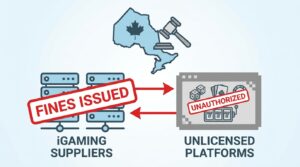
Ontario’s Alcohol and Gaming Commission (AGCO) has penalized two registered iGaming suppliers whose casino games were found operating on unlicensed gambling websites accessible to Ontario residents. The enforcement action underscores the province’s increasingly assertive stance toward supply-chain accountability in its regulated online gambling market. Both suppliers face financial penalties and compliance orders, marking a notable escalation in how Ontario regulators treat the distribution chain behind unauthorized gambling content.
What the Penalties Signal for Ontario’s iGaming Supply Chain
These fines land at a moment when Ontario’s regulated iGaming market is maturing rapidly, yet grey-market leakage remains a persistent irritant for regulators and licensed operators alike. The enforcement actions carry implications well beyond the two companies involved.
- Supply-side enforcement is now real: Ontario has shifted from targeting unlicensed operators to holding registered suppliers directly responsible for where their content ends up
- The penalties establish a precedent that game developers and aggregators cannot passively allow their products to appear on unauthorized sites serving Ontario players
- Compliance obligations extend beyond direct contracts — suppliers must actively monitor and control downstream distribution of their games
- Licensed operators in Ontario’s market gain a competitive signal: the regulator is working to close the gap between regulated and unregulated offerings
- Other Canadian provinces watching Ontario’s model now have a template for supply-chain accountability measures
How the Violations Were Identified
The AGCO discovered that casino games developed or distributed by the two suppliers were accessible on websites not registered under Ontario’s iGaming framework. Under the province’s regulatory structure, any entity supplying games to operators serving Ontario residents must be registered with the AGCO and operate exclusively through iGaming Ontario’s regulated marketplace. Games appearing outside that framework represent a direct breach of registration conditions.
What makes these cases particularly instructive is the question of intent versus negligence. The AGCO has not publicly alleged that either supplier deliberately placed games on unlicensed platforms. In practice, the issue often traces back to third-party aggregators or distribution agreements that predate a supplier’s entry into the Ontario market. But the regulator’s position is unambiguous: registration carries an obligation to control your product’s footprint.
That distinction matters.
Regulatory Architecture Behind the Action
Ontario launched its open iGaming market in April 2022, allowing private operators to offer legal online casino and sports betting products under AGCO oversight. The framework requires three tiers of registration: operators, gaming-related suppliers, and the games themselves. Suppliers who hold AGCO registration agree to a set of conditions that include ensuring their products do not appear on platforms operating outside the regulated environment.
The penalties issued here fall under the AGCO’s authority to impose monetary fines, issue compliance orders, or revoke registrations entirely. While revocation was not pursued in either case (a detail worth noting, given the severity that option would carry), the financial penalties and public disclosure serve as a calibrated warning. Other registered suppliers are now on notice that passive distribution oversight will not satisfy the regulator.
| Regulatory Requirement | Supplier Obligation | Consequence of Breach |
|---|---|---|
| AGCO Registration | Maintain active registration; comply with all conditions | Fines, compliance orders, or registration revocation |
| Distribution Control | Ensure games appear only on licensed Ontario platforms | Monetary penalties and public disclosure |
| Reporting | Notify AGCO of any unauthorized use of registered content | Potential escalation of enforcement action |
| Third-Party Agreements | Contractually restrict downstream distribution to regulated channels | Supplier bears responsibility regardless of intermediary actions |
Why Supply-Chain Accountability Reshapes Market Dynamics
For years, regulatory enforcement in online gambling focused almost exclusively on operators. Suppliers occupied a comparatively comfortable position: build the games, license them out, collect revenue. Ontario’s approach disrupts that arrangement by treating suppliers as co-responsible for the regulatory status of every platform hosting their content. Arguably, this reflects a broader shift in how digital regulators think about platform ecosystems, not just in gambling but across fintech, content distribution, and data services.
The practical effect is that suppliers operating in Ontario must now audit their distribution networks with a level of diligence that many have not historically applied. Contracts with aggregators and white-label partners need explicit geographic restrictions. Monitoring systems must flag when games surface on domains not tied to a registered operator. And when violations occur, the supplier’s response time and remediation efforts will likely influence the severity of any regulatory action.
Still, enforcement alone won’t eliminate grey-market supply leakage. Some game content reaches unauthorized platforms through technical replication or API exploitation rather than formal distribution agreements. Whether the AGCO expects suppliers to police those scenarios too remains an open question, one the regulator has not yet addressed in public guidance.
Strategic Considerations for iGaming Suppliers
The Ontario enforcement actions arrive as several other jurisdictions are tightening their own supply-chain rules. Suppliers with multi-market ambitions should treat this moment as an inflection point rather than an isolated regulatory event. A few operational priorities stand out:
- Audit all active distribution agreements for geographic scope and platform-registration requirements
- Implement automated monitoring to detect game content appearing on unregistered domains
- Establish internal escalation protocols so that unauthorized appearances trigger immediate contractual and technical remediation
- Engage proactively with the AGCO — self-reporting a distribution breach before the regulator discovers it may influence penalty outcomes
Frequently Asked Questions
What did the Ontario regulator penalize the suppliers for?
The AGCO fined two registered iGaming suppliers because their casino games were found on unlicensed gambling websites accessible to Ontario residents, breaching the conditions of their supplier registrations.
Can suppliers lose their Ontario registration over this type of violation?
Yes. The AGCO has the authority to revoke registrations, though in these cases it opted for monetary fines and compliance orders instead. Repeated violations or failure to remediate could trigger more severe action.
Does this affect operators or just suppliers?
Directly, these penalties target suppliers. But the signal extends to operators as well: the AGCO is scrutinizing the entire value chain, and operators partnering with non-compliant suppliers face their own reputational and regulatory risk.
How does Ontario’s approach compare to other jurisdictions?
Ontario’s supply-chain enforcement is among the more aggressive models globally. While the UK Gambling Commission and Malta Gaming Authority impose supplier obligations, Ontario’s willingness to publicly fine registered suppliers for downstream distribution failures sets a particularly direct precedent.