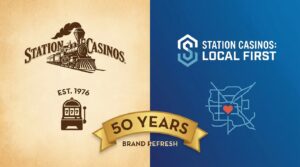
Station Casinos, the Las Vegas-based gaming operator that built its reputation serving locals rather than tourists, is leveraging its 50th anniversary to roll out a visual rebrand. The refresh touches everything from logos to property signage across its portfolio of neighborhood-oriented casinos in the Las Vegas Valley. But this isn’t a pivot. It’s a reaffirmation: the company is doubling down on the community-driven model that has defined it since 1976.
What the 50th Anniversary Rebrand Signals for Station Casinos
Milestone anniversaries in gaming often serve as convenient pretexts for strategic repositioning. In Station Casinos’ case, the visual overhaul arrives at a moment when the Las Vegas locals market is more competitive than ever, with new entrants and expanded tribal gaming options reshaping the landscape across the American Southwest.
- Brand continuity over disruption: The updated identity retains core visual elements while modernizing typography and color palettes, signaling evolution rather than reinvention.
- The rebrand spans the company’s full portfolio, including Red Rock Casino, Green Valley Ranch, and Palace Station, suggesting centralized brand governance across properties.
- Locals-market commitment: Rather than chasing convention traffic or international high rollers, Station Casinos is reinforcing its positioning as the default entertainment option for Las Vegas residents.
- Operational timing: The refresh coincides with ongoing capital investment in property upgrades, tying cosmetic identity changes to tangible guest-experience improvements.
A Half-Century Built on a Different Kind of Gamble
When Frank Fertitta Jr. opened the first Palace Station (then called The Casino) on Sahara Avenue in 1976, the conventional wisdom in Las Vegas gaming pointed toward the Strip. Tourists were the prize. Locals were an afterthought. Station Casinos bet otherwise, and that bet paid off across five decades.
The company’s model was deceptively simple: build casinos where Las Vegas residents actually live, offer better odds on video poker, run loyalty programs that reward frequency over flash, and make the buffet worth coming back for. That formula grew a single property into a network of more than a dozen gaming and entertainment destinations scattered across the valley’s suburban corridors.
Today, Station Casinos operates under its parent company Red Rock Resorts, which trades on the Nasdaq under the ticker RRR. The Fertitta family retains significant control, a governance structure that has allowed the company to pursue long-horizon strategies without the quarter-to-quarter pressure that publicly traded peers often face (a distinction that arguably gives them more room to invest in brand rather than just yield).
Why the Locals Market Deserves a Closer Look
Strip-focused operators dominate headlines. Yet the locals segment in Las Vegas has quietly outperformed in several key metrics over the past decade, particularly in gaming revenue per square foot and customer retention rates. Clark County’s population growth, which added roughly 300,000 residents between 2010 and 2023, provides a structural tailwind that tourist-dependent operators simply don’t enjoy.
Station Casinos has been a primary beneficiary. Its properties function less like destination resorts and more like community hubs: part casino, part movie theater, part bowling alley, part neighborhood restaurant cluster. The rebrand reinforces this identity at a time when newer competitors are attempting to replicate it.
Still, challenges persist. Rising construction costs have slowed expansion timelines. And while population growth fuels demand, it also attracts competition from operators who see the same demographic data.
The Psychology Behind Rebranding at Scale
Rebranding is never purely cosmetic. From a neuro-linguistic programming perspective, the way a brand presents itself shapes how customers unconsciously categorize their relationship with it. Station Casinos’ decision to modernize its visual identity while preserving familiar brand architecture is a textbook anchoring technique: it triggers existing positive associations (comfort, familiarity, local belonging) while layering on signals of progress and investment.
This matters because loyalty in the locals gaming market operates differently than on the Strip. Tourist-facing brands compete on spectacle. Locals brands compete on trust. When a regular at Green Valley Ranch sees updated signage and a refreshed logo, the implicit message isn’t “we’ve changed.” It’s “we’re still here, and we’re investing in you.” That distinction is subtle but commercially significant.
Consider the framing effect at work. A 50th anniversary positions the company as an institution, not just a business. Institutions carry weight. They suggest permanence, reliability, and deep roots. For a customer deciding between a Station property and a newer competitor, that psychological frame can tip the decision before any rational comparison of odds or amenities even begins.
The visual refresh also serves an internal function. Employees across dozens of properties receive a tangible signal that the organization is moving forward. In hospitality, where frontline staff turnover remains stubbornly high, these signals contribute to retention in ways that don’t always show up on a balance sheet.
What Comes After the Logo Change
A rebrand without operational follow-through is wallpaper. Station Casinos appears to understand this. Capital expenditure disclosures from Red Rock Resorts indicate ongoing property renovations at several key locations, including expanded dining options and upgraded hotel rooms at flagship properties.
Whether the refreshed brand identity translates into measurable gains in market share or customer acquisition will depend on execution at the property level. The logo is the easy part. The harder question is whether the company can maintain its local-first ethos as it scales, particularly if population growth continues to reshape the competitive dynamics of the Las Vegas Valley.
Frequently Asked Questions
What is Station Casinos’ 50th anniversary rebrand?
Station Casinos is updating its visual identity across all properties to mark its 50th year of operations. The refresh includes modernized logos, signage, and brand elements while maintaining the company’s established local-market positioning.
Who owns Station Casinos?
Station Casinos operates as a subsidiary of Red Rock Resorts, Inc., a publicly traded company controlled by the Fertitta family. The stock trades on the Nasdaq under the ticker RRR.
How many properties does Station Casinos operate?
The company runs more than a dozen gaming and entertainment properties throughout the Las Vegas Valley, including well-known locations like Red Rock Casino Resort & Spa, Green Valley Ranch Resort, and Palace Station.
Why does Station Casinos focus on locals instead of tourists?
The locals-first strategy dates back to the company’s founding in 1976. By building properties in residential areas and offering loyalty programs tailored to frequent visitors, Station Casinos carved out a niche that has proven resilient through multiple economic cycles. Clark County’s sustained population growth continues to validate that approach.



