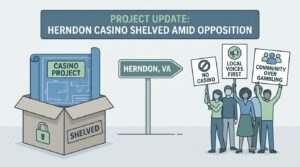
A proposed casino development in Herndon, Virginia, has been placed on hold after mounting resistance from local residents and community groups forced a strategic pause. The project, which aimed to bring a full-scale gaming facility to Northern Virginia, ran into a wall of public opposition that proved difficult to navigate. While the specifics of the developer’s long-term plans remain uncertain, the decision marks a significant setback for casino expansion efforts in one of the most economically dynamic corridors on the East Coast.
What the Herndon Casino Pause Signals for Northern Virginia
The shelving of this project carries implications well beyond a single municipality. Northern Virginia sits at the intersection of federal government proximity, tech-sector wealth, and rapid suburban growth, making it both an attractive and politically sensitive target for gaming operators. Here’s what matters most from a strategic standpoint:
- Community veto power remains potent: Even in high-revenue jurisdictions, organized local opposition can stall or kill casino proposals before they reach a formal approval stage.
- Virginia’s gaming expansion faces uneven terrain: While casinos in Bristol, Norfolk, and Danville have moved forward, Northern Virginia’s demographic and political profile presents a fundamentally different challenge.
- Developers may need to rethink engagement strategies entirely, shifting from announcement-first models to community-embedded approaches that build support before plans go public.
- Regulatory uncertainty compounds the risk: Without clear local buy-in, state-level gaming authorities have little incentive to fast-track licensing or approval processes for contested projects.
Why Herndon Pushed Back
Opposition to the casino didn’t materialize overnight. Residents raised concerns about traffic congestion, the social costs associated with gambling, and what many described as a fundamental mismatch between a casino and the town’s suburban character. Herndon, a community of roughly 24,000 people in Fairfax County, has spent years cultivating a reputation as a family-oriented town with a growing but carefully managed commercial base.
That identity proved difficult to reconcile with a large-scale gaming facility. And while proponents pointed to job creation and tax revenue, those arguments failed to gain traction against a well-organized coalition of residents who showed up to public meetings, circulated petitions, and pressured local officials.
The dynamic is not unique to Herndon (a pattern that has repeated across suburban communities nationwide), but the speed and intensity of the backlash here caught some observers off guard.
Virginia’s Broader Casino Landscape
Virginia legalized casinos in 2020, opening the door for up to five resort-style gaming facilities across the commonwealth. Four cities were initially designated: Bristol, Danville, Norfolk, and Portsmouth. A fifth location in Richmond was rejected by voters in a 2021 referendum, though a second attempt passed in 2023.
Northern Virginia was never part of that original legislative framework. Any casino proposal in the region would require either new legislation or creative structuring under existing law. That makes the political calculus considerably more complex.
| Location | Status | Key Developer |
|---|---|---|
| Bristol | Operational (Hard Rock) | Hard Rock International |
| Danville | Under construction | Caesars Entertainment |
| Norfolk | Under construction | Pamunkey Indian Tribe / Boyd Gaming |
| Portsmouth | Operational (Rivers Casino) | Rush Street Gaming |
| Richmond | Approved via 2023 referendum | Urban One |
| Herndon / NoVA | On hold — no legislative pathway confirmed | Undisclosed |
The contrast is stark. Projects in economically distressed areas like Bristol and Danville were welcomed as engines of revitalization. In affluent Northern Virginia, the value proposition looks entirely different, and residents have made clear they aren’t buying it.
How Community Framing Shapes Casino Outcomes
What happened in Herndon illustrates something that gaming industry executives and municipal planners often underestimate: the framing of a proposal matters as much as its economics. When a casino is presented as a lifeline for a struggling community, acceptance tends to follow. When it’s introduced into a thriving suburb without a compelling narrative of need, resistance builds fast.
Neurolinguistic research into decision-making suggests that people evaluate proposals not purely on data but through the lens of identity and belonging. Residents who see their community as quiet, safe, and family-centered will process a casino proposal as a threat to that self-image, regardless of projected tax revenues or employment numbers. The language used in early-stage outreach, the visual framing of architectural renderings, even the timing of public announcements all shape whether a community perceives a project as aligned with or hostile to its values.
Developers who ignore this dynamic do so at their own cost. Successful casino proposals in contested markets have typically involved years of relationship-building, transparent community benefit agreements, and a willingness to modify plans based on genuine feedback rather than token consultation. The Herndon episode suggests that none of those steps were adequately taken. Whether the project’s backers attempt a second approach with a revised strategy remains an open question, but the playbook for doing so is well-documented in jurisdictions from Massachusetts to Michigan.
Still, even the best community engagement can’t overcome a fundamental misalignment between a project and its proposed location. Some markets simply aren’t ready, and some never will be.
What Comes Next for Casino Expansion in the Region
The Virginia Lottery and Gaming Control framework currently governs the state’s casino licensing process, but Northern Virginia sits outside the existing statutory map. Any future attempt to bring a casino to Fairfax County or surrounding jurisdictions would likely require legislative action in Richmond, a prospect that carries its own political risks for lawmakers representing affluent suburban districts.
Operators eyeing the region may pivot toward smaller-format gaming concepts, entertainment-integrated venues, or sports betting partnerships that carry less community friction. But a full-scale resort casino in Northern Virginia? That timeline just got considerably longer.
Frequently Asked Questions
Why was the Herndon casino project put on hold?
Local residents organized significant opposition, citing concerns about traffic, gambling-related social costs, and incompatibility with the town’s suburban character. The developer paused the project in response.
Is casino gambling legal in Virginia?
Yes. Virginia legalized casino gaming in 2020, with facilities approved in Bristol, Danville, Norfolk, Portsmouth, and Richmond. Northern Virginia, however, is not currently part of the state’s designated casino framework.
Could a casino still come to Northern Virginia?
In theory, yes, but it would almost certainly require new state legislation and strong local support. Neither condition appears imminent given the current political environment and the Herndon experience.
How does community opposition typically affect casino projects?
It can delay, reshape, or permanently block them. Richmond’s initial casino referendum failed in 2021 before passing on a second attempt two years later. Herndon’s situation may follow a similar trajectory, or the project may not resurface at all.



