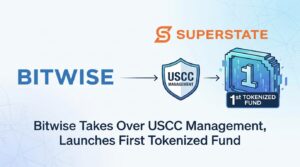
Bitwise is set to assume the role of investment manager for the USCC tokenized fund on June 1, a move that represents the firm’s inaugural entry into tokenized fund management. The transition also marks the second time this year that Superstate has handed off a fund to a larger asset manager, signaling a broader pattern in how tokenized financial products are maturing and migrating toward institutional-grade operators. For an industry still defining its infrastructure, this handoff carries weight beyond the two firms involved.
What the USCC Transition Signals for Tokenized Asset Management
The shift isn’t just administrative. When a crypto-native asset manager like Bitwise steps into the management of a tokenized fund originally built by a protocol-focused firm like Superstate, it reflects a quiet but meaningful consolidation in the tokenized securities space. A brief look at what this means in practice:
- First tokenized fund for Bitwise: This expands Bitwise’s product suite beyond its established crypto index and spot ETF offerings into on-chain structured products.
- Superstate’s second handoff this year: A pattern is forming. Superstate appears to be functioning increasingly as an incubator rather than a long-term operator of tokenized funds.
- The June 1 effective date suggests regulatory and operational groundwork has already been completed, pointing to a smoother institutional onboarding process than many expected.
- Institutional credibility boost: Bitwise brings distribution reach and compliance infrastructure that could accelerate USCC’s adoption among allocators who previously viewed tokenized funds with skepticism.
Why Superstate Keeps Letting Go
Superstate, founded by former Compound Finance founder Robert Leshner, has positioned itself at the intersection of DeFi infrastructure and traditional finance. Its approach to building tokenized products and then transitioning management to established asset managers is, arguably, more venture studio than fund house. That two such transitions have occurred within a single calendar year suggests this is deliberate strategy, not retreat.
The logic is straightforward enough. Building a tokenized fund requires deep protocol-level expertise. Scaling it requires something else entirely: compliance teams, distribution networks, and the kind of brand recognition that makes institutional allocators comfortable. Superstate builds. Bitwise scales. Whether this division of labor becomes a template for the broader tokenized fund ecosystem remains an open question.
Bitwise’s Expanding Footprint
For Bitwise, which has built its reputation on crypto index funds and spot Bitcoin ETF products, managing a tokenized fund is a lateral move with strategic depth. The firm already manages billions in crypto assets and has cultivated relationships with financial advisors and institutional investors who are increasingly asking about on-chain yield products and tokenized treasuries.
USCC fits neatly into that demand profile. Still, managing a tokenized fund introduces operational considerations that differ from traditional crypto fund management (a distinction regulators have been slow to enforce). Custody, on-chain settlement, smart contract risk, and token-level compliance all require infrastructure that Bitwise will need to demonstrate it can handle at scale.
And the timing matters. Tokenized U.S. Treasuries and similar products have attracted over $2 billion in assets across various platforms in 2024 and 2025, with BlackRock’s BUIDL fund and Franklin Templeton’s on-chain money market fund leading the charge. Bitwise entering this arena now positions it alongside, not behind, the largest players in traditional finance experimenting with blockchain-based fund structures.
How This Reshapes Competitive Dynamics
| Factor | Superstate (Pre-Handoff) | Bitwise (Post-Handoff) |
|---|---|---|
| Core Competency | Protocol design, tokenization architecture | Asset management, distribution, regulatory compliance |
| Target Audience | DeFi-native users, early adopters | Financial advisors, institutional allocators, RIAs |
| Operational Scale | Lean, builder-focused | Multi-billion AUM infrastructure already in place |
| Regulatory Positioning | Emerging | Established SEC-registered investment adviser with a longer compliance track record |
The Broader Reframing: Tokenized Funds as Institutional Products
What’s happening here extends well beyond two firms swapping roles. The tokenized fund market is entering a phase where the builders and the operators are separating into distinct layers. Early-stage protocol teams create the product. Institutional managers take over once the product proves viable. This mirrors, in some ways, how traditional finance has always worked: boutique shops originate, larger firms distribute.
But the blockchain layer adds complexity. On-chain transparency means investors can verify holdings in real time. Smart contract governance introduces automation that traditional fund administration hasn’t fully reckoned with. And the regulatory framework, at least on paper, hasn’t caught up with the pace of product innovation. Bitwise stepping into USCC management doesn’t resolve these tensions. It does, however, suggest that serious capital allocators are willing to operate within them.
One sentence worth sitting with: if Superstate’s model works, it could become the Y Combinator of tokenized finance, spinning up funds and handing them off to managers with the infrastructure to grow them.
Frequently Asked Questions
What is USCC?
USCC is a tokenized fund originally managed by Superstate, designed to offer on-chain exposure to structured financial products. Bitwise will take over its management starting June 1.
Why is Bitwise taking over management from Superstate?
Superstate appears to be operating as a builder and incubator of tokenized funds, transitioning operational management to larger asset managers once products reach a stage where institutional-grade distribution and compliance infrastructure become critical. Bitwise brings both.
Is this Bitwise’s first tokenized product?
Yes. While Bitwise manages several crypto index funds and has filed for spot crypto ETFs, USCC represents its first foray into managing a tokenized on-chain fund.
What does this mean for investors in USCC?
Existing investors should expect continuity in the fund’s investment strategy, with enhanced operational infrastructure and potentially broader distribution access through Bitwise’s established advisor and institutional networks. The transition date is June 1, and no disruption to fund operations has been indicated.



