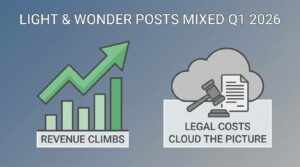
Light & Wonder delivered a Q1 2026 that defied easy categorisation. The cross-platform games company reported higher consolidated revenue and EBITDA growth across its core segments, yet the quarter’s bottom line took a hit from mounting legal expenses that tempered investor enthusiasm. The results underscore a company in transition, scaling its digital and gaming operations while navigating a litigation landscape that refuses to quiet down.
What Light & Wonder’s Q1 2026 Numbers Signal for the Gaming Sector
Before diving into the specifics, it helps to frame what this quarter actually reveals. Light & Wonder sits at the intersection of land-based gaming, digital iGaming, and SciPlay’s social casino business. Each of those verticals moved in a different direction during Q1, and the strategic implications are worth isolating.
- Revenue growth persisted across segments, suggesting that underlying demand for Light & Wonder’s content library and hardware remains robust despite broader macroeconomic headwinds.
- EBITDA expansion signals improving operational leverage, particularly in the digital division where margins tend to widen as content scales across jurisdictions.
- Legal costs acted as a material drag on net income, raising questions about how long litigation-related expenses will suppress profitability.
- The quarter reinforces a pattern: Light & Wonder can grow the top line, but converting that growth into shareholder returns depends on factors partially outside management’s control.
Revenue and EBITDA: The Upside Story
Light & Wonder’s consolidated revenue rose year-over-year in Q1 2026, driven by strength in its Gaming and SciPlay divisions. The Gaming segment, which encompasses slot machines, table systems, and related services sold to casinos worldwide, benefited from continued demand for premium cabinet placements. Operators have been refreshing their floors, and Light & Wonder’s newer titles appear to be earning favourable positioning.
SciPlay, the company’s social gaming arm, also contributed positively. Its revenue trajectory has been steadier than some analysts expected, partly because social casino games tend to be less cyclical than their real-money counterparts. And while the digital iGaming segment remains smaller in absolute terms, its growth rate outpaced the other two divisions, a trend consistent with the broader expansion of regulated online gambling markets in North America and parts of Europe.
EBITDA growth across the business reflects not just higher revenue but also tighter cost discipline in areas like content development and platform infrastructure. That said, the EBITDA figure excludes certain one-time items (a distinction worth watching in future quarters, as the line between recurring and non-recurring costs can blur).
How Legal Expenses Reshaped the Quarter
Here is where the narrative fractures. Despite operational momentum, Light & Wonder’s legal costs during Q1 2026 were significant enough to offset much of the earnings improvement. The company has been involved in multiple litigation matters, some related to intellectual property disputes and others tied to regulatory compliance in various jurisdictions.
What remains less clear is whether these costs represent a peak or a plateau. Management has historically characterised such expenses as episodic, but the frequency and scale suggest something more structural. For a company generating the kind of revenue Light & Wonder does, absorbing legal costs is manageable. The concern is more about predictability. Investors pricing in EBITDA growth need to know how much of that growth actually reaches the bottom line.
Still, the company has not disclosed settlement reserves or specific case outcomes that might signal resolution timelines.
Digital Expansion and the Broader Competitive Landscape
Light & Wonder’s digital gaming and cross-platform strategy continues to be its most compelling long-term narrative. The iGaming segment’s growth aligns with regulatory tailwinds in states like New Jersey, Michigan, and Pennsylvania, where online casino revenue has been climbing steadily. In Europe, the company has expanded its content distribution agreements with several tier-one operators.
But competition in the digital content supply space is intensifying. Rivals like Evolution, Pragmatic Play, and NetEnt parent Evolution AB are all vying for the same operator shelf space. Light & Wonder’s advantage arguably lies in its hybrid model: it can bundle land-based hardware relationships with digital content deals, offering operators a single-vendor solution that pure-play digital suppliers cannot match.
| Segment | Q1 2026 Revenue Trend | Key Driver |
|---|---|---|
| Gaming | Up year-over-year | Premium cabinet demand, floor refresh cycles |
| SciPlay | Steady growth | Resilient social casino engagement |
| Digital iGaming | Fastest-growing segment | North American regulatory expansion, new content launches |
Strategic Framing: Reading Between the Numbers
Quarterly results like these reward careful interpretation over headline scanning. Light & Wonder’s operational engine is clearly functioning. Revenue is climbing. EBITDA margins are expanding. The product pipeline, particularly in digital, positions the company well for a market that is structurally growing.
Yet the legal overhang introduces a variable that financial models struggle to capture cleanly. Litigation costs are inherently lumpy, and their timing rarely aligns with the cadence of earnings expectations. For executives and institutional investors evaluating Light & Wonder’s trajectory, the question is not whether the company can grow. It can. The harder question is whether the current share price already reflects that growth, or whether legal risk creates a discount that the market has yet to fully resolve.
One way to think about this: operational performance is a signal of capability, while legal costs are a signal of environment. Both matter, but they respond to different levers. Management can control product quality and market expansion. It has far less control over courtroom timelines.
Frequently Asked Questions
Did Light & Wonder’s revenue increase in Q1 2026?
Yes. Consolidated revenue grew year-over-year, with contributions from all three major segments: Gaming, SciPlay, and the digital iGaming division.
What caused the earnings drag in Q1 2026?
Elevated legal expenses were the primary factor suppressing net income despite top-line and EBITDA growth. The company is involved in multiple ongoing litigation matters across intellectual property and regulatory domains.
Which segment grew fastest?
Digital iGaming outpaced both Gaming and SciPlay in growth rate, driven by expansion in regulated North American markets and new content distribution agreements in Europe. In absolute revenue terms, Gaming remains the largest segment.
Is Light & Wonder profitable?
The company generated positive EBITDA in Q1 2026 and has been operationally profitable. Net profitability, however, was constrained by legal costs during the quarter, making the full-year outlook harder to pin down with precision.