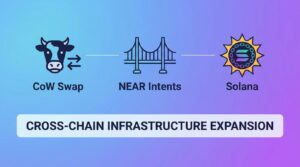
CoW Swap, the intent-based decentralized exchange that built its reputation on Ethereum’s MEV-protection landscape, is making a significant cross-chain leap. The protocol announced its expansion to the Solana blockchain, with NEAR Intents serving as the backend infrastructure connecting the two ecosystems. The move marks one of the more ambitious interoperability plays in DeFi this year, bridging an Ethereum-native trading protocol with Solana’s high-throughput architecture through a third-party intent layer. For traders and liquidity providers on both chains, the implications are immediate.
What CoW Swap’s Solana Expansion Signals for Cross-Chain DeFi
This isn’t simply a deployment on a new chain. The architecture behind the move matters as much as the destination. A brief look at what stands out:
- Intent-based execution reaches Solana: CoW Swap’s solver model, which matches user intents off-chain before settling on-chain, now operates across two fundamentally different blockchain architectures
- NEAR as invisible middleware: NEAR Intents functions as the cross-chain coordination layer, handling the routing and settlement logic without requiring users to interact with the NEAR blockchain directly
- The expansion positions CoW Swap against Solana-native aggregators like Jupiter, though the competitive dynamics will hinge on execution quality and MEV protection rather than speed alone
- Liquidity fragmentation gets a partial answer: by enabling solvers to source liquidity across Ethereum and Solana simultaneously, the protocol reduces one of DeFi’s most persistent structural problems
- For NEAR Protocol, this validates its pivot toward chain-abstraction infrastructure, a bet that has been slower to produce visible results than some in the ecosystem expected
How the Intent Architecture Actually Works Here
CoW Swap’s model differs from traditional DEX aggregators in a fundamental way. Users submit trade intents rather than explicit swap instructions. Solvers then compete to fill those intents, finding the best execution path across available liquidity sources. The result: traders get MEV protection and, in many cases, better pricing than they’d find routing through a single AMM.
Bringing this to Solana required a bridge layer capable of coordinating intent resolution across chains with very different consensus mechanisms and finality guarantees. That’s where NEAR’s chain-abstraction infrastructure enters the picture. NEAR Intents acts as a settlement and coordination protocol, allowing CoW Swap’s solvers to evaluate liquidity on Solana without needing native Solana integration at every layer of the stack.
Whether this abstraction introduces latency or execution risk in practice remains to be seen.
Why Solana, and Why Now
Solana’s DeFi ecosystem has matured considerably since its network instability issues in 2022 and 2023. Daily DEX volumes on Solana have routinely exceeded $1 billion in recent months, driven by memecoin activity, restaking protocols, and a growing institutional presence. For a protocol like CoW Swap, ignoring that liquidity pool was becoming harder to justify.
Still, the timing also reflects a broader strategic shift. Intent-based trading has moved from a niche Ethereum concept to something approaching an industry standard (a distinction that arguably owes more to marketing than to technical consensus). Multiple protocols are racing to define what cross-chain intents look like in production. CoW Swap’s partnership with NEAR gives it a head start on one particular version of that architecture.
And while Solana’s speed advantages are well-documented, the chain’s MEV dynamics are less mature than Ethereum’s. CoW Swap’s solver competition model could offer Solana traders protections they currently lack through native DEX infrastructure.
NEAR’s Quiet Infrastructure Play
For NEAR Protocol, this partnership carries weight beyond a single integration. The network has been repositioning itself as a chain-abstraction layer, moving away from competing directly as a Layer 1 smart contract platform. NEAR Intents represents the operational expression of that strategy.
By powering CoW Swap’s intent-based trading on Solana, NEAR demonstrates that its infrastructure can sit between major ecosystems without demanding user-facing visibility. That’s a difficult value proposition to communicate to retail users, but it resonates with protocol developers looking for reliable cross-chain plumbing.
The question NEAR hasn’t fully answered yet is scale. Handling intent coordination between two chains is one thing. Doing it across five or ten, with millions of concurrent intents, introduces complexity that no chain-abstraction protocol has proven it can manage at production volume.
Competitive Landscape and Market Positioning
| Feature | CoW Swap (Solana via NEAR) | Jupiter (Solana-native) | UniswapX (Ethereum-native) |
|---|---|---|---|
| Execution Model | Intent-based, cross-chain solvers | Aggregator with limit orders | Intent-based, Ethereum solvers |
| MEV Protection | Batch auctions + solver competition | Limited; relies on Solana’s fee market | Batch auctions |
| Cross-chain Capability | Ethereum ↔ Solana (via NEAR Intents) | Solana-only | Ethereum-only (currently) |
| Backend Infrastructure | NEAR chain-abstraction layer | Native Solana routing | Ethereum L1 settlement |
| Primary User Base | Ethereum traders expanding to Solana | Solana-native DeFi users | Ethereum DeFi participants |
Jupiter remains the dominant force on Solana by volume. But CoW Swap isn’t competing on the same axis. Its value proposition centers on execution quality and protection rather than routing breadth. Whether Solana’s user base, which skews toward speed and low fees, will prioritize those qualities is an open question the market will answer over the coming months.
Frequently Asked Questions
What does CoW Swap’s Solana launch mean for existing Ethereum users?
Ethereum users gain access to Solana liquidity through the same intent-submission interface they already use. Solvers handle the cross-chain complexity, so the user experience should remain largely unchanged, though cross-chain settlement times may differ from single-chain trades.
Do users need to hold NEAR tokens to use this integration?
No. NEAR Intents operates as backend infrastructure. Users interact with CoW Swap’s front end and don’t need NEAR tokens or a NEAR wallet.
How does this affect Solana’s existing DEX ecosystem?
It introduces a competing execution model that prioritizes MEV protection over raw speed. The impact will depend on whether Solana traders value that tradeoff enough to shift volume away from native aggregators. Early adoption patterns should clarify this within the first quarter of operation.



