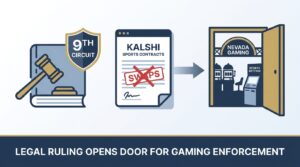
The U.S. Court of Appeals for the Ninth Circuit issued a consequential ruling on Friday, determining that Kalshi’s sports event contracts do not qualify as swaps under the Commodity Exchange Act (CEA). The decision strips away a layer of federal preemption that had shielded the prediction market operator from state-level gambling regulation. Nevada can now move to enforce its gaming laws against the platform’s sports-related offerings. For a company that has aggressively expanded its contract categories over the past two years, this ruling reshapes the regulatory terrain beneath its feet.
What the Ninth Circuit Ruling Means for Prediction Markets
Before unpacking the broader consequences, the core findings deserve close attention. The court’s reasoning hinged on a narrow but commercially decisive question: whether Kalshi’s event contracts meet the statutory definition of a swap. If they do, federal law would preempt state gambling statutes. The court said they don’t.
- Kalshi’s sports event contracts fall outside the CEA’s swap definition, according to the Ninth Circuit, removing federal preemption over state gambling laws
- Nevada now has a clear legal pathway to regulate or prohibit these contracts under its existing gaming framework
- The ruling creates a jurisdictional split that could force other states to reassess how they treat prediction market products tied to sporting outcomes
- Kalshi faces a potential patchwork of state-by-state enforcement actions, complicating its national expansion strategy
- Other prediction market operators offering similar contracts may need to reevaluate their regulatory exposure in states with robust gaming commissions
A Distinction Regulators Have Struggled to Draw
The boundary between derivatives and gambling has never been especially tidy. Prediction markets sit right on that fault line. Kalshi has long argued that its contracts function as legitimate financial instruments, subject to oversight by the Commodity Futures Trading Commission (CFTC). The company holds a designation as a regulated exchange under the CFTC, which it has used as both a compliance shield and a marketing asset.
But the Ninth Circuit’s analysis suggests that not every product traded on a CFTC-regulated platform automatically inherits swap status. That’s a meaningful distinction (and one regulators have been slow to enforce consistently). The court looked at the substance of the contracts rather than the venue where they trade, concluding that sports event contracts lack the financial characteristics that define swaps under the CEA.
Still, the ruling doesn’t invalidate Kalshi’s CFTC registration or its broader product suite. It targets a specific category. Which raises a harder question: where exactly does the line fall for contracts tied to elections, weather events, or economic indicators?
Nevada’s Position and the State-Level Ripple Effect
Nevada’s gaming regulatory apparatus is arguably the most sophisticated in the country. The state has decades of experience classifying and overseeing wagering products, and its Gaming Control Board has historically taken an expansive view of what constitutes gambling. With federal preemption now removed for Kalshi’s sports contracts, the state can apply its licensing requirements, consumer protections, and tax frameworks to these products.
This matters beyond Nevada. States like New Jersey, Pennsylvania, and Michigan have their own well-developed gaming regulatory structures. If those states follow Nevada’s lead and assert jurisdiction over prediction market contracts tied to sports, Kalshi’s event contract marketplace could face a fragmented compliance landscape that significantly raises operating costs.
And while Kalshi has positioned itself as a fintech innovator rather than a gambling operator, the court’s reasoning suggests that framing alone doesn’t determine regulatory treatment. Substance matters more than branding.
How This Shifts the Competitive Landscape
Kalshi is not the only player in this space. Polymarket, though primarily crypto-native and operating offshore for U.S. users, has drawn enormous volume around event-based contracts. The Iowa Electronic Markets have operated under a CFTC no-action letter for decades. Each occupies a slightly different regulatory niche.
| Platform | Primary Regulator | Sports Contracts | Exposure to State Gaming Laws |
|---|---|---|---|
| Kalshi | CFTC (designated contract market) | Yes, now contested | High, following Ninth Circuit ruling |
| Polymarket | Offshore / limited U.S. access | Limited | Lower direct exposure, but legally ambiguous |
| Iowa Electronic Markets | CFTC no-action letter | No | Minimal |
The ruling arguably gives traditional sportsbooks and licensed gaming operators a competitive advantage. They already navigate state licensing regimes. Prediction markets that resist that classification now face the worst of both worlds: federal oversight without federal preemption.
Reframing Risk: What Market Participants Should Consider
For institutional participants and retail traders using prediction markets, the Ninth Circuit’s decision introduces a layer of uncertainty that goes beyond one company’s product catalog. The classification of event contracts has direct implications for tax treatment, counterparty protections, and dispute resolution mechanisms. A contract classified as a swap carries different legal protections than one classified as a wager under state law.
Traders who have treated prediction market positions as financial instruments may need to reconsider that assumption, at least for sports-linked contracts. The practical difference between holding a regulated derivative and placing a bet under state gaming law is not merely semantic. It affects margin requirements, reporting obligations, and even the enforceability of the contract itself in certain jurisdictions.
What remains less clear is whether the CFTC will respond with updated guidance or whether it will defer to state regulators on products the court has now placed outside the swap framework. The commission has been navigating its own internal debates about event contracts for years, and this ruling may force a more definitive stance.
Frequently Asked Questions
Does this ruling make Kalshi’s platform illegal?
No. The ruling addresses a specific category of contracts tied to sports events and removes federal preemption that had prevented state gambling laws from applying. Kalshi remains a CFTC-regulated exchange, and its non-sports contracts are not directly affected by this decision.
Can other states besides Nevada now regulate Kalshi’s sports contracts?
In principle, yes. Any state with gaming laws on the books could assert jurisdiction over sports event contracts that the Ninth Circuit has determined are not swaps. Whether they will depends on each state’s regulatory priorities and enforcement capacity.
What happens if Kalshi appeals?
Kalshi could seek en banc review from the full Ninth Circuit or petition the U.S. Supreme Court. Either path would take months, and the outcome is far from guaranteed. In the interim, the ruling stands and Nevada can proceed with enforcement.
How does this affect prediction markets that don’t offer sports contracts?
The immediate legal impact is limited to sports event contracts. But the court’s analytical framework, focusing on the substance of the contract rather than the platform’s regulatory designation, could influence how future disputes over election, weather, or economic contracts are resolved.



