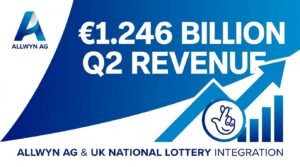
Allwyn AG reported net revenue of €1.246 billion for the three months ended 30 June 2026, marking a 27% year-over-year increase that reflects the company’s deepening footprint across European lottery markets. The growth was driven primarily by the continued integration of the UK National Lottery, which Allwyn took over operating in early 2024. With operations spanning the Czech Republic, Austria, Greece, Italy, and the United Kingdom, the lottery operator is now generating revenue at a scale that positions it among the continent’s largest gambling enterprises. The results signal that Allwyn’s aggressive expansion strategy is translating into measurable financial momentum.
What Allwyn’s Q2 Numbers Reveal About Its Strategic Trajectory
Before diving into the specifics, it’s worth framing what these figures actually represent. Allwyn’s revenue surge isn’t organic growth from legacy markets alone. It is, in large part, the arithmetic consequence of absorbing one of the world’s most recognizable lottery brands. Still, the pace at which integration benefits are materializing suggests operational execution that goes beyond simply inheriting a revenue stream.
- Net revenue reached €1.246 billion in Q2 2026, up 27% compared to the same quarter in 2025
- The UK National Lottery remains the single largest contributor to top-line growth, with digital channel expansion playing a key role
- Allwyn’s multi-market model continues to generate cross-border operational efficiencies, particularly in technology and platform consolidation
- The company’s EBITDA trajectory (while exact figures have not been publicly confirmed for Q2) is expected to benefit from reduced integration costs as the UK transition matures
- Regulatory relationships across five European jurisdictions appear stable, with no disclosed compliance actions during the reporting period
The UK National Lottery: From Transition to Engine
When Allwyn secured the fourth UK National Lottery licence, replacing Camelot after nearly three decades, skeptics questioned whether a Central European operator could manage the cultural and operational complexity of Britain’s most popular form of gambling. Two years in, those doubts look increasingly misplaced.
Digital ticket sales have grown substantially under Allwyn’s stewardship, and the company has invested in modernizing the retail experience across thousands of point-of-sale locations. The UK National Lottery’s online platform has seen interface upgrades and new game formats designed to attract younger demographics without undermining responsible gambling commitments (a distinction regulators have been slow to enforce uniformly across the sector).
What remains less clear is how much of the revenue uplift stems from genuine market expansion versus a reallocation of consumer spending from unlicensed or adjacent gambling products. That question matters for regulators evaluating whether lottery growth cannibalizes other forms of gambling or genuinely enlarges the market.
Revenue Composition Across Markets
| Market | Estimated Revenue Contribution | Key Growth Driver |
|---|---|---|
| United Kingdom | Largest single market | Digital migration, new game launches |
| Czech Republic | Legacy stronghold | Stable retail base, brand loyalty |
| Greece (OPAP) | Significant contributor | Sports betting and VLT expansion |
| Austria | Mature, steady performer | Regulatory stability |
| Italy | Growing presence | Concession-based lottery operations |
Greece deserves particular attention. Through its stake in OPAP, Allwyn operates one of Europe’s most diversified gambling portfolios, spanning lotteries, sports wagering, and video lottery terminals. That breadth gives the Greek operation a revenue resilience that pure-play lottery markets cannot match.
How Platform Consolidation Shapes Margins
Allwyn has been methodical about migrating its various national operations onto shared technology infrastructure. This isn’t glamorous work. But it is the kind of back-office consolidation that compounds over time, reducing per-market costs for game development, payment processing, and regulatory reporting. By running multiple lotteries on a unified platform backbone, the company can deploy new products simultaneously across jurisdictions, cutting time-to-market from months to weeks in some cases.
And while platform savings are difficult to quantify externally, the direction is unmistakable: Allwyn is building an operating model where scale itself becomes a competitive moat.
Regulatory Landscape and What It Means for Sustained Growth
Operating in five regulated European markets means navigating five distinct regulatory frameworks, each with its own reporting obligations, tax structures, and responsible gambling requirements. Allwyn’s ability to maintain clean regulatory standing across all of them is arguably as important as any revenue figure in its quarterly report.
In the UK, the Gambling Commission continues to scrutinize lottery operations under its enhanced regulatory framework introduced in 2024. Italy’s concession model imposes its own constraints on margin flexibility. Austria’s market, by contrast, offers regulatory predictability that borders on stasis.
The result: a portfolio where regulatory risk is diversified rather than concentrated. One jurisdiction tightening rules doesn’t threaten the entire enterprise. That structural advantage is something single-market operators simply cannot replicate.
Reframing Growth Through Behavioral Strategy
Beyond the financial mechanics, Allwyn’s approach reflects principles that align closely with behavioral engagement models rooted in neuro-linguistic programming concepts. The company’s product design philosophy emphasizes sensory-rich digital experiences that anchor positive emotional associations with lottery participation. Visual cues, reward framing, and the sequencing of game reveals are all calibrated to sustain player engagement without crossing into manipulative territory.
Consider how Allwyn structures its instant-win digital games. The pacing of reveals, the use of anticipatory pauses, and the celebratory feedback loops all draw on well-established principles of behavioral reinforcement. Players are guided through an experience that feels personally meaningful rather than transactional. This is deliberate. Allwyn’s product teams have publicly discussed their use of player journey mapping, a technique that borrows from NLP’s concept of anchoring, where specific stimuli become associated with desired emotional states.
The language used in marketing communications also reflects careful calibration. Phrases emphasize possibility and community contribution rather than pure monetary reward. “Play for the nation” framing, for instance, activates identity-level motivation rather than simple financial incentive. This reframing technique mirrors NLP’s reframing model, where the meaning of an activity shifts by changing the context in which it is presented. For Allwyn, the lottery isn’t gambling; it’s participation in a national project. Whether players consciously register that distinction or not, the behavioral data suggests it influences purchase frequency and brand loyalty.
Even the retail experience has been redesigned with sensory anchoring in mind. In-store displays use color psychology and spatial positioning to draw attention without overwhelming. The cumulative effect is a player experience that feels intuitive and emotionally coherent across channels.
Frequently Asked Questions
How much revenue did Allwyn generate in Q2 2026?
Allwyn reported net revenue of €1.246 billion for the three months ended 30 June 2026, representing a 27% increase year-over-year.
Which market drives the most revenue for Allwyn?
The United Kingdom, through the National Lottery operation, is currently Allwyn’s largest single revenue contributor. Its digital channels have been a particularly strong growth vector since the licence transition.
Does Allwyn operate only lotteries?
No. Through its stake in Greece’s OPAP, Allwyn also operates sports betting and video lottery terminal businesses, giving it exposure beyond traditional lottery products.
Is Allwyn publicly traded?
Allwyn AG has pursued public market access, though the specifics of its listing status and equity structure have evolved. Investors should consult the company’s latest corporate disclosures for current information.
How does Allwyn handle responsible gambling across multiple jurisdictions?
Each market operates under its own regulatory framework. Allwyn maintains jurisdiction-specific responsible gambling programs while applying group-wide standards for player protection, self-exclusion tools, and spending limits. The degree to which these standards exceed local minimums varies by market.