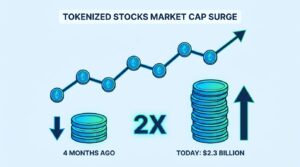
The tokenized stock market hit an all-time high of $2.3 billion in market capitalization by mid-July, according to Token Terminal data. That figure has nearly doubled since March, when the sector first breached the $1 billion threshold. What makes this rally distinctive is its breadth: the growth isn’t concentrated in a single platform or asset class but is showing up across every major issuer simultaneously, signaling a structural shift rather than a speculative spike.
Why the $2.3 Billion Milestone Signals More Than Hype
Tokenized equities have been discussed in institutional circles for years, often dismissed as a niche experiment. But the pace of capital formation in the first half of 2025 suggests the market has moved past proof-of-concept. Before unpacking what’s driving the acceleration, here are the strategic takeaways that matter most for executives and allocators watching this space.
- Market cap doubled in roughly 120 days, from $1 billion in March to $2.3 billion by mid-July, a velocity that outpaces most DeFi subsectors during the same period
- Growth is distributed across multiple issuers, reducing single-platform concentration risk and suggesting genuine demand-side pull
- On July 21 alone, trading activity spiked noticeably according to Artemis data, pointing to rising daily engagement rather than passive holding
- The trajectory positions tokenized stocks as a credible bridge between traditional capital markets and on-chain infrastructure
- Regulatory clarity in select jurisdictions (a distinction that varies enormously by country) appears to be removing friction for institutional participants
What’s Actually Fueling the Acceleration
Several forces are converging. First, the infrastructure for issuing and settling tokenized securities has matured considerably over the past 18 months. Platforms that once struggled with liquidity fragmentation have begun aggregating order flow more effectively, narrowing spreads and improving execution quality for larger trades.
Second, demand from non-US investors seeking exposure to US equities through blockchain rails has grown. Tokenized versions of major stocks offer 24/7 settlement, fractional ownership, and programmable compliance features that traditional brokerage accounts in many jurisdictions simply cannot match. For a retail investor in Southeast Asia or Latin America, buying a tokenized share of a US-listed company can be faster and cheaper than opening an international brokerage account.
And then there’s the institutional angle. Asset managers exploring on-chain analytics and tokenized asset tracking are increasingly treating these instruments not as curiosities but as allocation-ready products. The doubling of market cap in four months doesn’t happen on retail enthusiasm alone.
How Tokenized Stocks Compare to Broader RWA Growth
Tokenized equities sit within the larger real-world asset (RWA) tokenization trend, which includes treasuries, private credit, and commodities. But equities have historically lagged behind tokenized treasuries in adoption. That gap is narrowing.
| RWA Category | Estimated Market Cap (Mid-2025) | Growth Trend |
|---|---|---|
| Tokenized Treasuries | ~$3.5 billion | Steady, institutional-led |
| Tokenized Stocks | $2.3 billion | Rapid acceleration since Q1 2025 |
| Tokenized Private Credit | ~$9 billion | Dominant by volume, slower recent growth relative to base |
| Tokenized Commodities | ~$1.2 billion | Niche but stable |
The stock category’s trajectory is arguably the most interesting right now precisely because it was the slowest to gain traction. Equities carry more regulatory complexity than treasuries or commodities, which makes the recent surge all the more telling about where compliance frameworks are heading.
The Regulatory Dimension That Hasn’t Been Settled
Still, not everything is resolved. Tokenized stocks occupy an ambiguous zone in most regulatory frameworks. Are they securities? Derivatives? Synthetic instruments? The answer depends on the jurisdiction, the issuer’s structure, and whether the token represents direct ownership or merely tracks a price feed.
In practice, most tokenized stock platforms operate under derivative or synthetic asset classifications, which sidesteps some securities registration requirements but introduces counterparty risk that traditional equity ownership doesn’t carry. Whether regulators in the EU, US, or Asia-Pacific will eventually force these products into existing securities frameworks remains an open question, one that could either validate the market or compress it significantly.
Reframing How Investors Perceive On-Chain Equities
Beyond the numbers, there’s a psychological shift underway that deserves attention. For years, tokenized stocks were framed as a blockchain solution searching for a problem. Traditional investors saw no reason to move equity exposure on-chain when established brokerages worked well enough. That framing is changing, and the change is rooted in how market participants perceive accessibility and composability.
When an investor in a developing market can hold a fractional tokenized share, use it as collateral in a DeFi lending protocol, and settle the entire transaction in minutes rather than days, the value proposition stops being theoretical. It becomes visceral. This is the kind of experiential reframing that shifts adoption curves: not a whitepaper argument, but a felt difference in speed, cost, and flexibility. The mental model moves from “why would I do this on-chain?” to “why would I do this any other way?” And once that perceptual threshold is crossed, it rarely reverses.
Institutional players are undergoing a parallel but slower version of the same shift. Portfolio managers who once viewed tokenized assets as reputational risk are beginning to see them as operational efficiency. The language in boardrooms has changed from “should we explore this” to “which platform do we use.” That transition, quiet as it is, may matter more than any single data point in the Token Terminal dashboard.
Frequently Asked Questions
What are tokenized stocks?
Tokenized stocks are blockchain-based representations of traditional equity shares. They can represent direct ownership or synthetic exposure to a stock’s price, depending on the issuer and jurisdiction. Settlement happens on-chain, typically much faster than conventional T+1 or T+2 cycles.
Who is buying tokenized equities?
The buyer base spans retail investors in regions with limited brokerage access and institutional allocators experimenting with on-chain portfolio construction. Geographic diversity is a defining feature of this market’s growth.
Are tokenized stocks regulated?
It depends entirely on where and how they’re issued. Some jurisdictions treat them as derivatives; others have not yet classified them. The regulatory landscape remains fragmented, which creates both opportunity and uncertainty for participants.
How liquid are these markets?
Liquidity has improved markedly in 2025, though it still trails traditional equity markets by orders of magnitude. Spreads have tightened on major platforms, but thin order books during off-peak hours remain a challenge for larger positions.



