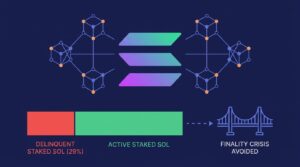
Solana came dangerously close to losing transaction finality early Wednesday when 28.83% of staked SOL went delinquent, leaving the network just 4.5 percentage points from a critical threshold. The incident, flagged by staking protocol Marinade Finance, affected 90 validators and resulted in a combined loss of 333 SOL in rewards. While the network recovered without a full outage, the episode raises pointed questions about validator concentration and the fragility of consensus under stress.
What the Delinquency Spike Means for Solana’s Network Health
Before unpacking the implications, it helps to understand the numbers and what they nearly triggered. Solana requires at least 66.67% of staked SOL to remain active for the network to maintain finality, the mechanism that confirms transactions as irreversible. When delinquency hit 28.83%, active stake dropped to roughly 71.17%. That margin is thin. Had another 4.5 percentage points of stake gone offline, the chain would have stopped finalizing blocks entirely.
- 90 validators were affected, representing a significant cluster of the network’s consensus participants
- The combined penalty: 333 SOL in missed rewards, a modest but measurable cost for operators already running on tight margins
- Solana’s finality threshold sits at 66.67% of active stake, and the network came within striking distance of breaching it
- No full outage occurred, but the incident underscores how quickly localized validator failures can cascade toward systemic risk
- This is not Solana’s first brush with network instability; previous outages in 2022 and 2023 drew scrutiny from both developers and institutional observers
Why 90 Validators Going Offline at Once Matters
Validator delinquency on a proof-of-stake network is not unusual in isolation. Nodes go offline for maintenance, software bugs, or infrastructure failures. But 90 validators dropping simultaneously points to a correlated failure, possibly tied to shared hosting providers, a software update, or a network-layer disruption. That correlation is the real concern.
Solana currently has over 1,500 active validators, yet the concentration of stake among a smaller subset means that even a relatively small number of outages can disproportionately affect consensus. Marinade Finance, which operates a liquid staking platform on Solana, was among the first to publicly report the delinquency data. Their visibility into staking dynamics made the disclosure faster than it might otherwise have been.
Still, the speed of recovery should not obscure the structural vulnerability. A network that can lose nearly a third of its staked participation in a single event has a concentration problem, regardless of whether finality is ultimately preserved.
The Finality Threshold: A Design Trade-Off Under Scrutiny
Solana’s 66.67% supermajority requirement for finality is standard across many proof-of-stake protocols. It balances security against liveness. But in practice, the buffer between normal operations and that threshold depends entirely on how stake is distributed and how resilient validators are to simultaneous failure.
When the buffer shrinks to 4.5 percentage points, the network is operating in a zone where a single additional infrastructure event (a cloud provider outage, a DNS failure, a botched client update) could halt finalization. That is not a theoretical risk. It is an operational one, and it has materialized before on Solana with more severe consequences.
What remains less clear is whether the validator set has become more resilient since earlier outages, or whether growth in total stake has simply masked persistent concentration risks.
Validator Economics and the Cost of Downtime
The 333 SOL in lost rewards may seem modest at current prices. But for smaller validators, missed epochs compound. Delegators notice. And in a competitive staking market, even brief delinquency can trigger stake migration to more reliable operators.
This creates an uneven dynamic. Larger, better-capitalized validators with redundant infrastructure absorb these events more easily. Smaller operators, arguably the ones most important for decentralization, bear a disproportionate cost. The incentive structure, at least on paper, pushes stake toward concentration rather than away from it.
Comparative Validator Resilience
| Factor | Large Validators | Small Validators |
|---|---|---|
| Infrastructure redundancy | Typically multi-region, failover-capable | Often single-provider, limited failover |
| Impact of missed rewards | Absorbed within operating margins | Can threaten viability over repeated incidents |
| Delegator retention | High brand trust buffers short outages | Delegators may migrate quickly after delinquency |
| Contribution to decentralization | Lower marginal value | Critical for reducing stake concentration, yet most vulnerable to exactly this kind of event |
How Stakeholders Should Interpret Network Stress Events
For delegators, developers, and institutional participants evaluating Solana, episodes like this one function as stress tests, unplanned but informative. The network did not fail. But the proximity to failure carries its own signal.
Interpreting that signal requires moving beyond binary outcomes. A network that stays online is not necessarily healthy. And a network that briefly loses 29% of its staked participation is communicating something about its operational resilience that uptime statistics alone will not capture. The question is whether the ecosystem treats this as a warning or a footnote.
Reframing the narrative matters here. Rather than asking “did Solana go down?” the more productive framing is: “how much margin does the network have before it does?” That shift in perspective, from outcome to buffer, changes how risk is assessed by anyone building on or allocating capital to the chain.
Protocols and dApps relying on Solana’s transaction finality guarantees should, arguably, be modeling these scenarios explicitly. A 4.5-point margin is not a comfortable cushion for applications processing high-value or time-sensitive transactions. Understanding the difference between theoretical uptime and practical resilience under correlated stress is not optional for serious operators.
Frequently Asked Questions
What does “delinquent” mean for a Solana validator?
A validator is marked delinquent when it stops voting on blocks, typically due to going offline or falling out of sync with the cluster. Delinquent validators do not participate in consensus and miss staking rewards during the period of inactivity.
Has Solana experienced full outages before?
Yes. Solana has had multiple network outages in prior years, some lasting several hours. These events prompted changes to client software and validator requirements, though concerns about network stability have persisted among developers and investors.
Could this happen again?
Correlated validator failures are inherently difficult to prevent entirely, especially when validators share infrastructure providers or run identical software versions. The risk is structural, not incidental, and mitigation depends on diversifying the validator set across geographies, providers, and client implementations.