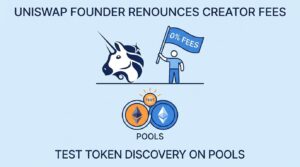
Uniswap founder Hayden Adams moved swiftly to address concerns after tokens created during internal testing of the protocol’s new Pools feature were publicly discovered. Adams confirmed that all creator fees generated from what the team described as “Uniswap employee testing” have been renounced, with proceeds redirected to an automated buy-and-burn contract. The incident, disclosed Wednesday by TradePools, underscores the reputational sensitivity surrounding insider activity in decentralized finance, even when the activity is benign in intent.
What the Fee Renouncement Signals for DeFi Governance
Before unpacking the specifics, it’s worth framing why this matters beyond the immediate optics. In a sector where trust is architected through code rather than institutions, even routine internal testing can trigger scrutiny if it generates economic value that flows back to insiders. The speed of Adams’s response reflects a broader pattern: DeFi founders increasingly operate under a transparency standard that traditional tech companies rarely face. Here are the key strategic takeaways from this episode.
- Fee redirection to buy-and-burn: By routing creator fees into an automated buy-and-burn contract, Uniswap effectively neutralized any perception of insider enrichment from the test tokens.
- Reputational risk management: The rapid public response suggests Uniswap’s leadership treats even minor perception issues as material governance events.
- The discovery was made externally, not disclosed proactively by the team, which raises questions about internal disclosure protocols for testing activities that generate on-chain economic outputs.
- Precedent for protocol builders: Other teams developing token creation or launchpad features will likely face similar scrutiny during testing phases, making sandboxed or fee-exempt testing environments a practical necessity.
How the Test Tokens Were Discovered
The tokens in question were created during the development and quality assurance process for Uniswap’s Pools feature. On-chain observers identified the tokens and traced their origin to wallets associated with Uniswap employees. TradePools flagged the activity publicly on Wednesday, prompting Adams to respond.
What made this notable wasn’t the existence of test tokens (a routine part of smart contract development) but the fact that creator fees were being generated and, at least temporarily, accruing to those wallets. In DeFi, where every transaction is visible and permanent, the distinction between “testing” and “trading” can collapse in the eyes of community observers.
The Buy-and-Burn Mechanism
Adams specified that all fees from the test activity were redirected to an automated buy-and-burn contract. This mechanism uses accumulated fees to purchase tokens on the open market and permanently remove them from circulation. It’s a well-established deflationary tool in token economics, and in this context, it serves a dual purpose: eliminating any financial benefit to insiders while creating a small positive supply-side effect for token holders.
Still, the company has not disclosed the exact dollar value of the fees involved.
Why Transparency Gaps Compound in DeFi
The episode sits at the intersection of two tensions that define modern DeFi development. First, protocols need to test features in production environments to ensure smart contract reliability. Testnets can simulate conditions, but they cannot replicate the economic dynamics of live markets with real liquidity. Second, any on-chain activity by protocol insiders is subject to immediate public audit, a level of exposure that traditional software companies never contend with during QA cycles.
This creates an asymmetry. Builders are expected to test in the open, yet any economic byproduct of that testing is treated as potentially suspect. Whether that standard is fair or not (a distinction the community has been slow to formalize), it is the operating reality for teams building at the protocol layer.
Uniswap’s decentralized exchange platform has processed hundreds of billions in cumulative trading volume, making it one of the most scrutinized protocols in the ecosystem. That visibility cuts both ways: it attracts users and liquidity, but it also means that even minor internal activities are amplified.
Broader Implications for Token Launchpad Features
Uniswap’s Pools feature represents the protocol’s expansion into token creation and launch infrastructure. As more established DeFi protocols move into this space, the testing-to-launch pipeline becomes a governance surface area that teams must actively manage.
| Aspect | Current Practice | Emerging Expectation |
|---|---|---|
| Internal testing | Conducted on mainnet with live contracts | Fee-exempt or sandboxed environments for employee testing |
| Fee disclosure | Reactive, post-discovery | Proactive disclosure of any insider-generated fees during development |
| Community communication | Founder-level social media response | Structured governance updates with on-chain verification |
| Fee handling | Redirected to buy-and-burn after flagging | Automatic fee exemption for designated test wallets built into the contract itself |
The table above illustrates a gap between current norms and where community expectations are heading. Teams that close this gap proactively will arguably face fewer reputational disruptions.
What Protocol Teams Can Learn From This Response
Adams’s handling of the situation offers a template, though not a perfect one. The response was fast, specific, and included a concrete remediation mechanism. But the fact that the discovery came from external observers rather than an internal announcement leaves a residual question about whether Uniswap’s internal processes flagged the fee accrual before TradePools did.
For other protocol teams, the lesson is structural. Building token creation or launchpad features means building governance infrastructure around the testing process itself. That includes designated test wallets with public labels, automatic fee waivers for internal activity, and pre-announced testing windows that set community expectations before on-chain artifacts appear.
And yet, even with all those safeguards, the fundamental tension remains: in a transparent system, intent is invisible but outcomes are not.
Frequently Asked Questions
What are creator fees in the context of Uniswap Pools?
Creator fees are charges generated when tokens are created and traded through Uniswap’s Pools feature. These fees typically accrue to the wallet that initiated the token creation, which in this case were wallets used by Uniswap employees during testing.
What is a buy-and-burn contract?
It’s an automated smart contract that uses collected fees to purchase tokens on the open market and then permanently destroys them, reducing total supply. Think of it as a programmatic way to ensure no individual benefits from the redirected funds.
Did Uniswap employees profit from the test tokens?
According to Hayden Adams, all creator fees were renounced and redirected. No official figure for the fees involved has been disclosed, and the team has characterized the activity as routine product testing rather than trading.
Why does this matter for DeFi users?
Because it tests the boundaries of insider transparency in decentralized protocols. If teams can generate fees during internal testing without disclosure, it erodes the trust model that DeFi is built on. The precedent set here will likely shape how other protocols handle similar situations.



