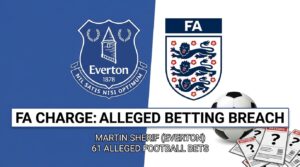
The Football Association has charged Everton forward Martin Sherif in connection with 61 alleged bets on football matches, placing the young player at the centre of a disciplinary case that underscores the sport’s ongoing struggle with betting-related misconduct. Sherif, who has been part of Everton’s development setup, now faces scrutiny under FA Rule E8, which prohibits players from placing bets on any football-related activity worldwide. The charge covers a pattern of alleged betting behaviour rather than an isolated incident, raising pointed questions about enforcement, education, and the culture surrounding gambling within English football’s lower ranks.
What the FA Charge Against Martin Sherif Means for Everton and English Football
The sheer volume of alleged bets — 61 in total — sets this case apart from many recent betting-related charges in English football. While high-profile cases involving senior professionals tend to attract the most attention, charges against younger or academy-level players reveal a less visible but arguably more systemic issue. Here are the key strategic takeaways:
- Scale of alleged activity: Sixty-one bets suggest a sustained pattern, not a momentary lapse. If proven, this would rank among the more prolific individual betting violations the FA has dealt with in recent seasons.
- FA Rule E8 enforcement is widening: The FA’s willingness to pursue charges against players outside the first-team spotlight signals a broader enforcement posture, one that extends beyond marquee names.
- Everton, already navigating financial and regulatory pressures, faces reputational exposure at a time when the club can least afford additional scrutiny.
- Youth and development players are not exempt: The case reinforces that betting prohibitions apply uniformly across all registered players, regardless of squad status or age.
- Potential sanctions range from fines to lengthy suspensions, depending on the nature and timing of the bets placed.
FA Rule E8: The Framework Behind the Charge
FA Rule E8 is unambiguous. It bars all participants — players, coaches, match officials — from betting on any football match or competition anywhere in the world. That includes accumulator bets, in-play wagers, and bets placed through third parties. The rule exists not merely to prevent match-fixing but to preserve the integrity of competition at every level.
What makes this case notable is the number of alleged violations attributed to a single individual. Most betting charges involve a handful of bets, sometimes placed over a short window. Sixty-one alleged bets imply either a prolonged period of activity, a high frequency, or both.
Sherif has until 19 June 2025 to respond to the charge. The FA has not disclosed the specific matches or competitions involved, nor has it indicated whether any of the alleged bets related to Everton’s own fixtures or competitions the club participated in. That distinction matters enormously. Betting on one’s own team or league carries far heavier sanctions and, in extreme cases, can trigger criminal investigation.
A Pattern Across English Football
Sherif’s case does not exist in isolation. Over the past several years, the FA has ramped up its detection capabilities, working closely with betting operators and integrity monitoring services to flag suspicious wagering activity linked to registered participants. Ivan Toney’s eight-month ban in 2023 — following 232 proven betting charges — remains the most prominent recent example. But dozens of lower-profile cases have followed.
Still, the question lingers: are these charges catching the problem, or merely scratching the surface?
The proliferation of mobile betting apps has made it trivially easy for anyone, including professional footballers, to place wagers in seconds. Education programmes run by the FA and the Professional Footballers’ Association target players from academy level upward, yet the recurrence of charges suggests those programmes have not fully penetrated the culture (a point the PFA itself has acknowledged, at least indirectly).
How Sanctions Typically Break Down
| Offence Type | Typical Sanction Range | Notable Precedent |
|---|---|---|
| Betting on unrelated matches | Fine + short suspension (weeks to months) | Kieran Trippier — 10-week ban (2020) |
| Betting on own team’s competition | Extended suspension (months) | Ivan Toney — 8-month ban (2023) |
| Large volume of bets | Heavier sanctions, scaled to frequency and duration | Case-dependent; aggravating factor in sentencing |
| Sharing inside information for betting purposes | Severe suspension + potential criminal referral | Rare but precedent exists |
Why Younger Players Are Particularly Vulnerable
There is a behavioural dimension to cases like this that rarely gets adequate attention. Young players, often earning modest wages relative to senior professionals, exist in an environment saturated with gambling advertising and peer normalisation of betting. The psychological accessibility of betting platforms — instant feedback, variable reward schedules, low perceived stakes — maps closely onto patterns that behavioural researchers associate with habit formation in younger demographics.
And the paradox is sharp: the very individuals most immersed in football’s daily rhythms, who understand form and fixtures intimately, are the ones categorically forbidden from acting on that knowledge. For a 19- or 20-year-old surrounded by a culture where betting is ambient, the rule can feel abstract until enforcement makes it concrete.
Clubs bear responsibility here too. Everton, like all Premier League and EFL clubs, is expected to ensure players understand their obligations under FA regulations. Whether Sherif received adequate guidance, and whether the club’s internal compliance mechanisms flagged any activity before the FA intervened, will likely form part of the broader conversation — even if it falls outside the formal charge.
Frequently Asked Questions
What is FA Rule E8?
FA Rule E8 prohibits all registered participants in English football from betting on any football match, competition, or football-related event globally. It applies to players at every level, from academy scholars to senior internationals.
What sanctions could Martin Sherif face?
Sanctions depend on the specifics — whether bets involved his own club’s matches, the time period, and any mitigating factors. Penalties can range from fines and warnings to suspensions lasting several months. Given the volume of 61 alleged bets, a significant suspension is plausible if the charges are upheld.
Has Everton commented on the charge?
As of the charge being made public, Everton has not released a detailed public statement on the matter. The club is expected to cooperate with the FA’s disciplinary process.
How does the FA detect betting by players?
The FA works with licensed betting operators and third-party integrity services that monitor wagering patterns. Accounts linked to registered participants — or their known associates — can trigger alerts that lead to formal investigations.
What Comes Next
Sherif has until 19 June 2025 to provide his response. From there, the case will either proceed to a regulatory commission hearing or be resolved through an agreed sanction if the player accepts the charge. The timeline for resolution typically stretches several weeks beyond the response deadline, though expedited proceedings are possible.
For Everton, the immediate priority is containment — ensuring the charge against a development player does not spiral into a broader narrative about institutional oversight. For the FA, the case adds another data point to an enforcement record that grows longer each season, without any clear sign that the underlying behaviour is diminishing.



