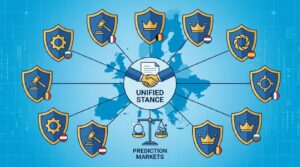
A coalition of nine European gambling regulators has moved to establish a coordinated position on prediction markets, signalling growing unease across the continent about how these platforms fit within existing regulatory frameworks. The joint effort, spearheaded through the Gaming Regulators European Forum (GREF), reflects a recognition that prediction markets straddle an uncomfortable line between financial instruments and gambling products. And while Europe’s regulatory landscape remains fragmented on the issue, this initiative marks the most concerted attempt yet to bring coherence to a space that has largely operated in grey zones.
What the Regulatory Coalition Actually Wants
Before unpacking the strategic implications, it helps to understand the core concerns driving this coalition and what their alignment could mean for operators, investors, and the broader market.
- Classification clarity: The regulators want a shared framework for determining whether prediction markets qualify as gambling, financial trading, or something else entirely (a distinction regulators have been slow to enforce)
- Consumer protection gaps: Several jurisdictions have flagged that users on prediction platforms lack the safeguards available to both retail investors and traditional bettors
- Cross-border enforcement remains nearly impossible without harmonised definitions
- Market integrity risks: Prediction markets tied to political outcomes or real-world events raise manipulation concerns that neither gambling nor financial regulators have fully addressed
- Licensing inconsistencies: Some platforms operate under gambling licences in one jurisdiction while being treated as unregulated entities in another
Why Nine Regulators, and Why Now?
The timing is not accidental. Prediction markets surged in visibility during 2024, driven largely by platforms like Polymarket attracting significant trading volumes around the U.S. presidential election. That spike in activity caught the attention of regulators who had previously treated these platforms as niche curiosities. The volume of money flowing through event-based contracts made it impossible to ignore.
Nine regulators joining forces through GREF suggests a tipping point. Individually, most European gambling authorities lack the jurisdictional reach to regulate platforms that operate across borders or from offshore bases. Collectively, they gain leverage to influence EU-level policy discussions and potentially shape how the European Commission approaches the sector.
Still, the coalition faces a structural problem. Not all nine regulators share the same legal foundation for classifying prediction markets. In some member states, event-based wagering falls squarely under gambling law. In others, it occupies a regulatory vacuum. That asymmetry is precisely what makes coordination difficult but also what makes it necessary.
The Polymarket Factor and Cross-Border Tensions
No discussion of prediction market regulation in Europe can avoid the Polymarket platform and its rapid growth in event-based trading. The platform, which operates primarily from a U.S. base, has drawn scrutiny from multiple European authorities questioning whether its services constitute unlicensed gambling when accessed by EU residents.
France’s gambling authority ANJ took a notably aggressive posture in 2024, blocking access to certain prediction market platforms. But other jurisdictions have been more cautious, uncertain whether their existing legal tools even apply. That patchwork response is exactly what the GREF coalition aims to address.
How Prediction Markets Challenge Traditional Regulatory Categories
The fundamental tension here is taxonomic. Prediction markets don’t fit neatly into boxes that regulators built decades ago.
| Feature | Gambling Product | Financial Instrument | Prediction Market |
|---|---|---|---|
| Outcome basis | Chance or sporting event | Asset price movement | Real-world event (elections, weather, policy decisions) |
| Regulatory body | Gambling authority | Financial markets regulator | Unclear in most jurisdictions |
| Consumer protections | Responsible gambling rules | MiFID II / investor suitability | Varies widely; often minimal |
| Licensing requirement | Jurisdiction-specific | Harmonised under EU law | Inconsistent or absent |
What remains less clear is whether the coalition favours pulling prediction markets under gambling regulation or advocating for an entirely new category. The latter would require legislative action at the EU level, a process measured in years rather than months.
Reframing the Debate: What Operators Should Understand
For platform operators, the instinct may be to view this coalition as a threat. That reading is incomplete. Regulatory clarity, even if it comes with stricter requirements, arguably benefits established operators more than it harms them. Unlicensed competitors face the greatest exposure. Platforms already investing in compliance infrastructure could find themselves with a structural advantage if harmonised rules raise the barrier to entry across Europe.
The real risk sits with operators who have built their models on regulatory arbitrage. Running a prediction market from a jurisdiction with no specific rules while serving customers across the EU has been viable precisely because of the fragmentation this coalition seeks to eliminate.
And there’s a subtler dynamic at play. Institutional interest in prediction markets as information-aggregation tools has grown considerably. Academic researchers, policy analysts, and even some government bodies have explored using prediction markets as forecasting mechanisms. If regulators classify these platforms purely as gambling, that informational utility could be curtailed in ways that carry broader costs.
Frequently Asked Questions
What is GREF?
The Gaming Regulators European Forum is a network of European gambling regulators that facilitates cooperation, information sharing, and policy coordination across member jurisdictions. It does not have binding regulatory authority but serves as an influential platform for shaping collective positions.
Are prediction markets currently illegal in Europe?
Not uniformly. Some jurisdictions treat them as unauthorised gambling if offered without a licence, while others have no specific rules addressing them. The legal status depends heavily on how each country’s gambling and financial regulations define the activity.
Could this lead to an EU-wide prediction market regulation?
Possibly, though the path would be long. A coordinated position from nine regulators strengthens the case for EU-level action, but legislative proposals would need to navigate the European Commission, Parliament, and Council. In practice, harmonised guidance or mutual recognition agreements are more likely in the near term than a dedicated directive.
How does this affect users of prediction market platforms?
For now, the immediate impact on individual users is limited. But if regulators move toward requiring licences or imposing access restrictions, users in certain countries may find platforms blocked or subject to new verification requirements. Consumer protection measures, if implemented, would likely include deposit limits and transparency obligations.