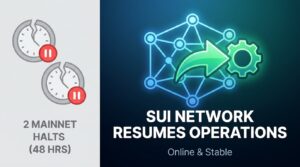
Sui, currently ranked as the 31st-largest cryptocurrency by market capitalization, confirmed its mainnet has resumed processing transactions following two separate outages within a 48-hour window. The consecutive halts knocked the Layer 1 blockchain entirely offline, raising pointed questions about network resilience at a moment when institutional interest in alternative chains has been climbing. Validators have since deployed what the Sui team characterized as a long-term fix, and transaction flow has been restored.
What Back-to-Back Outages Signal for Sui’s Infrastructure
Two mainnet halts in two days is not a routine hiccup. For a blockchain positioning itself as a high-performance Layer 1 competitor, consecutive downtime events carry reputational weight that extends well beyond the technical postmortem. The incidents underscore a tension familiar across newer chains: speed and throughput ambitions sometimes outpace the battle-tested stability that enterprise users and DeFi protocols demand.
Sui’s architecture relies on a delegated proof-of-stake consensus mechanism with object-centric transaction processing, a design choice meant to enable parallel execution and high throughput. But when validators encounter bugs or consensus failures in such systems, the consequences tend to be binary. The network either works or it doesn’t.
That binary quality is precisely what made these outages so visible.
Strategic Implications of the Sui Mainnet Disruption
Beyond the immediate technical resolution, the dual outage carries several business and ecosystem consequences worth tracking closely:
- Validator coordination under stress: The speed of the fix suggests Sui’s validator set can mobilize quickly, but the fact that a second halt followed the first raises questions about whether the initial patch was insufficiently tested.
- DeFi protocol exposure: Any protocols running on Sui with time-sensitive operations (liquidations, oracle updates, yield strategies) faced a period of complete inactivity, a scenario that can cascade into losses for users.
- Competing Layer 1 networks, including Aptos and Solana, will likely use these incidents in positioning conversations with developers weighing ecosystem commitments.
- Market confidence: SUI token holders absorbed the news in real time. While short-term price action is noisy, repeated outages tend to erode the kind of trust that sustains long-term capital allocation.
How Sui’s Response Compares to Industry Precedent
Network outages are not unique to Sui. Solana experienced multiple high-profile halts during 2022 and early 2023, events that temporarily damaged sentiment but did not prevent the chain from staging a significant ecosystem recovery. Arbitrum, too, faced a sequencer outage in 2023 that briefly paused transaction ordering. In each case, the market’s longer-term judgment hinged less on the outage itself and more on the quality and transparency of the response.
Sui’s team described the deployed patch as a “long-term fix” rather than a stopgap, which (if accurate) suggests the root cause has been identified and addressed at a structural level. Still, the phrase invites scrutiny. Whether the fix holds under sustained load and adversarial conditions will determine if this episode becomes a footnote or a recurring liability. The Sui Layer 1 blockchain platform has published limited technical detail so far, and the community will expect a thorough incident report in the coming days.
The Broader Layer 1 Reliability Question
What makes this moment particularly charged is context. Layer 1 blockchains are competing not just with each other but with Layer 2 rollups and modular architectures that promise comparable performance with inherited security from Ethereum. Every outage on an alternative L1 strengthens the narrative that monolithic chain designs carry concentrated risk.
Arguably, the real test for Sui is not whether it can recover from two halts but whether it can demonstrate the kind of uptime consistency that makes institutional deployments viable. Enterprise-grade reliability means five-nines availability (99.999%), a standard no blockchain has consistently met. But the gap between aspiration and reality narrows or widens with each incident like this one.
And while retail users may shrug off a few hours of downtime, protocols managing hundreds of millions in total value locked cannot afford that flexibility.
Rebuilding Confidence After Downtime
Network recovery is a technical event. Confidence recovery is a communications challenge, and it unfolds over weeks, not hours. Sui’s next moves matter more than the fix itself. Transparent root-cause analysis, independent auditing of the patch, and verifiable uptime metrics over the following quarter will collectively shape whether developers and capital allocators treat this as growing pains or a structural concern.
The pattern across crypto infrastructure is consistent: projects that publish detailed postmortems and implement monitoring improvements tend to recover trust faster than those that move on quietly. Silence after an outage is its own signal.
Frequently Asked Questions
What caused the Sui mainnet to halt twice?
The Sui team has not yet released a full technical postmortem. Validators deployed what was described as a long-term fix after the second halt, suggesting the root cause involved a consensus or transaction-processing issue that the first patch did not fully resolve.
Were user funds at risk during the outages?
Blockchain halts typically freeze transaction processing rather than compromise asset security. Funds held on-chain remain intact, though users and protocols cannot execute transactions, withdrawals, or smart contract calls during downtime.
How does this compare to Solana’s outages?
Solana experienced several outages in 2022–2023, some lasting multiple hours. The chain recovered ecosystem momentum over subsequent quarters, partly through transparent communication and infrastructure upgrades. Whether Sui follows a similar trajectory depends on the durability of its fix and the depth of its public reporting.
Should developers reconsider building on Sui?
Two outages in 48 hours warrant scrutiny, not necessarily abandonment. Developers evaluating any chain should weigh uptime history, validator decentralization, and the team’s incident-response track record as part of a broader risk assessment. The next few weeks of network performance will be telling.



