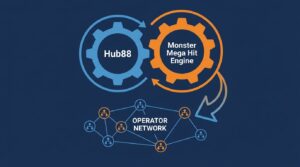
Hub88, the B2B platform powering a broad network of online gaming operators, has expanded its content portfolio by integrating the Monster Mega Hit engine from its supplier partner. The deal gives Hub88’s operator clients direct access to a game mechanic that has gained traction for its high-volatility, jackpot-style gameplay. While specific financial terms remain undisclosed, the move signals Hub88’s continued push to differentiate its aggregation offering in an increasingly crowded distribution landscape.
What This Integration Means for Hub88’s Operator Partners
Before diving into the specifics, it’s worth framing why supplier-platform integrations like this carry strategic weight beyond the surface-level content addition. For operators plugged into Hub88’s network, each new engine or game mechanic represents a potential lever for player acquisition, retention, and average revenue per user. Here’s what stands out:
- Broader content differentiation: Operators gain access to the Monster Mega Hit engine without negotiating separate supplier agreements, reducing time-to-market
- Hub88 strengthens its value proposition as an aggregator by offering exclusive or early-access mechanics that competing platforms may not carry
- Player engagement upside: High-volatility engines like Monster Mega Hit tend to drive longer session times among a specific player segment, particularly in markets where jackpot-style products perform well
- The integration reflects a wider industry pattern where platforms compete less on volume of titles and more on the uniqueness of game mechanics available to their networks
How the Monster Mega Hit Engine Works
The Monster Mega Hit engine operates as a jackpot-layer mechanic that can be applied across multiple game titles. Rather than functioning as a standalone slot, it overlays existing games with a progressive prize structure that escalates based on player activity across the network. That networked element is key. It means the jackpot pool grows faster than single-game progressives, which in turn creates larger headline prize figures that operators can use in marketing.
This kind of engine-level integration differs from a standard game launch. Operators aren’t simply adding another title to a lobby; they’re layering a mechanic that touches multiple products simultaneously. The operational complexity is higher, but so is the potential impact on player behavior (a distinction that not every aggregation deal can claim).
Comparing Engine-Level vs. Title-Level Integrations
| Feature | Engine-Level Integration | Standard Title Launch |
|---|---|---|
| Scope | Applies across multiple games | Single game addition |
| Player impact | Networked jackpot pools; cross-game engagement | Isolated to one title’s performance |
| Integration complexity | Higher; requires platform-level coordination | Relatively straightforward |
| Marketing leverage | Larger headline prizes; broader campaign potential | Limited to individual game branding |
| Revenue model | Contribution-based pooling across operator network | Standard GGR share on a per-title basis, typically simpler to forecast |
The Aggregation Arms Race Intensifies
Hub88 operates in a segment where differentiation has become genuinely difficult. Dozens of aggregation platforms now offer thousands of titles from overlapping supplier rosters. The result: a market where simply having “more games” no longer moves the needle for operators evaluating platform partners.
And that’s precisely why engine-level deals matter more than they did two years ago. By securing access to mechanics like Monster Mega Hit, Hub88’s integration platform positions itself as more than a content pipe. It becomes a distribution channel for gameplay innovation, which is a harder thing for competitors to replicate quickly.
Still, the question of exclusivity looms. Whether Hub88 holds any period of exclusive access to the Monster Mega Hit engine, or whether the supplier plans parallel distribution through rival aggregators, will ultimately determine how much competitive advantage this deal actually delivers.
Framing the Opportunity: Why Perception Shapes Operator Decisions
Beyond the technical mechanics, there’s a psychological dimension to how integrations like this influence operator behavior. In B2B gaming, platform selection is rarely driven by spreadsheet analysis alone. Operators evaluate aggregators partly on momentum, partly on perceived innovation velocity, and partly on the signal that specific partnerships send about a platform’s market position.
When an aggregator announces an engine-level integration rather than a routine title launch, it reframes how operators perceive the platform’s trajectory. This is anchoring at work. The announcement sets a reference point: Hub88 isn’t just adding games, it’s adding capabilities. That framing shapes future conversations with prospective operator clients, even before any performance data from the Monster Mega Hit engine becomes available.
Operators themselves are susceptible to what behavioral economists call loss aversion in this context. If a competing operator on the same platform activates the engine first and sees measurable uplift, the cost of inaction feels disproportionately large. Aggregators understand this dynamic well, and supplier integration announcements are often timed and communicated with exactly this effect in mind. The practical takeaway for operators evaluating Hub88’s latest addition is to separate the signal from the noise: request pilot data, define KPIs before activation, and benchmark against existing jackpot mechanics already in their lobbies. Enthusiasm is useful. But disciplined evaluation prevents operators from over-indexing on novelty at the expense of proven performers already generating revenue.
Frequently Asked Questions
What is the Monster Mega Hit engine?
It’s a jackpot-layer mechanic designed to overlay multiple game titles with a networked progressive prize structure. Rather than being a single slot, it enhances existing games across an operator’s portfolio.
How does this affect operators on Hub88’s network?
Operators gain access to the engine through their existing Hub88 integration, meaning no separate supplier deal is required. The speed of deployment depends on each operator’s technical readiness, but the aggregation layer handles the heavy lifting. In practice, this should compress launch timelines significantly compared to direct integrations.
Is the Monster Mega Hit engine exclusive to Hub88?
That hasn’t been confirmed publicly. Exclusivity terms, if any, would materially change the competitive calculus for operators weighing activation.
Why do engine-level integrations matter more than individual game launches?
They touch multiple products at once, create larger jackpot pools through networked contributions, and give operators a marketing narrative that extends beyond a single title. The strategic value is qualitatively different.