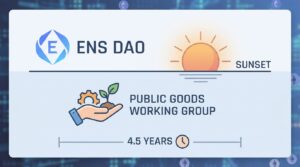
The ENS DAO Public Goods Working Group has officially wound down after four and a half years of sustained investment in Ethereum’s foundational infrastructure. Working group lead Simona Pop confirmed the closure on X Thursday morning, marking the end of a funding body that channeled hundreds of thousands of dollars into builder grants and ecosystem development. The group’s final term allocated $450,000 in USDC and 72.5 ETH (approximately $123,000 at current prices) across its remaining commitments. For a DAO ecosystem still grappling with how to fund public goods sustainably, this is more than a procedural change.
What the Shutdown Signals for DAO-Led Public Goods Funding
Before unpacking the strategic implications, it helps to frame what this working group actually did. Operating under the Ethereum Name Service governance framework, the Public Goods Working Group served as one of the DAO’s primary vehicles for directing treasury capital toward non-commercial infrastructure projects. Its mandate covered grants, ecosystem tooling, and broader Ethereum public goods that lacked obvious revenue models. The decision to sunset it raises pointed questions about the viability of DAO-funded infrastructure programs at scale.
- Direct financial impact: The final term’s combined allocation of $450,000 USDC and 72.5 ETH represents a meaningful but not outsized commitment, suggesting the group may have been operating with diminishing budgets relative to earlier terms.
- Governance signal: Sunsetting a working group rather than restructuring it indicates a deliberate strategic pivot within ENS DAO’s governance priorities.
- The closure does not necessarily mean ENS DAO will stop funding public goods entirely, but the mechanism through which it does so will almost certainly change.
- Broader ecosystem effect: Builder grants and infrastructure funding from established DAOs have been a lifeline for early-stage Ethereum projects. One fewer source compounds the pressure on remaining funders like Optimism’s RetroPGF and Gitcoin.
A Quiet Reckoning for DAO Working Groups
Working groups have been the organizational backbone of many large DAOs since 2021. They promised something that flat governance structures struggled to deliver: focused execution with delegated authority. Yet the ENS DAO’s decision to close its Public Goods Working Group fits a broader pattern. Across the DAO landscape, working groups have faced scrutiny over accountability, spending efficiency, and contributor burnout.
Simona Pop’s tenure as lead spanned nearly the entire lifespan of the group. That kind of continuity is rare in DAO governance, where contributor churn tends to be high and institutional memory thin. Still, even well-run working groups face a structural tension: they depend on recurring governance votes for funding, which means they must continuously justify their existence to tokenholders whose priorities shift.
Whether ENS DAO replaces this group with a different structure (a grants council, perhaps, or a more automated funding pipeline) remains an open question.
How Public Goods Funding Has Evolved in Ethereum
The concept of funding public goods through decentralized treasuries was, arguably, one of the more ambitious experiments in crypto governance. Ethereum’s ecosystem has tested multiple models over the past several years, each with distinct tradeoffs:
| Funding Model | Example | Key Strength | Primary Challenge |
|---|---|---|---|
| DAO Working Groups | ENS DAO Public Goods WG | Focused mandate, delegated authority | Governance fatigue, recurring approval cycles |
| Retroactive Public Goods | Optimism RetroPGF | Rewards proven impact | Difficult to standardize evaluation criteria across rounds |
| Quadratic Funding | Gitcoin Grants | Community-driven capital allocation | Sybil resistance and matching pool dependency |
| Protocol-Level Funding | Protocol Guild | Direct to core contributors | Narrow scope, limited to protocol-layer work |
The ENS working group’s closure doesn’t invalidate the model. But it does suggest that even well-resourced DAOs find it difficult to sustain dedicated public goods programs over multi-year horizons without structural fatigue setting in.
The Psychology of Collective Funding Decisions
What makes public goods funding so persistently difficult in decentralized organizations isn’t just a coordination problem. It’s a framing problem. When tokenholders vote on budget allocations, they’re making decisions under conditions of deep uncertainty about impact. Neuro-linguistic programming research on decision-making offers a useful lens here: people anchor heavily on the most recent information available to them, and they tend to discount outcomes that are diffuse or delayed.
Public goods, by definition, produce benefits that are widely distributed and hard to attribute to any single funder. That makes them psychologically unrewarding for individual voters in a way that, say, a marketing campaign with visible metrics is not. The framing of proposals matters enormously. Working groups that present their impact in concrete, specific terms (number of grants deployed, projects funded, developer hours supported) tend to survive longer than those that speak in abstractions about “ecosystem health.”
And yet even strong framing can’t fully overcome the structural incentive mismatch. Tokenholders who vote to fund public goods bear a concentrated cost (dilution of treasury) for a diffuse benefit (better infrastructure that helps everyone, including competitors). This is the classic free-rider dynamic, transplanted into on-chain governance. ENS DAO’s experience suggests that sustained public goods funding may require mechanisms that reduce the cognitive and political burden on individual voters, whether through delegation, automation, or protocol-level commitments that bypass discretionary votes altogether.
Reframing the narrative around public goods from “spending” to “investment” could shift how communities perceive these allocations. The language used in governance proposals shapes voter behavior more than most DAO contributors realize.
Frequently Asked Questions
Why was the ENS DAO Public Goods Working Group shut down?
The working group was sunset after four and a half years of operation. While the specific rationale hasn’t been fully detailed in public, the closure aligns with broader trends of DAO governance bodies reassessing the sustainability and structure of long-running working groups.
Will ENS DAO continue to fund public goods?
That hasn’t been ruled out. The closure of this particular working group doesn’t preclude ENS DAO from establishing alternative funding mechanisms, though no successor structure has been publicly announced yet.
How much did the working group allocate in its final term?
The final term committed $450,000 in USDC and 72.5 ETH, which at current market prices amounts to roughly $123,000 in ETH value on top of the stablecoin allocation.
What does this mean for projects that relied on ENS public goods grants?
Projects previously funded through this channel will need to seek alternative sources. Gitcoin, Optimism’s RetroPGF rounds, and Protocol Guild represent some of the remaining avenues for Ethereum public goods funding, though each operates under different criteria and timelines.