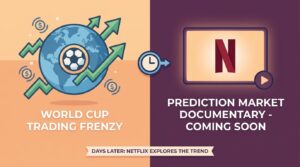
Netflix has scheduled the release of a prediction market documentary for July 26, timing the launch to coincide with the aftermath of World Cup trading activity. The streaming giant’s move into this niche but rapidly growing corner of finance signals broader mainstream interest in event-driven speculation. While details about the documentary’s full scope remain limited, its arrival at a moment when prediction markets are drawing unprecedented public attention is unlikely to be coincidental.
Why a Prediction Market Film Matters Right Now
Prediction markets have shifted from academic curiosities to front-page financial instruments in a remarkably short window. Before diving into what Netflix’s documentary could mean for the industry, here are the strategic takeaways worth tracking:
- Netflix’s decision to greenlight this project reflects a bet that prediction markets have crossed into mainstream cultural relevance, not just financial relevance
- The July 26 release date, positioned just after World Cup trading peaks, suggests deliberate editorial timing to capture audience interest while the topic is still live
- Increased media exposure could accelerate regulatory scrutiny of platforms operating in the prediction market space
- For prediction market operators, the documentary represents both an opportunity (user acquisition) and a risk (public backlash if framed negatively)
- The film may shape how retail participants perceive event contracts, potentially influencing trading volumes in the months following release
Prediction Markets and the World Cup Convergence
World Cup events have historically driven spikes in prediction market activity. Sports-adjacent trading attracts participants who might never touch a derivatives contract but will happily stake money on a match outcome. That crossover audience is precisely the demographic Netflix excels at reaching.
Platforms like Polymarket’s event-driven trading platform have seen surging volumes around major global events, and the World Cup is no exception. By releasing its documentary in the immediate wake of this trading surge, Netflix positions the film to land while audiences are already primed with awareness of how prediction markets function. It’s a sequencing decision that mirrors how news organizations time investigative pieces to coincide with peak public interest.
What This Signals for the Streaming Industry
Netflix has a track record of turning niche financial topics into cultural moments. The platform’s earlier forays into finance-adjacent storytelling attracted millions of viewers who had no prior exposure to the underlying subject matter. A prediction market documentary fits squarely within that playbook.
But there’s a subtler dynamic at work. Streaming platforms increasingly compete not just on entertainment value but on cultural timing. Whoever captures a trending topic first owns the narrative. And prediction markets, sitting at the intersection of politics, sports, finance, and technology, offer a narrative surface area that few other topics can match.
Still, the question lingers: will the documentary treat prediction markets as innovation or as a new frontier for gambling risk?
Regulatory Implications Worth Watching
Mainstream media attention tends to accelerate regulatory timelines. When millions of viewers encounter a financial product through a documentary (a distinction regulators have historically been slow to act on preemptively), the political pressure to respond increases substantially. The CFTC in the United States has already been navigating complex questions about which event contracts qualify as regulated instruments versus which cross into prohibited territory.
A high-profile Netflix release could tip that balance. Regulators who might otherwise take a measured, multi-year approach to rulemaking could find themselves compelled to issue guidance or enforcement actions more quickly. For prediction market operators, the calculus is straightforward: more visibility means more users, but also more oversight.
How Perception Shapes Market Adoption
The framing of any documentary carries enormous weight in shaping public perception, and this principle extends well beyond entertainment. Neuro-linguistic programming research has long established that the way information is structured and presented fundamentally alters how audiences process and internalize it. When viewers encounter prediction markets through a narrative lens rather than a technical one, their emotional and cognitive responses differ markedly from those produced by reading a whitepaper or regulatory filing.
Anchoring effects play a significant role here. If the documentary’s opening frames prediction markets through the lens of successful forecasting during elections or pandemics, viewers will anchor their understanding to that positive association. Conversely, if the opening sequence highlights losses or manipulation risks, that negative anchor persists throughout the viewing experience and beyond. The order in which information is presented matters as much as the information itself.
Reframing is equally critical. Prediction markets have struggled with a perception problem: many potential participants view them as glorified gambling. A well-constructed documentary has the capacity to reframe these instruments as tools for information aggregation and collective intelligence. That shift in mental model, from “betting” to “forecasting,” could unlock participation from demographics that currently self-exclude on moral or reputational grounds. Even sophisticated institutional players sometimes avoid prediction markets not because of regulatory barriers but because of how participation might be perceived internally.
The documentary’s language choices will ripple outward. Whether narrators use terms like “traders” versus “bettors,” or “contracts” versus “wagers,” will influence how media outlets, regulators, and the public discuss prediction markets for months afterward.
Frequently Asked Questions
When does the Netflix prediction market documentary release?
The documentary is scheduled for release on July 26, timed shortly after World Cup trading activity.
What are prediction markets?
Prediction markets are platforms where participants trade contracts based on the outcomes of future events, ranging from elections and sports to economic indicators. They function as a mechanism for aggregating collective forecasts into market-implied probabilities.
Could this documentary affect prediction market regulation?
Arguably, yes. Mainstream exposure through a platform with Netflix’s reach tends to compress regulatory timelines. The CFTC and other bodies may face increased pressure to clarify their stance on event contracts, particularly those tied to sports and political outcomes.
Why did Netflix choose this timing?
The release date appears strategically aligned with the conclusion of World Cup trading, a period when prediction market awareness peaks among general audiences. Netflix has not publicly confirmed this reasoning.