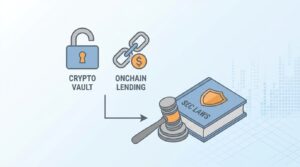
SEC Commissioner Hester Peirce has weighed in on a question that has quietly unsettled decentralized finance builders for months: whether crypto vaults and onchain lending strategies fall within the reach of U.S. federal securities laws. In a statement published July 22, titled “Headstands and Summervaults: A Statement on Crypto Vaults and Lending Strategies,” Peirce laid out a framework suggesting that the answer depends heavily on how these products are structured and managed. The statement arrives at a moment when DeFi protocols are scaling rapidly and regulatory clarity remains, at best, partial.
What Peirce’s Statement Means for DeFi Builders and Investors
Before diving into the specifics, it helps to understand the stakes. Crypto vaults — automated smart contract strategies that pool user deposits to generate yield — have become a cornerstone of DeFi infrastructure. Billions of dollars sit in these vehicles across protocols like Yearn Finance, Aave, and others. Peirce’s statement doesn’t introduce new rules, but it sharpens the lens through which existing ones might apply. Here are the key strategic takeaways:
- Crypto vaults that pool assets and rely on a manager or protocol team to execute yield strategies could meet the definition of an investment contract under the Howey test
- Onchain lending arrangements where returns depend on the efforts of a third party face similar scrutiny — passive depositors may be treated as securities investors
- The structure and governance model of a vault matters more than the label attached to it; calling something “decentralized” does not automatically exempt it
- Peirce’s framing suggests the SEC is developing internal thinking on these products, even if formal rulemaking hasn’t followed
- Protocols operating without registration or exemption could face enforcement risk if their vault products are deemed securities
The Howey Test, Applied to Smart Contracts
At the core of Peirce’s analysis sits the Howey test, the decades-old Supreme Court standard for determining whether something qualifies as a security. It asks whether there is an investment of money in a common enterprise with an expectation of profits derived from the efforts of others. That last prong — “efforts of others” — is where things get complicated in DeFi.
A vault where users deposit tokens and a strategy manager (whether human or algorithmically governed by a core team) allocates those funds across lending pools, liquidity positions, or arbitrage trades starts to look a lot like a managed investment vehicle. The smart contract automates execution, but someone still designs the strategy, adjusts parameters, and captures fees. That someone’s involvement could be enough to satisfy Howey.
Still, not every vault fits neatly into this box. A fully permissionless, immutable contract where no party controls or updates the strategy arguably lacks the “efforts of others” element (a distinction regulators have been slow to enforce). But how many vaults truly meet that standard? Fewer than their marketing pages suggest.
Why This Matters Right Now
Timing is everything. The broader crypto regulatory landscape in the United States has shifted toward engagement rather than pure enforcement under the current SEC leadership. Peirce, long regarded as the commission’s most crypto-sympathetic voice, appears to be using this window to establish guardrails before less friendly regulators might impose blunter ones.
And while her statement carries no binding legal authority, it functions as a signal. Protocols building vault products should treat it as an early warning system. The gap between a commissioner’s public thinking and an enforcement action can close faster than most founders expect.
Several DeFi protocols have already begun restructuring governance and fee models in anticipation of tighter oversight. Whether those changes will prove sufficient remains an open question — one the SEC has not yet answered definitively.
How Protocols Can Assess Their Exposure
For teams operating vault or lending products, the practical question is straightforward: does your product look like a security?
| Factor | Higher Risk of Securities Classification | Lower Risk |
|---|---|---|
| Strategy management | Core team designs and updates strategies | Immutable, user-directed strategy selection |
| Fee structure | Performance fees paid to protocol operators | Flat gas-only costs, no management fees |
| Marketing language | Promises of yield, returns, or passive income | Neutral descriptions of protocol mechanics |
| Governance control | Multisig or team-controlled upgrades | Fully decentralized DAO with broad token distribution |
| User role | Deposit-and-forget; no active decisions required | Users must actively select and manage positions |
This isn’t a compliance checklist — it’s a risk spectrum. Most real-world products sit somewhere in the middle, which is precisely the ambiguity Peirce’s statement highlights without fully resolving.
Reframing Risk: What DeFi Teams Should Internalize
Beyond the legal mechanics, there’s a cognitive shift worth noting. Many DeFi builders have operated under the assumption that code-is-law provides a kind of jurisdictional immunity. That assumption was always fragile. Peirce’s statement makes it more so.
The framing matters here. Teams that view regulatory engagement as a constraint tend to delay action until enforcement arrives. Those that treat it as a design input — building compliance considerations into protocol architecture from the start — tend to survive regulatory cycles with fewer scars. This isn’t about capitulation to legacy frameworks. It’s about recognizing that the SEC’s jurisdiction over investment contracts doesn’t evaporate because the contract runs on Ethereum.
Arguably, the most resilient protocols over the next two years will be those that can demonstrate genuine decentralization — not as a marketing claim, but as a structural reality auditable onchain. Token distribution, governance participation rates, upgrade authority: these become compliance artifacts as much as technical ones.
What remains less clear is how the SEC will treat hybrid models — products that start centralized and progressively decentralize. That gray zone is where most of the industry actually lives.
Frequently Asked Questions
Are all crypto vaults considered securities under U.S. law?
No. Peirce’s statement emphasizes that classification depends on structure, management involvement, and how returns are generated. A vault where users passively deposit funds and a team manages strategies faces higher scrutiny than a fully permissionless, user-directed system.
Does this statement create new regulations?
It does not. Commissioner statements carry no binding legal force. But they signal internal SEC thinking and often precede more formal guidance or enforcement actions.
What should DeFi protocol teams do in response?
Assess whether their vault or lending products could satisfy the Howey test. Review governance structures, fee models, and marketing language. Consider engaging securities counsel — particularly if the protocol operates with a core team that controls strategy updates or captures performance-based fees. The cost of a legal review is trivially small compared to the cost of an SEC enforcement proceeding.



