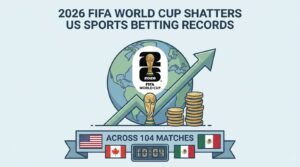
The 2026 FIFA World Cup has generated record-breaking sports betting activity across the United States, with operators reporting unprecedented handle volumes spanning all 104 matches of the expanded tournament. The event, co-hosted by the US, Mexico, and Canada, arrived at a moment when legal sports wagering infrastructure had reached critical mass across dozens of American states. What followed was a sustained surge in betting engagement that outpaced every prior international sporting event on US soil.
Why the 2026 World Cup Became a Watershed for US Betting Markets
Several forces converged to make this tournament unlike anything the American sports betting industry had previously absorbed. The structural expansion of the World Cup from 64 to 104 matches created, at a basic level, more inventory. More matches meant more markets, more in-play opportunities, and a longer window of sustained engagement. But the sheer volume of games only tells part of the story.
Why Frances Online Sports Betting Market Surges matters
The story around 2026 FIFA World Cup Shatters US Sports Betting Records Across 104 Matches fits into a broader sequence of market and compliance decisions. For context, see Frances Online Sports Betting Market Surges. A connected update on France's Online Sports Betting Market Surges Past €1.3bn in Stakes During 2026 FIFA World Cup helps clarify the strategic direction behind these changes.
Reading both pieces together can help readers track how positioning, licensing priorities, and execution are evolving. (Licensed online sports betting operators in France collectively processed more than €1.3bn in wagers during the 2026 FIFA World Cup, according to data released…)
The US hosting advantage cannot be overstated. Time zones aligned with peak betting hours. Matches kicked off during afternoons and evenings rather than early mornings, a scheduling reality that had historically suppressed American wagering on global football tournaments. And with matches played in cities like New York, Los Angeles, Dallas, and Miami, local fan engagement translated directly into betting participation (a dynamic that domestic leagues have long relied on but international events rarely enjoy in the US market).
Arguably, the most consequential factor was market maturity. When the 2022 World Cup took place in Qatar, legal sports betting existed in roughly 30 US states. By mid-2026, that number had climbed past 38, with several of the newest markets, including Missouri and Vermont, contributing meaningful handle for the first time during a global tournament.
Operator Performance and Handle Metrics That Stand Out
Major operators saw soccer betting handle spike well beyond seasonal norms. FanDuel’s sportsbook operations reported significant increases in both new account registrations and reactivations tied to World Cup promotions. DraftKings, BetMGM, and Fanatics Sportsbook all rolled out tournament-specific features including group stage parlays, golden boot props, and match-level micro-markets designed to capture in-play volume.
The numbers reflected a market that had been preparing for this moment. Consider the contrast:
| Metric | 2022 World Cup (Qatar) | 2026 World Cup (US/Mexico/Canada) |
|---|---|---|
| Total matches | 64 | 104 |
| US states with legal betting | ~30 | 38+ |
| Peak match time zone alignment | Morning (EST) | Afternoon/Evening (EST) |
| Estimated US handle growth vs. prior WC | Baseline | Substantially higher across all tracked operators |
Still, not every operator benefited equally. Smaller regional books with limited soccer market depth struggled to compete with the promotional firepower and product sophistication of national platforms.
How the Tournament Reshaped Bettor Behavior
One pattern that emerged quickly: the World Cup pulled in bettors who typically wager exclusively on NFL, NBA, or MLB. Soccer, long considered a secondary sport in American betting culture, crossed a threshold during this tournament. Operators reported that a meaningful share of World Cup bettors had no prior soccer wagering history on their platforms.
Parlay betting dominated. Multi-leg same-game parlays on individual matches proved especially popular, with bettors combining match result, total goals, and player prop markets into single tickets. This format, already the fastest-growing product type in US sportsbooks, found a natural fit with the World Cup’s high-profile matchups.
In-play wagering also surged. The structure of soccer, with its continuous 45-minute halves and relatively few stoppages, creates a rhythm that lends itself to live betting in ways that stop-and-start American sports do not. Operators who had invested in low-latency live odds feeds and real-time market depth saw disproportionate returns.
The Regulatory and Revenue Implications
For state regulators and tax authorities, the World Cup handle spike carries direct fiscal consequences. States that levy taxes on gross gaming revenue from sports betting, particularly high-tax jurisdictions like New York with its 51% rate, stood to collect meaningful incremental revenue during the tournament window.
Less clear is whether this surge represents a permanent elevation in soccer betting demand or a one-time event-driven spike. The 2024 European Championship and Copa América both generated notable US betting interest, suggesting a trend rather than an anomaly. Yet the home-soil advantage of the 2026 World Cup introduced variables that future overseas tournaments will not replicate.
What This Means for the Industry’s Strategic Calculus
The record-setting performance of the 2026 World Cup reinforces a thesis that major operators have been building toward for years: global sporting events, when properly aligned with US time zones and supported by mature market infrastructure, can rival domestic tentpole events in betting volume. The implications ripple outward.
- Customer acquisition costs dropped during the tournament as organic interest drove sign-ups, reducing reliance on expensive promotional spending
- Operators with deeper soccer market expertise gained a competitive edge that will carry into future international events
- The tournament validated multi-sport platform strategies over single-sport specialization
- State-level revenue data from the World Cup period will likely influence pending legislative debates in states still considering legalization
Which raises a harder question: can the industry sustain this level of soccer engagement between major tournaments, or does it remain a quadrennial phenomenon?
Frequently Asked Questions
How many matches were played in the 2026 FIFA World Cup?
The expanded tournament format featured 104 matches, up from 64 in the 2022 edition, with games hosted across venues in the United States, Mexico, and Canada.
Why did US sports betting activity spike during the 2026 World Cup?
Three factors drove the record numbers: favorable time zone alignment for US bettors, the expansion from 32 to 48 teams creating more matches, and the continued growth of legal sports betting across American states. The home-soil dynamic also pulled in casual fans who might not otherwise have engaged with soccer wagering.
Did the World Cup attract new bettors to sportsbook platforms?
Yes. Operators reported that a significant portion of World Cup bettors had no prior soccer betting history, suggesting the tournament served as an effective cross-sport acquisition event.
Which betting formats were most popular during the tournament?
Same-game parlays and in-play wagering dominated, with bettors combining match outcomes, goal totals, and player props into multi-leg tickets at rates that exceeded typical soccer betting patterns.