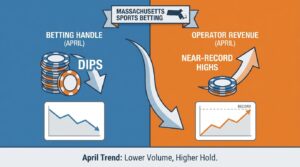
Massachusetts sportsbooks recorded a slight decline in total wagering during April 2025, yet operators managed to post one of their strongest revenue months since the state launched legal sports betting. The combination of favorable hold rates and shifting bettor behavior produced a month where less action somehow translated into more profit. It’s a pattern that underscores how mature the Massachusetts market is becoming, even as seasonal trends continue to shape handle volumes.
What April’s Numbers Reveal About Massachusetts Betting Economics
Before diving into the specifics, the broader picture matters. April’s performance suggests that Massachusetts operators are getting better at managing margins, and that the state’s tax revenue from sports wagering remains resilient even when bettors pull back slightly. Here are the key strategic takeaways:
- Total sports betting handle fell modestly compared to March, consistent with the seasonal drop-off after the NCAA basketball tournament and NFL postseason
- Gross gaming revenue remained near record levels, driven by operator hold percentages that outpaced recent monthly averages
- Online and mobile platforms continued to dominate, accounting for the vast majority of all wagers placed in the state
- Tax contributions to Massachusetts remained strong, reinforcing the fiscal case for regulated sports betting
- Retail sportsbook activity showed relative stability, though its share of total handle remains in the single digits
Handle Decline Meets Revenue Resilience
April is historically a softer month for U.S. sportsbooks. The March Madness frenzy fades, the NFL is months away, and while the NBA and NHL playoffs generate interest, they don’t match the sheer volume of football season. Massachusetts followed that national pattern.
Still, the revenue story diverged from the handle story in a way that deserves attention. Operators posted hold rates well above the trailing twelve-month average, meaning they kept a larger share of every dollar wagered. Whether that reflects sharper line-setting, less sophisticated bettor pools in the spring months, or simply variance is hard to pin down with one month of data. But the margin expansion was real.
That gap between handle and revenue is worth watching over the coming months.
How the Major Operators Performed
The competitive landscape in Massachusetts remains concentrated among a handful of dominant platforms. DraftKings, headquartered in Boston, continued to lead the market in both handle and revenue, leveraging its home-state advantage and aggressive promotional strategy. FanDuel maintained its position as the clear number two, with BetMGM and other licensed operators competing for the remaining share.
| Metric | April 2025 (Approx.) | Trend vs. March |
|---|---|---|
| Total Handle | Slight decline | Down modestly |
| Gross Gaming Revenue | Near-record | Up or flat |
| Operator Hold Rate | Above average | Higher than March |
| Online vs. Retail Split | ~90%+ online | Consistent |
| State Tax Revenue | Strong | Stable to higher, reflecting revenue gains |
The Mobile Wagering Engine
Online sportsbooks once again accounted for the overwhelming majority of bets placed. Retail locations (a distinction regulators have been slow to expand beyond the state’s existing casino properties) contributed a small but steady slice. This isn’t surprising. Across every U.S. state with both channels, mobile dominates by wide margins. Massachusetts is no exception.
What makes the Massachusetts mobile market particularly interesting is its density. The state’s population is concentrated in the Greater Boston metro area, where smartphone penetration and disposable income both skew high. That demographic profile supports not just volume but higher average bet sizes, which in turn supports the elevated revenue figures operators reported.
Regulatory and Fiscal Implications
Massachusetts taxes online sports betting revenue at 20% and retail at 15%. With gross gaming revenue running near record levels in April, the state’s take remained robust. For legislators who debated the merits of legalization for years before finally passing a bill in 2022, these numbers provide ammunition. And while no single month proves a long-term fiscal thesis, the consistency of Massachusetts tax receipts from sports betting has quieted some early skeptics.
Less clear is whether regulators will use this period of market stability to revisit promotional credit rules or adjust licensing frameworks. Several other states have tightened rules around how operators deduct promotional spending from taxable revenue. Massachusetts hasn’t signaled imminent changes, but the conversation is never far from the surface.
Bettor Psychology and Seasonal Patterns: Why Spring Tells a Different Story
Understanding why handle dips in spring while revenue holds firm requires looking beyond the calendar. Behavioral patterns among recreational bettors shift meaningfully once football ends. The casual bettor who places a few NFL parlays each weekend largely disappears by April. What remains is a more engaged, often more frequent bettor base following the NBA and NHL playoffs, along with MLB’s early season.
This residual pool tends to wager differently. Bet frequency may stay high, but individual wager sizes often decrease. Parlays, which carry higher theoretical hold for operators, remain popular among this group. The psychological pull of a potential big payout from a small stake keeps parlay volumes elevated even as straight bet handle softens. Operators understand this dynamic intimately and calibrate their promotional offers accordingly, targeting retention over acquisition during these months.
There’s also an anchoring effect at work. Bettors who experienced the intensity of March Madness or Super Bowl wagering carry a mental benchmark into spring. When their engagement naturally drops, they often perceive themselves as “taking a break” even while still placing regular bets. This self-narrative reduces the psychological friction associated with continued gambling, which arguably benefits operators during what would otherwise be a deeper seasonal trough. Platforms like FanDuel’s sportsbook lean into this by offering sport-specific promotions tied to playoff milestones, keeping users tethered to the app without requiring the same acquisition spend that football season demands.
The framing of bets matters too. Operators increasingly present wagers in terms of entertainment value rather than financial return, a subtle but effective reframing that aligns with how spring bettors already think about their activity. It’s not about winning money; it’s about staying in the game.
Frequently Asked Questions
How much did the Massachusetts sports betting handle drop in April?
The decline was modest, consistent with typical seasonal patterns seen after March Madness and the NFL postseason. Exact figures vary by reporting source, but the dip was not dramatic.
Why did revenue stay high even though handle fell?
Operators posted above-average hold rates in April, meaning they retained a larger percentage of each wager. Higher hold percentages can offset lower total volume, and that’s precisely what happened.
Which operator leads the Massachusetts market?
DraftKings continues to hold the top position in both handle and revenue. Being headquartered in Boston gives the company a brand recognition edge that competitors have struggled to close.
What tax rates apply to Massachusetts sports betting?
Online sports betting revenue is taxed at 20%, while retail sportsbook revenue faces a 15% rate. These rates have remained unchanged since the market launched.
Is Massachusetts likely to change its sports betting regulations soon?
No immediate regulatory overhaul has been signaled. That said, several states have recently revisited promotional credit deductions and licensing terms, and Massachusetts regulators are presumably watching those developments.



