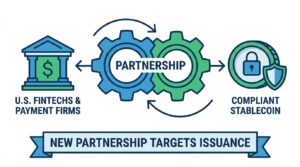
A newly announced partnership is positioning itself to simplify the process of issuing regulatory-compliant stablecoins in the United States, targeting fintechs, payment companies, and other enterprises looking to enter the digital dollar space. The collaboration addresses one of the most persistent friction points in crypto-adjacent finance: navigating the patchwork of U.S. regulatory expectations around stablecoin issuance. By combining infrastructure capabilities with compliance frameworks, the partners are betting that demand for white-label or turnkey stablecoin solutions will accelerate as federal legislation inches closer to reality.
What This Alliance Signals for U.S. Stablecoin Infrastructure
Before diving into the strategic takeaways, it’s worth framing the broader context. Stablecoin transaction volumes surpassed $10 trillion in 2024, and the U.S. remains both the largest demand center and the most legally ambiguous jurisdiction for issuers. Several bills, including the proposed GENIUS Act and the Clarity for Payment Stablecoins Act, have advanced through congressional committees but remain unsigned. That regulatory limbo has paradoxically created opportunity for infrastructure providers willing to build compliance-first tooling now, ahead of formal rules.
- Lowered barriers to entry: The partnership is designed to let companies issue stablecoins without building reserve management, licensing infrastructure, or compliance stacks from scratch.
- Regulatory front-running: By embedding compliance into the issuance layer, the partners are positioning clients to meet anticipated federal requirements before they take effect.
- Fintechs and payment firms gain a faster path to offering dollar-denominated digital tokens within their existing product ecosystems.
- Competitive pressure on incumbents: Circle and Tether currently dominate stablecoin supply. Enabling new entrants could fragment market share, at least at the margins.
- Enterprise-grade focus: The target audience isn’t crypto-native startups; it’s regulated financial services firms seeking programmable money rails.
Why Compliance-First Stablecoin Issuance Matters Now
The timing here is deliberate. U.S. regulators have spent much of the past two years signaling that stablecoins will be the first digital asset category to receive comprehensive federal oversight. The Office of the Comptroller of the Currency has already issued interpretive letters permitting national banks to hold stablecoin reserves, and state-level money transmitter frameworks have begun adapting to accommodate digital dollar products.
Still, the gap between regulatory intent and operational clarity remains wide. Most companies exploring stablecoin issuance face a tangle of state-by-state licensing requirements, reserve attestation standards that vary by jurisdiction, and anti-money laundering obligations that demand specialized infrastructure. Building all of that internally is expensive and slow (a distinction regulators have been slow to enforce between “unable” and “unwilling” to comply).
This partnership essentially offers a shortcut. By packaging reserve custody, compliance monitoring, and token issuance into an integrated service, it removes months of development time and millions in upfront cost. Whether that shortcut holds up under eventual federal scrutiny is a question the market hasn’t fully priced in.
The Competitive Landscape Shifts
Circle’s USDC and Tether’s USDT together account for more than 90% of the global stablecoin market by capitalization. But the next phase of stablecoin growth arguably won’t be driven by these two tokens alone. Instead, it may come from branded stablecoins issued by banks, neobanks, and payment processors seeking to embed programmable dollar functionality directly into their platforms.
PayPal’s launch of PYUSD in 2023 was an early signal. Visa’s experiments with stablecoin settlement on Solana and Ethereum pointed in the same direction. And while those efforts came from companies large enough to build proprietary infrastructure, the vast majority of mid-market fintechs lack that capacity. That’s precisely the gap this partnership targets.
| Factor | Current State | Expected Shift |
|---|---|---|
| Stablecoin issuers in the U.S. | Dominated by Circle, Tether, PayPal | Dozens of new entrants via turnkey platforms |
| Compliance infrastructure | Custom-built, expensive | Modular, embedded in issuance layer |
| Federal regulatory framework | Pending (GENIUS Act, others) | Expected within 12–18 months |
| Primary use case | Trading, cross-border transfers | Payroll, B2B payments, embedded finance |
How Enterprises Should Think About Stablecoin Strategy
For executives evaluating whether to issue a stablecoin, the calculus has shifted. A year ago, the question was whether the regulatory environment would permit it. Today, the question is whether waiting carries more risk than acting. Companies that delay may find themselves competing against rivals who already have compliant stablecoin infrastructure integrated into their payment flows, with established user bases and transaction volume.
The reframing matters psychologically as much as strategically. Decision-makers anchored to the “wait for clarity” posture may underestimate how quickly first-mover advantages compound in payments. Network effects in money movement are notoriously sticky. Once a stablecoin is embedded in a payroll system or a B2B settlement workflow, switching costs rise fast.
Yet the risks of moving too early aren’t trivial either. An issuer that launches under state money transmitter licenses today could face costly restructuring if federal legislation imposes different reserve or capital requirements. The partnership’s value proposition rests on its ability to absorb that regulatory adaptation on behalf of clients, but the details of how that works in practice remain thin.
Broader Implications for Digital Dollar Adoption
Arguably, the most consequential effect of partnerships like this one won’t be visible in market share charts. It will show up in the normalization of stablecoins as a payment primitive rather than a crypto curiosity. When a mid-sized payroll company or a cross-border remittance firm can issue a dollar-backed token as easily as it can open a bank account, the entire framing of “crypto adoption” changes.
That shift carries implications for the Federal Reserve’s own digital currency deliberations. Every compliant private stablecoin that enters circulation reduces the urgency (and political appetite) for a central bank digital currency. Whether that outcome is intentional or incidental depends on whom you ask.
Frequently Asked Questions
What is a compliant stablecoin?
A compliant stablecoin is a digital token pegged to a fiat currency, typically the U.S. dollar, that meets applicable regulatory requirements including reserve backing, licensing, and anti-money laundering obligations. The specific requirements vary by jurisdiction.
Who benefits most from turnkey stablecoin issuance platforms?
Mid-market fintechs and payment companies stand to gain the most. These firms often have the customer base and transaction volume to justify a branded stablecoin but lack the internal resources to build compliance and reserve management infrastructure independently.
When is U.S. stablecoin legislation expected?
Multiple bills are advancing through Congress, with the GENIUS Act among the most prominent. Industry observers and legislative analysts generally expect some form of federal stablecoin framework within the next 12 to 18 months, though timelines remain uncertain.



