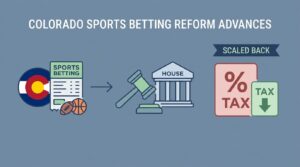
Colorado legislators have pushed a sports betting reform bill forward to the state House, though not before stripping out one of its most contentious provisions. The measure, which originally sought to impose a significantly higher tax rate on licensed operators, was amended in committee to soften the fiscal blow on the industry while still directing new revenue toward water infrastructure and problem gambling programs. The bill’s progression marks a pivotal moment for Colorado’s regulated betting market, now among the most competitive in the United States.
What the Amended Bill Actually Changes for Colorado’s Betting Market
Before diving into the strategic implications, it helps to frame what this legislation does — and what it no longer does — for operators and state coffers alike.
- Tax rate rollback: The original proposal to sharply increase the tax on adjusted gross sports betting revenue was scaled back during committee deliberations, preserving a more operator-friendly rate structure
- Revenue earmarked for water projects and responsible gambling initiatives remains a central feature of the bill
- Regulatory tightening: Provisions around advertising standards and consumer protections were retained, signaling that lawmakers still intend to impose stricter guardrails on how sportsbooks market to Colorado residents
- The bill must still clear the full House and Senate before reaching the governor’s desk, leaving room for further amendments
- Industry response has been cautiously optimistic, with operators viewing the tax compromise as a workable middle ground — at least on paper
Why Lawmakers Retreated on the Tax Hike
Colorado’s sports betting ecosystem launched in May 2020, and the state has consistently ranked among the top markets nationally by handle volume. That success, however, created a political paradox: strong betting activity paired with relatively modest tax revenue compared to states like New York, which levies a 51% rate on mobile sports wagering. Some Colorado legislators saw an opportunity to close that gap.
But the comparison is misleading in important ways. New York’s punishing tax rate operates alongside a limited-license model that restricts competition. Colorado, by contrast, runs an open-market framework with dozens of licensed operators. Raising taxes dramatically in that environment risks pushing smaller operators out entirely, concentrating the market among a handful of well-capitalized firms. Committee members appeared to recognize this dynamic when they voted to pare back the rate increase.
Still, the political appetite for higher betting taxes hasn’t vanished. It has simply been deferred.
Revenue Allocation: Water and Responsible Gambling
One element that survived the amendment process largely intact is the bill’s revenue distribution framework. A meaningful share of new tax proceeds would flow toward Colorado’s state water plan, which faces a multibillion-dollar funding shortfall over the coming decades. The western state’s water infrastructure needs are acute, and lawmakers from both parties have been searching for sustainable funding mechanisms that don’t require general fund appropriations.
A separate allocation targets problem gambling services. Colorado’s Division of Gaming has reported steady increases in self-exclusion requests since the market launched, a trend that mirrors national patterns as mobile betting becomes more accessible. The bill would expand funding for treatment programs, helpline operations, and public awareness campaigns (a distinction regulators have been slow to enforce in practice, despite growing demand for these services).
How Colorado’s Tax Framework Compares
| State | Tax Rate (Online) | Market Model | Launch Year |
|---|---|---|---|
| Colorado (current) | 10% | Open market, 25+ operators | 2020 |
| New York | 51% | Limited licenses (9 platforms) | 2022 |
| New Jersey | 14.25% | Casino-tethered, competitive | 2018 |
| Illinois | Up to 40% (tiered) | Tiered by revenue, evolving | 2020 |
| Colorado (proposed, amended) | Details under negotiation | Open market retained | — |
The Advertising Question Nobody Fully Answered
Tucked within the bill are provisions tightening how sportsbooks can advertise in Colorado. These include restrictions on bonus-offer language, mandatory responsible gambling disclosures in promotional materials, and potential limits on advertising density during live sports broadcasts. The provisions echo regulatory moves in the United Kingdom and several Australian states, where advertising saturation became a public backlash trigger before legislators intervened.
Whether Colorado’s proposed rules go far enough is debatable. And whether enforcement mechanisms have real teeth remains an open question that the bill’s current text doesn’t fully resolve.
What Operators Should Be Watching Next
For sportsbooks operating in Colorado, the amended bill represents a compromise rather than a victory. The tax rate, while lower than initially proposed, still moves upward. Advertising constraints will require compliance adjustments. And the legislative journey isn’t over — the full House vote introduces another round of potential amendments, followed by Senate consideration.
Operators with thinner margins may find even a modest tax increase difficult to absorb without adjusting promotional spending or odds offerings. Larger platforms like DraftKings and FanDuel, which dominate Colorado’s market share, are better positioned to weather incremental cost increases. Yet even they have publicly lobbied against steep rate hikes in other jurisdictions, arguing that excessive taxation ultimately shrinks the legal market and pushes bettors toward unregulated alternatives.
The bill’s fate in the full House will likely hinge on whether legislators view the current compromise as sufficient to fund their water and public health priorities — or whether pressure builds to restore a higher rate before the session ends.
Frequently Asked Questions
What is Colorado’s current sports betting tax rate?
Colorado taxes adjusted gross sports betting revenue at 10%, one of the lower rates among U.S. states with legal mobile wagering.
Why was the original tax increase scaled back?
Committee members weighed concerns that a sharp rate hike could disadvantage smaller operators in Colorado’s open-market model, potentially consolidating the industry among a few dominant platforms. The compromise preserves competitive dynamics while still generating additional revenue.
Where would the new tax revenue go?
Primarily toward Colorado’s water infrastructure plan and expanded problem gambling services, including treatment programs and public awareness efforts.
Is the bill finalized?
No. It must pass the full House, then the Senate, and could face further amendments at each stage before reaching the governor.