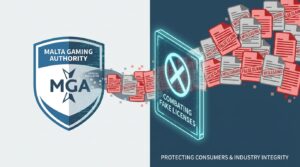
The Malta Gaming Authority (MGA) has once again moved to flag operators falsely claiming to hold its licence, a recurring problem that continues to undermine trust in one of Europe’s most established gambling regulatory frameworks. In its latest enforcement update, the regulator identified multiple entities misrepresenting their licensing status to attract players under the pretence of regulatory oversight. The issue, while not new, has grown more persistent and arguably more sophisticated in recent months. For an authority that has spent years building credibility as a gold-standard regulator, each fraudulent claim chips away at that reputation.
Why the MGA’s Licensing Integrity Problem Keeps Resurfacing
Before diving into the specifics, it’s worth framing what’s at stake. The MGA licence is among the most recognised credentials in the global iGaming sector, and that recognition is precisely what makes it a target for misuse. Operators that falsely display MGA branding or claim authorisation gain an unearned layer of consumer trust, which translates directly into player deposits and market access. The business implications extend beyond the fraudulent operators themselves; they affect every legitimately licensed entity competing in the same space.
- The MGA has repeatedly issued public notices identifying entities making false and misleading claims about holding a valid licence
- Unauthorised use of the MGA’s name and logo creates a two-tier credibility problem: consumers are deceived, and legitimate licensees face reputational spillover
- Regulatory enforcement remains reactive rather than preventive, raising questions about whether current tools are sufficient to deter misuse at scale
- The pattern suggests that bad actors view the risk-reward calculus as favourable, particularly when operating from jurisdictions with limited cross-border enforcement cooperation
- Industry stakeholders have called for stronger verification mechanisms, including real-time licence validation tools accessible to players
What the MGA Has Actually Done
The regulator maintains a public register of licensed entities, and it periodically publishes lists of companies that have been found to falsely claim MGA authorisation. These notices serve a dual function: alerting consumers and putting the broader market on notice. But the cadence of these announcements tells its own story. That the MGA must keep issuing them suggests the problem is not shrinking.
In practice, the MGA’s enforcement toolkit includes licence revocation, financial penalties, and public blacklisting. It has also pursued cooperation with other European regulators and law enforcement bodies to address cross-border violations. Still, the nature of online gambling makes jurisdictional enforcement inherently difficult. An operator registered in a non-cooperative jurisdiction can display an MGA logo on its website with relative impunity, at least until the regulator catches up.
One sentence captures the tension well: the MGA’s brand is strong enough to be worth stealing, but not yet protected by mechanisms fast enough to prevent the theft.
The Broader Regulatory Landscape and Cross-Border Gaps
This isn’t a problem unique to Malta. Regulators across the European Economic Area face similar challenges, from the UK Gambling Commission to Sweden’s Spelinspektionen. What distinguishes the MGA’s situation is the sheer volume of operators it oversees and the global reach of its licence. With hundreds of active licensees and a regulatory framework that covers B2B and B2C operations alike, the surface area for misuse is vast.
Cross-border enforcement gaps compound the issue. When an unlicensed operator targets players in Germany or the Netherlands while falsely claiming MGA credentials, the regulatory response requires coordination between multiple national authorities. That coordination is improving (the European Forum of Gambling Regulators has made strides), but it remains slow relative to the speed at which fraudulent sites can launch and rebrand.
| Enforcement Mechanism | Current Status | Effectiveness |
|---|---|---|
| Public blacklisting of unauthorised entities | Active, regularly updated | Moderate; relies on consumer awareness |
| Licence verification register | Available on MGA website | Useful but underutilised by players |
| Cross-border regulatory cooperation | Expanding through EU frameworks | Limited by jurisdictional fragmentation |
| Financial penalties for misuse | Applied where jurisdiction permits | Difficult to enforce against offshore entities operating outside cooperative frameworks |
How Players and Industry Stakeholders Can Protect Themselves
The Malta Gaming Authority’s official licence verification page remains the most reliable tool for confirming whether an operator holds a valid licence. Yet awareness of this resource among casual players is low. Industry groups have suggested embedding real-time verification widgets directly into operator websites, a move that would shift the burden of proof from the consumer to the platform.
For B2B providers, the implications are equally significant. Affiliate networks and software suppliers that partner with unlicensed operators risk their own regulatory standing. Due diligence processes need to account not just for whether a partner claims to hold a licence, but whether that claim can be independently verified in real time. Several compliance technology firms have begun offering automated licence-checking APIs, though adoption remains uneven across the sector.
Reframing the Problem: Trust Architecture in Digital Gambling
At its core, the false licensing issue is a trust architecture problem. The iGaming industry operates in a digital environment where visual cues (logos, badges, licence numbers) substitute for the physical trust signals that exist in brick-and-mortar gambling. When those digital signals can be copied and deployed without consequence, the entire trust framework weakens. And weakened trust doesn’t just hurt regulators; it suppresses market growth by making cautious consumers reluctant to engage with legitimate platforms.
Behavioural research in consumer decision-making suggests that trust signals operate on a heuristic level. Players don’t verify; they recognise. A familiar logo triggers a cognitive shortcut that bypasses critical evaluation. This is precisely the mechanism that fraudulent operators exploit. Addressing it requires more than enforcement after the fact. It demands a redesign of how licensing credentials are presented and validated in the digital space, moving from static images to dynamic, verifiable trust markers that cannot be replicated by unauthorised parties.
The concept of “anchoring” also plays a role here. Once a player has formed an initial impression of an operator’s legitimacy based on a displayed licence, subsequent red flags are psychologically discounted. This anchoring effect means that the damage from false licensing claims is front-loaded: by the time a player encounters contradictory information, the initial trust anchor has already shaped their behaviour and, often, their deposits.
Frequently Asked Questions
How can I check if an online casino is genuinely licensed by the MGA?
Visit the MGA’s official website and use their licence verification tool. Enter the operator’s name or licence number to confirm its status directly with the regulator, rather than relying on logos or claims displayed on the operator’s own site.
What happens to operators caught falsely claiming MGA authorisation?
The MGA publicly identifies these entities and may pursue enforcement action where jurisdictional reach allows. In practice, operators based in non-cooperative jurisdictions are harder to penalise, which is part of why the problem persists.
Does a false MGA licence claim mean the operator is necessarily fraudulent in other ways?
Not automatically, but it is a significant red flag. An operator willing to misrepresent its regulatory status has already demonstrated a disregard for transparency, and that pattern rarely stops at the licence badge.