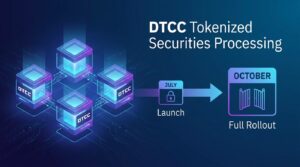
The Depository Trust & Clearing Corporation (DTCC) has confirmed plans to begin processing a limited set of tokenized trades through its DTC unit starting in July 2025, with a broader rollout scheduled for October. The move marks one of the most significant steps yet by a legacy financial market infrastructure provider to integrate blockchain-based assets into mainstream post-trade workflows. For an industry that has spent years debating whether tokenization would reshape capital markets, the timeline now has concrete dates attached to it.
What DTCC’s Tokenization Timeline Signals for Capital Markets
The phased approach reflects both ambition and caution. Rather than flipping a switch, DTCC is staging its entry into tokenized asset processing with a controlled initial phase before scaling up. Here’s what matters most for market participants:
- July 2025 marks the start of limited tokenized trade processing through the DTC unit, targeting a narrow set of eligible instruments and counterparties during the pilot window.
- By October, the service expands to a broader universe of tokenized securities, potentially covering a wider range of asset classes and participants.
- This positions DTCC as a central node in the tokenized securities ecosystem, reinforcing its role as the backbone of U.S. post-trade infrastructure even as the underlying technology shifts.
- Firms that have been building tokenization capabilities in isolation now face a clearer integration path with existing clearing and settlement rails.
- The timeline also puts pressure on competing infrastructure providers and blockchain-native platforms to demonstrate interoperability or risk being sidelined.
Why the DTC Unit Is the Right Entry Point
DTCC’s decision to route tokenized trade processing through its DTC subsidiary is deliberate. The Depository Trust Company already handles custody and settlement for the vast majority of U.S. equities and fixed-income securities. Layering tokenized asset support onto this existing framework reduces friction for broker-dealers and institutional investors who are already embedded in DTC’s operational ecosystem.
That matters more than it might seem at first glance.
One of the persistent barriers to tokenized securities adoption has been the gap between blockchain-native issuance platforms and traditional post-trade systems. Tokens issued on distributed ledgers still need to settle, clear, and reconcile against the same regulatory and operational standards as conventional instruments. By anchoring tokenized processing within DTC, DTCC is effectively saying: the plumbing doesn’t need to be rebuilt from scratch. It needs to be extended. Whether that framing satisfies blockchain purists who envisioned a more radical overhaul of market structure is another question entirely.
Market Context: Tokenization Gains Institutional Traction
DTCC’s announcement lands in a market environment where tokenization has moved well past the proof-of-concept stage. BlackRock’s BUIDL fund, launched on the Ethereum blockchain, crossed $1 billion in assets under management earlier this year. JPMorgan’s Onyx platform has processed hundreds of billions in tokenized repo transactions. And multiple sovereign debt issuers have experimented with blockchain-based bond offerings.
Still, most of this activity has occurred in parallel to (not through) traditional market infrastructure. The gap between tokenized issuance and standardized post-trade processing has created operational complexity that limits scalability. DTCC’s entry addresses that bottleneck directly.
| Phase | Timeline | Scope |
|---|---|---|
| Pilot launch | July 2025 | Limited tokenized trades, select participants |
| Broad rollout | October 2025 | Expanded asset coverage, wider market access |
| Full integration (projected) | To be confirmed | DTCC has not disclosed a specific date for complete integration across all eligible asset types |
How This Reshapes the Competitive Landscape
For blockchain-native settlement platforms, DTCC’s move is a double-edged development. On one hand, it validates the thesis that tokenized securities will become a meaningful part of capital markets infrastructure. On the other, it raises the stakes considerably. Competing with DTCC on post-trade processing requires not just superior technology but also the regulatory trust, network effects, and institutional relationships that DTCC has built over decades.
Arguably, the firms best positioned to benefit are those already operating at the intersection of traditional finance and digital assets. Custodians with dual capabilities, broker-dealers investing in tokenization readiness, and technology vendors building middleware between blockchain protocols and legacy systems all stand to gain from a clearer integration pathway.
But smaller, blockchain-first platforms may find their addressable market narrowing if DTCC captures the institutional segment early.
Regulatory Alignment and What Remains Unresolved
DTCC operates under SEC oversight, which gives its tokenized processing service an implicit regulatory endorsement that standalone blockchain platforms lack (a distinction regulators have been slow to formalize). The SEC has yet to issue comprehensive guidance on how tokenized securities should be treated across the full trade lifecycle, from execution through to final settlement.
What DTCC’s phased approach does, in practice, is create a de facto regulatory sandbox within an already-regulated entity. The July pilot will likely generate operational data and compliance insights that inform both DTCC’s own scaling decisions and, potentially, the SEC’s rulemaking agenda. Whether the Commission uses this as a template or treats it as one input among many remains to be seen.
Frequently Asked Questions
What types of tokenized securities will DTCC process initially?
DTCC has indicated the July pilot will cover a limited set of tokenized instruments, though the specific asset classes and eligibility criteria have not been publicly detailed. Broader coverage is expected with the October expansion.
Does this replace blockchain-based settlement?
No. DTCC’s service integrates tokenized assets into existing post-trade infrastructure rather than replacing distributed ledger technology. The goal is interoperability, not displacement.
How does this affect firms already using tokenization platforms?
Firms with existing tokenization capabilities may benefit from a standardized integration point with DTC’s clearing and settlement systems. The competitive implications vary depending on whether a firm is building complementary tools or directly competing with DTCC’s post-trade services.
Will international markets be affected?
DTCC’s initial rollout focuses on U.S. markets through its DTC subsidiary. Cross-border implications will depend on how other central securities depositories respond and whether interoperability standards emerge across jurisdictions. That conversation, at least on paper, has barely started.



