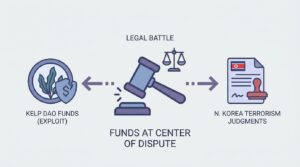
A freshly filed emergency motion is contesting a New York court order that would divert recovered funds from the Kelp DAO exploit toward satisfying decades-old terrorism judgments against North Korea. The dispute sits at an unusual intersection of decentralized finance recovery, sovereign immunity doctrine, and long-standing claims by victims of state-sponsored terrorism. At stake is not just the fate of these particular funds, but a broader question about how courts treat recovered crypto assets when competing legal claims collide.
What the Emergency Motion Actually Challenges
The motion targets a court order that would redirect funds originally recovered from the Kelp DAO exploit. Rather than returning those assets to the protocol or its affected users, the order channels them toward plaintiffs holding judgments against North Korea for terrorism-related acts, some dating back decades. The legal theory connecting the two rests on allegations that North Korean-linked actors were behind the exploit, a claim that, at least on paper, would allow terrorism judgment holders to intercept recovered proceeds under certain U.S. statutes.
But the emergency motion argues this redirection is improper. The filing challenges both the procedural basis for the order and the substantive leap required to treat DeFi exploit recoveries as attachable assets belonging to a foreign sovereign. Whether the court agrees will hinge on questions that have rarely, if ever, been tested in this specific configuration.
Why This Case Carries Weight Beyond the Courtroom
Before unpacking the strategic implications, it helps to frame what makes this dispute unusual. DeFi exploit recoveries have grown more common as on-chain forensics improve and law enforcement cooperation expands. Yet the legal infrastructure for returning those funds remains patchy. This case threatens to complicate that infrastructure further by introducing a competing claimant class that most protocol teams and recovery specialists have never had to account for.
- Precedent risk for DeFi recoveries: If the court upholds the redirection, future exploit recoveries could face similar interception by judgment creditors, creating uncertainty for protocols and their users about whether recovered funds will actually come home.
- North Korea attribution as a legal lever: The case depends on linking exploit proceeds to North Korean actors. That attribution, increasingly common in blockchain forensics reports, now carries direct financial consequences in civil litigation.
- Terrorism judgment holders have long struggled to collect on their awards against North Korea, given the regime’s limited attachable assets in U.S. jurisdiction. Crypto recoveries represent a novel enforcement mechanism.
- Protocol governance implications: DAOs and protocol teams may need to consider legal strategies for recovered funds before exploits even occur, building recovery frameworks that account for third-party claims.
The North Korea Connection: Attribution and Its Consequences
U.S. authorities and private blockchain analytics firms have attributed a growing share of DeFi exploits to North Korean-linked hacking groups, most prominently the Lazarus Group. The sums are staggering. According to multiple industry reports, North Korean-affiliated actors stole over $1.7 billion in cryptocurrency during 2022 alone, with the figure remaining elevated in subsequent years.
This attribution pattern has consequences that extend well beyond criminal prosecution. Under U.S. law, holders of terrorism-related judgments against state sponsors of terrorism can, in certain circumstances, attach assets connected to those states. The legal pathway is narrow and contested (a distinction regulators and courts have been slow to clarify), but the Kelp DAO case represents one of its most concrete tests in the crypto space.
Kelp DAO’s restaking protocol and its community now find themselves caught between two sympathetic claimant groups: users who lost funds in the exploit and terrorism victims who have waited years for meaningful compensation.
How Courts Have Handled Competing Claims on Crypto Assets
There is limited but growing case law around competing claims on seized or recovered digital assets. The U.S. Department of Justice has pursued civil forfeiture actions against North Korean-linked crypto on multiple occasions, sometimes resulting in funds being directed toward victim restitution in terrorism cases. Still, those actions typically involve government-initiated seizures rather than private exploit recoveries routed through DeFi protocols.
| Scenario | Typical Outcome | Kelp DAO Difference |
|---|---|---|
| Government-seized crypto from sanctioned entities | Forfeiture, potential terrorism victim restitution | These funds were recovered through protocol-level action, not government seizure |
| Exchange-frozen funds linked to hacks | Returned to victims or held pending litigation | No centralized exchange intermediary involved |
| Private recovery of exploit proceeds | Generally returned to affected protocol/users | Court order redirects funds to unrelated judgment creditors, which is largely unprecedented |
The asymmetry is clear. And it raises a harder question: does the method of recovery determine who has priority over the funds?
Strategic Framing for DeFi Protocols and Legal Teams
For protocol operators watching this case, the practical takeaway is uncomfortable. Recovery efforts that succeed on-chain may face legal challenges off-chain that redirect the very assets teams worked to reclaim. This dynamic arguably changes the cost-benefit calculus of pursuing recoveries in the first place, particularly when attribution points toward sanctioned state actors.
Legal counsel advising DAOs should be evaluating whether pre-exploit governance frameworks can establish clearer claims over recovered funds. Proactive legal structuring, including jurisdiction selection and standing documentation, may prove more valuable than reactive litigation once funds are already in dispute. The alternative is a growing queue of third-party claimants who view every successful DeFi recovery as a potential enforcement opportunity.
Frequently Asked Questions
What is the Kelp DAO exploit?
The Kelp DAO exploit involved the unauthorized extraction of funds from the protocol. Recovery efforts subsequently reclaimed a portion of those assets, which are now subject to competing legal claims in a New York court.
Why are terrorism judgment holders involved?
Plaintiffs holding decades-old terrorism judgments against North Korea are seeking to attach the recovered funds, arguing that North Korean-linked actors were responsible for the exploit. U.S. law provides limited mechanisms for terrorism victims to collect against state sponsors through connected assets.
Could this affect other DeFi protocols?
Yes. If the court’s order stands, it creates a template that terrorism judgment creditors and potentially other judgment holders could use to intercept future DeFi exploit recoveries linked to sanctioned actors. The ripple effects would be significant.
What happens next in the case?
The emergency motion will be heard by the New York court. The outcome depends on whether the court finds that recovered DeFi exploit funds qualify as attachable assets under the relevant terrorism-related statutes, a question without clear precedent.