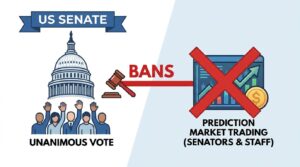
The United States Senate has unanimously adopted an immediate prohibition on prediction market activity by its members and staff. The resolution, passed without opposition, bars senators and their employees from trading on platforms that allow wagers on political, legislative, or electoral outcomes. It marks the first formal restriction of its kind at the federal legislative level, arriving amid surging public interest in prediction markets and growing scrutiny of potential conflicts of interest in Congress.
What the Senate’s Prediction Market Ban Means for Policy and Platform Operators
This vote did not emerge in a vacuum. The decision reflects mounting unease over the intersection of speculative trading and legislative power, particularly as platforms like Kalshi’s regulated prediction exchange and Polymarket have expanded their offerings to include contracts tied to congressional votes, policy decisions, and election results. Here are the core strategic takeaways:
- Immediate enforcement: The ban takes effect right away, with no phase-in period, signalling the Senate’s urgency in addressing perceived ethical exposure.
- Scope covers both principals and staff: Unlike some financial disclosure rules that apply unevenly, this resolution captures senators and all employees, closing a gap that critics had flagged.
- The resolution does not extend to the House of Representatives, leaving a notable asymmetry in congressional ethics standards.
- No criminal penalties attached (yet): The ban operates through Senate ethics rules rather than statute, meaning enforcement will fall to the Senate Ethics Committee rather than federal prosecutors.
- Signal to regulators: The unanimous nature of the vote gives the CFTC and SEC a clear political mandate to scrutinize prediction market operators more aggressively.
Why Prediction Markets Drew Senate Attention
Prediction markets have existed in various forms for decades, but the 2024 election cycle pushed them into mainstream visibility. Polymarket alone processed billions of dollars in volume around the US presidential race. Kalshi, which holds a CFTC-regulated designation, fought a legal battle to list election-related contracts and won a federal court ruling in its favour last year.
That expansion created an uncomfortable question. If a senator knows the trajectory of a bill before the public does, could they profit from a prediction market contract tied to that bill’s passage? The scenario is not hypothetical; it mirrors the insider trading concerns that led to the STOCK Act in 2012, which restricted congressional stock trading (a distinction regulators have been slow to enforce consistently).
Still, prediction markets differ from equities in a fundamental way. They are zero-sum instruments whose value derives entirely from the outcome of a discrete event. A senator trading on whether their own committee will advance a nominee is arguably more direct than buying shares in a defence contractor before a procurement vote. The ethical surface area is, in practice, wider.
How the Ban Was Structured
The resolution adopted by the Senate defines “prediction market activity” broadly. It encompasses any transaction on a platform, whether regulated or unregulated, domestic or offshore, that involves contracts contingent on political, legislative, or electoral events. The definition also captures derivatives and synthetic instruments that replicate prediction market exposure.
Enforcement sits with the Senate Select Committee on Ethics. Violations could result in sanctions ranging from public censure to referral for further investigation. What remains less clear is how the committee plans to monitor compliance, particularly given the pseudonymous nature of blockchain-based platforms like Polymarket, which operates primarily through cryptocurrency wallets.
| Feature | Senate Prediction Market Ban | STOCK Act (2012) |
|---|---|---|
| Scope | Senators and all Senate staff | Members of Congress, senior staff, executive branch officials |
| Covered instruments | Prediction market contracts on political/legislative/electoral events | Stocks, bonds, commodities, and other securities |
| Enforcement body | Senate Ethics Committee | DOJ, SEC, and congressional ethics offices |
| Penalties | Ethics sanctions; no statutory criminal penalties currently | Civil and criminal penalties, including fines and imprisonment |
| Effective date | Immediate upon adoption | Signed into law April 2012, with subsequent amendments weakening disclosure requirements |
The House Gap: A Regulatory Asymmetry
One detail that deserves attention: the House of Representatives has not adopted a parallel measure. That gap matters. Senate staff who move to House offices, or lobbyists who interact with both chambers, operate under different rules depending on which side of the Capitol they’re standing on. Whether House leadership follows the Senate’s lead will likely depend on how much political pressure builds during the current session.
Broader Implications for Prediction Market Operators
For platforms themselves, the Senate vote carries weight beyond its direct jurisdictional reach. A unanimous resolution from one chamber of Congress sends a clear message to the CFTC, which has been weighing how aggressively to regulate event contracts. The Commodity Futures Trading Commission had already proposed rules to limit certain types of political event contracts, and this vote arguably strengthens the agency’s hand.
Platform operators now face a dual challenge. They must demonstrate that their markets serve a legitimate price-discovery function while simultaneously building compliance infrastructure robust enough to screen for prohibited participants. Kalshi, as a CFTC-registered exchange, has existing KYC protocols. Polymarket, which routes most activity through decentralised wallets, faces a harder technical problem.
And while the ban targets participants rather than platforms, the reputational risk for any exchange that inadvertently facilitates prohibited trading by a Senate staffer could be severe.
What Industry Participants Should Watch Next
The Senate’s move opens several threads that will unfold over the coming months. The CFTC’s pending rulemaking on event contracts could incorporate language mirroring the Senate resolution. House leadership faces growing pressure to act. And prediction market operators must reckon with the possibility that congressional trading bans are just the first layer of a broader regulatory framework targeting political event contracts.
At least on paper, the Senate has drawn a bright line. Whether that line holds depends on enforcement mechanisms that, for now, remain largely undefined.
Frequently Asked Questions
Does this ban apply to all members of Congress?
No. The resolution applies only to US senators and Senate staff. The House of Representatives has not adopted an equivalent measure, creating an uneven standard across the two chambers.
Are prediction markets themselves now illegal?
They are not. The ban restricts who can participate, not whether the markets can operate. Platforms like Kalshi continue to function under CFTC oversight, and no new restrictions on platform operations were included in the resolution.
What happens if a senator violates the ban?
Violations fall under the jurisdiction of the Senate Ethics Committee, which can impose sanctions including public censure. There are currently no statutory criminal penalties tied specifically to this resolution, though existing insider trading laws could apply in certain circumstances.
Could this lead to a broader federal ban on political prediction markets?
Possibly. The unanimous vote gives regulators political cover to pursue tighter rules. The CFTC has already signalled interest in restricting certain categories of event contracts, and congressional action tends to accelerate agency rulemaking.



