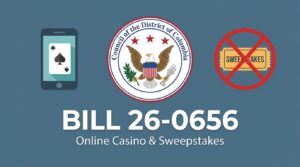
Washington, D.C.’s Committee on Human Services held a nearly four-hour hearing on Bill 26-0656, the “Internet Gaming and Consumer Protection Act of 2026,” a proposal that would legalise online casinos in the District while outlawing the dual-currency sweepstakes casino model entirely. Introduced by Councilmember Wendell Felder (D-Ward 7), the bill targets what Felder described as a $700 million illegal gambling market already operating within District boundaries. The hearing drew testimony from responsible gaming advocates, regulatory officials, and industry stakeholders, exposing sharp divides over how the capital should regulate digital wagering.
What Bill 26-0656 Would Actually Change for DC’s Gambling Market
Before unpacking the strategic implications, it helps to understand the scope of what the legislation attempts. The bill would create a licensed, regulated online casino framework under District oversight, while simultaneously shutting down sweepstakes casinos that use dual-currency systems to operate in legal grey areas. Felder’s opening remarks positioned the measure as both a consumer protection initiative and a revenue opportunity, arguing that unregulated operators already serve District residents without any of the safeguards or tax contributions a licensed regime would require.
- Revenue recapture: The bill explicitly aims to redirect a portion of the estimated $700 million flowing through unlicensed channels into a taxed, regulated framework.
- Sweepstakes model elimination: Dual-currency sweepstakes casinos, which skirt traditional gambling definitions by using virtual coins alongside cash-redeemable prizes, would face a complete ban under the proposed legislation.
- The regulatory structure envisions a licensing process that could attract established operators already active in legalised U.S. markets, potentially reshaping DC’s competitive landscape.
- Consumer safeguards: Responsible gaming provisions featured prominently in testimony, with advocates pressing for deposit limits, self-exclusion tools, and mandatory operator contributions to problem gambling programmes.
- Whether the Council of the District of Columbia can move the bill through committee and secure full council support remains an open question, particularly given the lobbying weight of sweepstakes operators.
The Sweepstakes Casino Problem
Dual-currency sweepstakes casinos occupy a peculiar niche in American gambling. They allow users to play casino-style games using virtual currencies, with one currency purchasable and another awarded for free, redeemable for cash prizes. Operators argue this structure falls outside the legal definition of gambling because no direct purchase of a chance to win is required. Regulators in several states have disagreed, and the model has drawn increasing scrutiny from attorneys general and consumer protection agencies nationwide.
Felder’s bill takes an unambiguous position: the model is gambling, and it should be treated as such.
That stance matters beyond DC. If the District successfully bans sweepstakes casinos while simultaneously creating a licensed online casino market, it establishes a template other jurisdictions could follow. Several state legislatures have struggled to classify sweepstakes platforms (a distinction regulators have been slow to enforce), and a clear legislative prohibition paired with a viable legal alternative could accelerate similar efforts elsewhere.
Who Testified and What They Said
The hearing’s witness list reflected the tension at the centre of this debate. Industry advocates for licensed online gambling emphasised the consumer protection benefits of regulation, pointing to geolocation technology, identity verification, and responsible gaming tools already deployed in states like New Jersey and Pennsylvania. Responsible gaming experts, meanwhile, urged the committee to build robust safeguards into any legalisation framework rather than treating them as afterthoughts.
Not everyone at the table agreed on the path forward. Sweepstakes industry representatives pushed back against the proposed ban, arguing their platforms provide entertainment options that differ fundamentally from traditional casino gambling. Still, the weight of testimony appeared to favour regulation over the status quo, with multiple witnesses describing the current environment as untenable for consumers who lack any recourse when disputes arise with unlicensed operators.
A $700 Million Market Operating Without Guardrails
Felder’s $700 million figure deserves scrutiny. The number represents an estimate of illegal and unregulated gambling activity within the District, though the methodology behind it was not detailed during the hearing. Even if the actual figure sits lower, the underlying point holds: a substantial volume of gambling activity occurs in DC without licensing, taxation, or consumer protection oversight. Arguably, the precise dollar amount matters less than the regulatory vacuum it represents.
How This Fits the Broader U.S. Online Gambling Landscape
Since the Supreme Court’s 2018 decision in Murphy v. NCAA struck down the federal ban on sports betting, states have moved at varying speeds to legalise different forms of online wagering. Sports betting has expanded rapidly, with more than 30 states now offering legal markets. Online casino legalisation has proceeded more cautiously, with only a handful of states operating regulated iGaming frameworks.
| Jurisdiction | Online Casino Status | Sweepstakes Stance |
|---|---|---|
| New Jersey | Legal since 2013 | Regulated separately |
| Pennsylvania | Legal since 2019 | Under review |
| Michigan | Legal since 2021 | No explicit ban |
| Washington, D.C. (proposed) | Proposed under Bill 26-0656 | Full ban proposed |
| Connecticut | Legal since 2021 | Limited enforcement activity |
DC’s proposal is distinctive because it bundles online casino legalisation with an explicit sweepstakes prohibition. Most states that have legalised iGaming have dealt with sweepstakes platforms through enforcement actions or regulatory guidance rather than outright legislative bans. The District’s approach, if enacted, would be among the most aggressive in the country.
What Operators and Stakeholders Should Watch
For licensed operators eyeing the DC market, the bill signals opportunity. A regulated framework with clear licensing requirements and consumer protection mandates creates the kind of predictable environment that major operators prefer. Companies already holding licences in multiple U.S. states would likely be well-positioned to enter the District quickly.
But the sweepstakes industry faces a different calculus. A ban in the nation’s capital carries symbolic weight beyond its immediate market impact. DC is small geographically, yet its legislative actions often attract outsized attention from federal policymakers and other jurisdictions. Sweepstakes operators who have built business models around regulatory ambiguity may find that ambiguity harder to sustain if the District draws a firm line.
And while the bill’s prospects remain uncertain, the length and depth of the hearing suggest the committee is taking the proposal seriously. Four hours of testimony is not a perfunctory exercise.
Frequently Asked Questions
What are dual-currency sweepstakes casinos?
These platforms let users play casino-style games using two types of virtual currency. One can be purchased; the other is given away free and can be redeemed for cash prizes. Operators contend this structure does not constitute gambling under most existing state laws, though that interpretation is increasingly contested.
Would Bill 26-0656 legalise sports betting in DC?
No. Sports betting is already legal in the District under separate legislation enacted in 2018. Bill 26-0656 focuses specifically on online casino games and the sweepstakes model.
How much tax revenue could DC generate from legal online casinos?
The bill’s proponents have cited the $700 million illegal market as a baseline, but specific tax rate proposals and revenue projections were not fully detailed during the hearing. Comparable states have generated tens of millions annually from iGaming taxes, though DC’s smaller population would likely yield more modest figures.
When could the bill become law?
The legislation must clear committee, receive full council approval, and undergo a congressional review period unique to DC governance. No firm timeline has been established, and amendments during the committee process could alter key provisions substantially.



