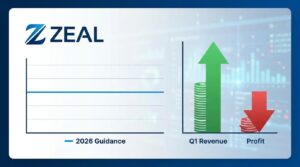
ZEAL Network SE maintained its full-year 2026 outlook after posting first-quarter results that showed revenue growth alongside a narrowing of profit margins. The Germany-based online lottery platform reported higher top-line figures driven by continued customer acquisition and billings expansion, yet rising operational costs compressed earnings. For investors and industry watchers tracking the European digital lottery space, the quarter offers a study in the tension between growth investment and near-term profitability.
What ZEAL’s Q1 Numbers Signal for the Digital Lottery Market
The results land at a moment when regulated online gambling operators across Europe face mounting pressure to demonstrate sustainable unit economics, not just user growth. Here’s what stands out from the quarter:
- Revenue increased year-on-year, supported by higher billings volume and an expanding active customer base across ZEAL’s lottery brokerage and games segments
- Profitability narrowed, with EBITDA and net income both declining compared to the prior-year period, reflecting elevated spending on marketing and technology
- The company reaffirmed its 2026 guidance, suggesting management views the cost trajectory as front-loaded rather than structural
- Customer acquisition metrics remained strong, though the cost per acquisition appears to have risen
- ZEAL’s strategic bet on its own lottery products (as distinct from pure brokerage) continues to shape the revenue mix
Revenue Up, Margins Under Pressure
ZEAL’s top line benefited from a combination of jackpot-driven demand and organic growth in its registered user base. Billings, the gross transaction value processed through the platform, climbed as the company expanded its reach within Germany’s regulated lottery market. That growth translated into higher revenue, though the precise magnitude of the increase reflects both volume gains and modest improvements in take rates.
But the cost side told a different story. Marketing expenditure rose as ZEAL pursued aggressive customer acquisition, a deliberate strategic choice that management has signalled repeatedly over recent quarters. Technology and platform development costs also ticked higher. The result: an EBITDA figure that, while still positive, came in below the year-ago quarter. Net profit followed a similar path downward.
This pattern is not unique to ZEAL. Across the European regulated gambling sector, operators are grappling with the arithmetic of growth-stage spending in markets where regulatory clarity has improved but competitive intensity has sharpened. The question is whether ZEAL’s investment phase yields durable customer lifetime value or simply inflates acquisition costs in a market with natural ceiling effects (a distinction that won’t become clear until retention data matures over the next several quarters).
Why Management Chose to Reaffirm Guidance
Perhaps the most telling detail from the quarter is what didn’t change. ZEAL left its 2026 financial targets untouched, a decision that implies confidence in second-half acceleration or, at minimum, a belief that Q1’s cost dynamics will not persist at the same intensity throughout the year.
The company’s guidance framework rests on continued billings growth, improving EBITDA margins as marketing spend normalises, and further penetration of its proprietary games portfolio. Management has previously indicated that the shift from pure lottery brokerage toward owned-and-operated game formats carries higher margins once scale is achieved. Whether that inflection arrives in 2025 or slips into 2026 remains an open variable.
Still, reaffirming guidance after a margin-compressing quarter is a statement of intent. It tells the market that ZEAL views its current spending as investment, not overhead.
The Broader Competitive Landscape
Germany’s online lottery market operates under a regulatory framework that, at least on paper, provides licensed operators with meaningful barriers to entry. ZEAL Network’s digital lottery brokerage platform holds a strong position within this structure, but competition from state-owned lottery operators and other licensed digital brokers keeps pricing power constrained.
Across Europe, the trend toward digital-first lottery distribution continues to accelerate. Traditional retail ticket sales have plateaued or declined in most major markets, pushing state lotteries to partner with or compete against digital platforms. ZEAL’s dual model, combining brokerage with proprietary games, positions it to capture value on both sides of that shift. And while the German market remains the company’s core, any expansion into adjacent European jurisdictions would introduce both opportunity and regulatory complexity.
Strategic Framing: Growth Investment or Margin Erosion?
The distinction matters enormously for how analysts and investors interpret ZEAL’s trajectory. Companies that spend aggressively on customer acquisition in regulated markets with high switching costs can generate outsized returns once the spending normalises. Companies that spend aggressively in commoditised markets with low switching costs often find themselves on a treadmill.
ZEAL’s argument leans on the former. Lottery customers, once acquired and habituated to a platform, tend to exhibit strong retention characteristics. The product itself is largely undifferentiated at the ticket level, but platform experience, payment convenience, and trust in a licensed operator create meaningful stickiness. If ZEAL’s cohort economics validate this thesis over the coming quarters, the current margin compression will look like a calculated bet rather than a structural weakness.
Yet not all market participants share this optimism. Some analysts have flagged the rising cost-per-acquisition trend as a potential warning sign, particularly if jackpot cycles normalise and billings growth decelerates.
Frequently Asked Questions
What does ZEAL Network SE do?
ZEAL Network SE operates as a digital lottery broker and gaming company based in Germany. It enables customers to participate in state lotteries online and also offers proprietary lottery-style games through its platforms, including Lotto24 and Tipp24.
Why did ZEAL’s profit decline in Q1 despite revenue growth?
Higher marketing and technology spending drove up operational costs faster than revenue grew. Management has characterised this as deliberate investment in customer acquisition and platform development rather than a sign of deteriorating fundamentals.
Is ZEAL Network changing its financial targets?
No. The company reaffirmed its 2026 guidance, indicating that management expects the current cost trajectory to moderate and margins to recover as the customer base scales.
How does Germany’s lottery regulation affect ZEAL?
Germany’s interstate gambling treaty provides a licensing framework that restricts market entry, giving licensed operators like ZEAL a degree of competitive insulation. Regulatory compliance costs are real, but the framework also limits the threat from unlicensed competitors.
What Comes Next for ZEAL
The second quarter will be closely watched for signs that marketing spend is beginning to plateau relative to revenue. Jackpot cycles, inherently unpredictable, will influence billings volatility. And the company’s proprietary games segment, arguably the highest-margin piece of the business, needs to demonstrate that it can grow without cannibalising brokerage revenue. If Q2 shows even modest margin stabilisation, the reaffirmed guidance gains credibility. If it doesn’t, the conversation shifts.



